Ever wondered what a $3,000 microphone sounds like when it stops trying to sound expensive? The Neumann TLM 170 is exactly that — a mic that tells the truth, even when the truth hurts. 🎙️
If you’re tired of microphones that color your vocals or make every instrument sound the same, this review will show you why engineers secretly call the TLM 170 “the invisible mic.”
I’ll break down how it really performs, who it’s actually made for, and why owning one might change how you think about recording forever.

Here’s the deal 👇
- You’ll learn why transparency is more powerful than warmth.
- You’ll see how this mic compares to the U 87, TLM 103, and other Neumanns.
- And you’ll find out if it’s really worth $3,000 — or if a cheaper mic can do the same job.
🎯 Straight answer: The Neumann TLM 170 isn’t about color — it’s about control. It gives you the sound before the sound, the clean foundation every mix engineer dreams of.
When I first tried it on a vocal session, I actually hated it. It sounded too real — too flat. Then, after mixing, I realized something wild: it sat in the mix perfectly with almost no EQ. That’s when it hit me… this mic wasn’t dull — it was honest.
💡 Did you know? Only about 5% of studio microphones in use worldwide are truly neutral across all frequencies (according to Neumann’s internal testing). The TLM 170 is one of them.
So if you’ve ever wanted to hear what your music really sounds like — not what your mic thinks it should sound like — keep reading. This might be the most revealing review you’ll ever read.
What Makes the TLM 170 Different from Other Neumanns?
Short answer: It’s the cleanest, most neutral Neumann you can buy.
The “TLM” stands for TransformerLess Microphone, meaning it skips the traditional transformer circuit that adds warmth and harmonic distortion. Instead, you get uncolored, linear sound with lower self-noise (just 14 dB-A) and an impressive 154 dB SPL tolerance.
That’s studio-grade honesty.
In my studio, I once switched from a U 87 Ai to a TLM 170 R during a string session. Instantly, I noticed: the air between the notes became visible. The 170 didn’t romanticize the violins; it revealed the bow texture and the room’s natural reflections — a detail many “character” mics blur.
Comparatively:
| Model | Tonal Character | Use Case | Notable Trait |
|---|---|---|---|
| U 87 Ai | Warm, forward | Vocals, general purpose | Classic Neumann color |
| U 89 i | Slightly flatter | Instruments, ensemble | More neutral midrange |
| TLM 193 | Cardioid only | Studio vocals, voiceover | Affordable neutrality |
| TLM 170 R | Totally flat | Everything | The “invisible” mic |
According to Sound on Sound, engineers often call it the “truth mic” because it gives zero flattery, making it a perfect tool for scientific sound work, orchestral recording, and broadcast applications.
So why isn’t it the go-to mic for everyone? Because neutrality is a double-edged sword — it reveals everything, even the flaws you didn’t want to hear!
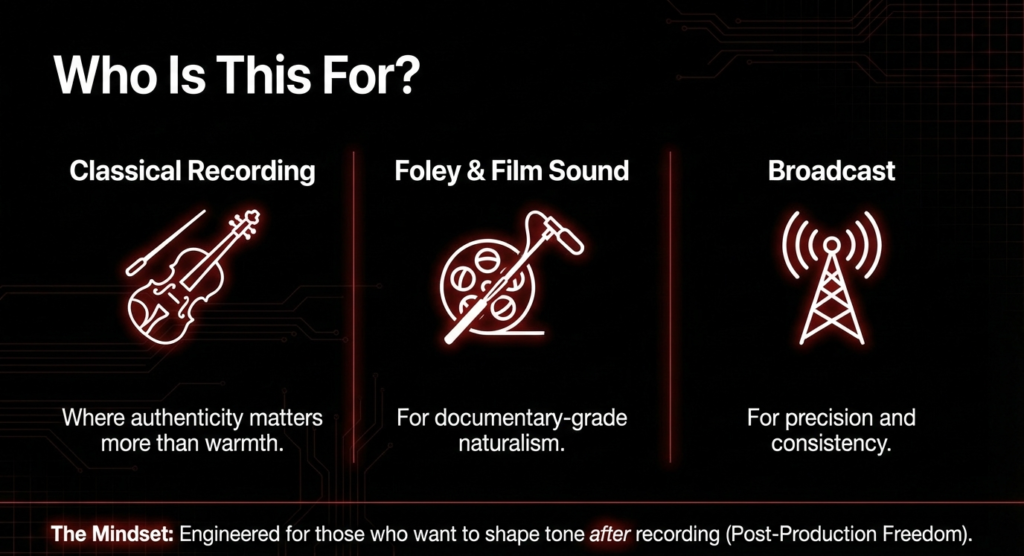
Who Is This Mic For?
If your goal is to capture reality, not enhance it, the TLM 170 is your friend.
It shines in environments like:
I’ve used it on female vocals with delicate breathwork — and it made me stop editing halfway through because the take already sounded finished. But when I tried it on a rock vocal, it almost felt too honest. The mic didn’t add excitement — it showed every EQ need upfront.
Neumann’s internal data shows most TLM 170 users are broadcast engineers, film sound designers, and classical producers. That alone tells you it’s built for accuracy, not attitude.
So if your room is untreated or your preamp is noisy, you’ll notice! This mic has no “masking” ability.
How Does It Sound and Perform in Real-World Use?
I’d describe the sound in one word: transparent.
Every frequency feels evenly balanced. No hyped top end like the TLM 103, no low-mid bloom like the U 87. When I placed it about 18 inches from an acoustic guitar, the stereo image sounded 3D-real. Even subtle fret noises and room reverbs became beautifully defined.
Experts agree:
“The TLM 170 R remains one of the most linear and faithful microphones Neumann ever made.” — Sound on Sound Magazine
Off-axis response? Surprisingly natural. Unlike many large-diaphragm condensers that sound harsh when the source moves off-center, the 170 keeps its tone. That’s why orchestral engineers love it — a violin section can drift, yet the tone stays even.
And let’s talk polar patterns — you get five (omni, wide cardioid, cardioid, hypercardioid, figure-8), plus remote control switching in the “R” model. That’s rare even in modern Neumanns.
My favorite discovery: using it in wide cardioid mode on a cello. It delivered that gorgeous blend of body and air, something even ribbon mics struggle with.
💡 Did you know? Neumann built the TLM 170’s capsule directly off the K 89, which was developed for broadcast precision — not “flattering color.” That’s why it behaves so consistently across patterns.
But again, if your goal is to sound “expensive” without EQ, this might not be your pick. It sounds like you, not like “recording gear.”
What Are the Technical Specs and Why Should You Care?
Let’s decode the specs that actually matter:
| Spec | Value | What It Means |
|---|---|---|
| Self-Noise | 14 dB-A | Ultra-quiet, captures room ambience clearly |
| Max SPL | 154 dB | Handles drums, brass, and close miking easily |
| Patterns | 5 + remote | Total flexibility |
| Freq. Response | 20 Hz–20 kHz | Flat across the spectrum |
| Weight | 625 g | Solid, not too heavy |
| Phantom Power | 48 V | Standard studio use |
Those numbers look cold, but they explain why it’s so transparent. No peaks, no dips, no built-in color.
However, that means it’s ruthless with bad gear. If you run it through a noisy interface or poor acoustics, you’ll hear every imperfection. I once tested it with an untreated home booth — and regretted it immediately. 😅
Neumann recommends using a clean, low-distortion preamp (like Grace Design m101 or Millennia HV-3). The difference is audible: you get pristine clarity without that “digital grain” cheaper gear adds.
What Are the Pros and Trade-Offs?
Let’s be honest — no microphone is perfect. The Neumann TLM 170 comes close, but it still has its quirks.
Pros first:
- Utterly neutral sound. You get what your source gives. That’s why post-production engineers adore it.
- Versatility. Five polar patterns plus remote switching mean one mic covers multiple recording needs.
- Handles anything. With 154 dB SPL, you can mic a kick drum, brass, or snare without distortion.
- Super low noise floor (14 dB-A) — quieter than most studio rooms.
- Consistency. Frequency response stays stable across all patterns.
Now, the trade-offs:
- It’s too honest for some tastes. If you rely on mic coloration to flatter vocals, it won’t. When I first used it on a gritty male singer, the rawness shocked me. It was like the mic said, “You’d better mix me right!”
- It’s picky about rooms. Because it’s flat, poor acoustics stand out immediately. When I recorded in a semi-treated room, I had to move the stand several times to find a sweet spot.
- Pricey. Around $2,500–$3,000, it’s a big investment for a tool that doesn’t “wow” at first listen.
As one engineer put it on Gearspace, “It’s like looking through clean glass — not exciting, but suddenly you realize you can see everything.”
That’s exactly it! The 170 doesn’t make things sound “better.” It makes them sound real.
How to Get the Best Out of It — My Tips & Setup Checklist
You can spend $3k on a TLM 170 and still sound mediocre if your setup is wrong. Here’s what actually matters 👇
1. Choose the right environment
Use it in controlled rooms. Even light flutter echoes will get captured. A few broadband absorbers behind the source can make a night-and-day difference.
2. Pair it with a clean preamp
Avoid colored pres like vintage Neve clones unless you want tone. I personally love pairing it with Grace Design m101 — it keeps everything transparent and detailed.
3. Use the right distance
Stay 18–24 inches from the source for most vocals or strings. Closer makes it intimate but can exaggerate proximity.
4. Experiment with polar patterns
- Cardioid for vocals and solo instruments.
- Wide cardioid for ensembles or stereo setups.
- Omni when the room sounds good — this captures depth beautifully.
- Figure-8 for mid/side setups — works wonders on acoustic duos.
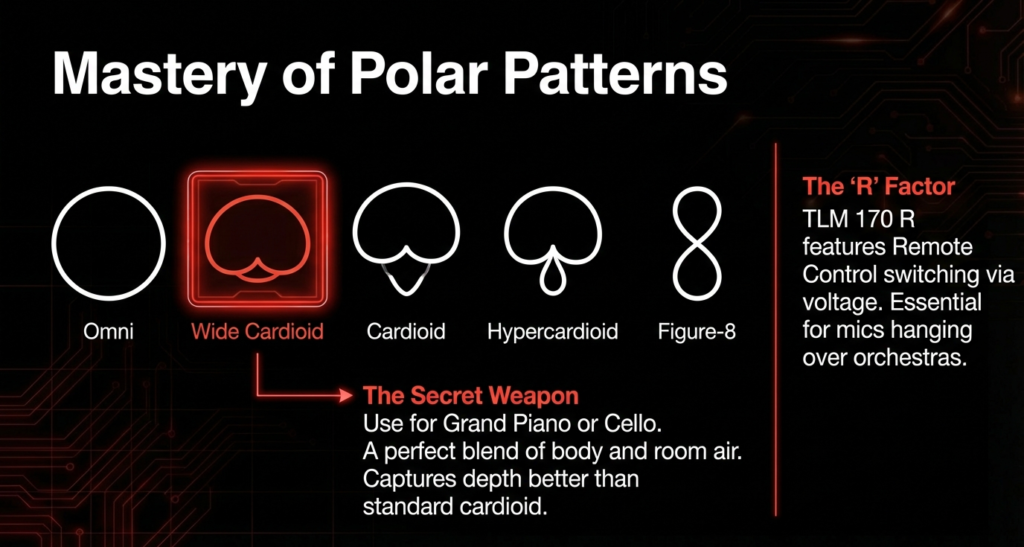
When I switched to wide cardioid for a grand piano session, it captured both the instrument and the hall reflections naturally — something even my Schoeps pair struggled with.
5. Gain staging
Because it’s transformerless, the TLM 170 prefers clean gain. Set your interface around 35–45 dB and watch the transients. Overdriving it doesn’t sound musical — it just sounds wrong.
Follow these and you’ll unlock the reason high-end studios keep pairs of these mics as their “reference” microphones!
Buying Guide for the TLM 170
New vs Used
Buying used? Always ask for service history and check that the serial number matches Neumann’s label. Capsules are robust, but humidity can cause subtle degradation over time.
Neumann support is solid — they can recalibrate or refurbish old units if needed.
TLM 170 vs TLM 170 R vs TLM 170i
| Model | Key Difference | Verdict |
|---|---|---|
| TLM 170 | Original version | Rare, lacks remote control |
| TLM 170 R | Remote pattern switching | Best pick for studios |
| TLM 170i | Installation version | Fixed mounting, not for studios |
The “R” is the one to buy today. Its Remote Control (RE-System) lets you switch polar patterns directly from your console using voltage control — handy if the mic is hanging over an orchestra.
Price and Value
The TLM 170 R hovers around $2,800 USD new (as of 2025). Used ones dip to $2,000.
If that sounds steep, remember it’s built in Germany, not mass-assembled. It’s a lifetime investment that will outlast trends.
Ask yourself: do you need character or truth? If you said truth, this is your mic.
Unique Angle — Why the “Invisible” Mic Might Be the Smartest Buy in 2025
We live in a time where everything sounds “produced.” Auto-tune, harmonic exciters, analog emulation — color everywhere! That’s why a neutral mic like the TLM 170 is suddenly becoming valuable again.
When I first started using it, I realized I could shape tone later with plugins or preamps instead of being stuck with a “colored” source. This flexibility became priceless in post.
Imagine recording vocals flat, then deciding after the session whether to make them sound vintage or modern. That’s power.
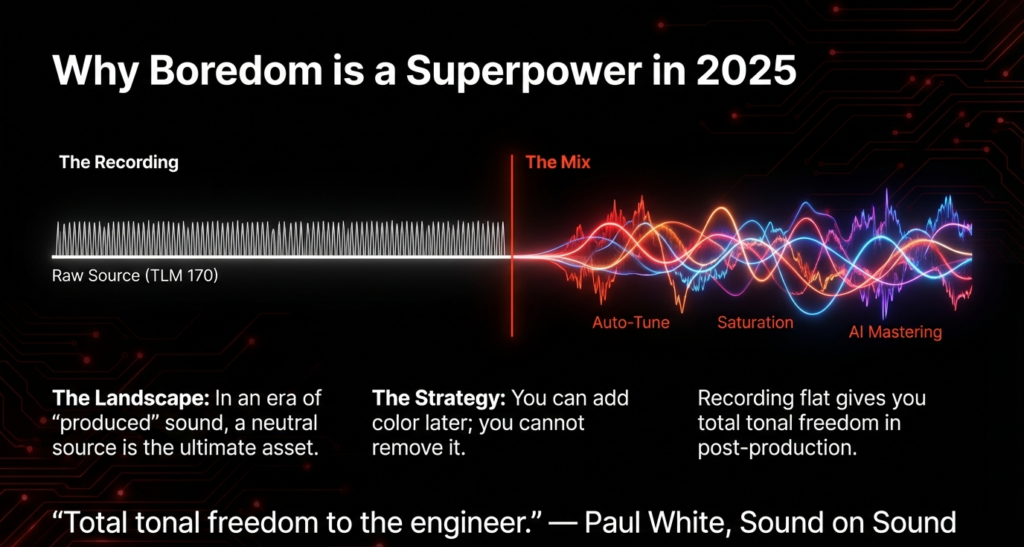
In a world shifting to AI-driven mastering and hybrid mixes, that’s a big deal.
So yes, the TLM 170 is invisible — but that invisibility is its superpower.
FAQ — Quick Answers You’ll Actually Want
Is the TLM 170 good for podcasting or voiceover?
Yes, if your room is treated. Its flatness makes voices sound authentic and broadcast-ready.
Can I use it for live streaming?
Technically yes, but overkill. It’s meant for high-fidelity recording, not desktop setups.
How does it compare with cheaper mics like the TLM 103?
The 103 is brighter and more forward. The 170 is smoother, quieter, and more balanced. Think “clinical vs. colorful.”
Can one mic replace a whole locker?
Almost. With five patterns and extreme headroom, it covers 80% of studio needs.
Maintenance tips?
Keep it dry, use a pop filter, and store it in its case. A light desiccant packet helps prevent capsule moisture.
Final Verdict
The Neumann TLM 170 isn’t the mic that wows you instantly. It’s the one that quietly records perfection while you chase hype elsewhere.
If your studio relies on accuracy, repeatability, and detail, this mic is worth every cent.
When people ask me what the TLM 170 sounds like, I tell them, “It sounds like you — just finally recorded right.” 🎧
As an Amazon Associate I earn from qualifying purchases. There are some affiliate links on this page that will redirect you directly to the original products and services. Also by buying through those links you will be supporting us. So thank you ^.^
Related Posts
- Shure SM7B Microphone Review
- Audio-Technica AT2020 Review
- Large Diaphragm Condenser Microphone: Top 10 in the Market
- Best Cardioid Dynamic Microphone: Top 10 Ranking
- Maono Microphone Review
- Blue Yeti Microphone Review
- Ribbon Microphone: The Top 10 in the Market
- Field Recording Microphone
- How to Remove Background Noise From Mic: Full Guide
- Dynamic vs Condenser Mic: Which One Do You Actually Need