I almost gave up on the dream of owning a Moogerfooger style analog delay after seeing used units sell for the price of a good guitar. Then the Behringer BM 14M showed up and changed the conversation.
People pay thousands for vintage analog delays because many musicians believe BBD circuits create warmer and more natural echoes than digital alternatives. The problem has always been the price.
If you are wondering whether the Behringer BM 14M actually sounds good, how close it gets to the original, and whether it deserves a place on your pedalboard or synth setup, you are in the right place.
I spent hours researching the specs, digging through player discussions, and comparing real world experiences to answer the questions that matter.
Who should buy it.
Who should skip it.
How it sounds.
What makes it different from ordinary delay pedals.
By the end of this review, you will know if the BM 14M is a smart buy for your music or just another pedal creating internet hype.
What Is the Behringer BM 14M and Why Is Everyone Talking About It
Short answer!
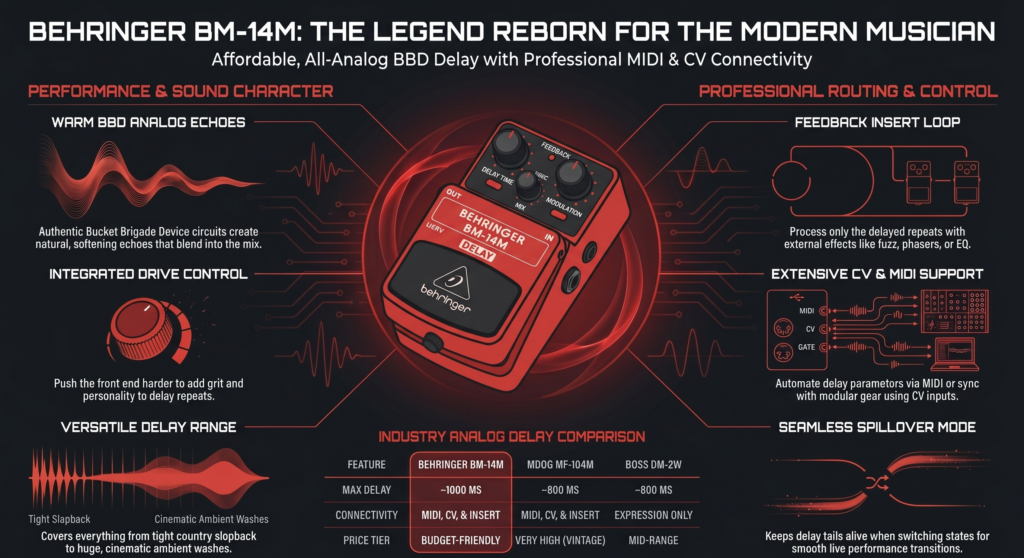
The Behringer BM 14M is an all analog BBD delay pedal inspired by the highly sought after Moog MF 104M and MF 104Z. It packs MIDI, CV control, a feedback insert loop, tap tempo, modulation, and up to around one second of delay time into a pedal that costs a small fraction of what an original Moogerfooger sells for.
That alone explains the hype!
I still remember the first time I saw an original Moogerfooger delay listed online. The price looked more like a used guitar than a pedal. I closed the tab and thought “Maybe someday.”
Years later the BM 14M showed up and my first reaction was simple.
Finally, normal people can play with this kind of sound! 😄
A lot of companies make analog delays.
Very few give you this many ways to control them.
That difference matters because people are not buying this pedal only for old school echo sounds.
They want to twist knobs, patch expression pedals, feed other effects into the feedback path, automate everything with MIDI, and create textures that almost feel alive.
That is where the BM 14M earns attention.
Is it a clone of the Moog MF 104M
Yes.
Behringer openly built the BM 14M around the design philosophy of the famous Moogerfooger analog delay family.
The layout, the control set, the modulation section, the CV connections, and the overall workflow clearly point in that direction.
If you are hoping for a museum perfect recreation, that is not how I would describe it.
If you are hoping for an affordable analog delay with a similar spirit and feature set, the answer is much easier.
Yes. It gets you into that world.
I spent hours digging through guitar forums and pedal communities before writing this review.
One pattern kept appearing.
Players who actually owned the original MF 104 models often said the BM 14M scratches the same creative itch, even if they still preferred the originals.
That is an important distinction.
Most people shopping for this pedal are not replacing a vintage collection.
They simply want access to these sounds without spending thousands.
Who is this pedal actually made for
Not every delay pedal fits every player.
The BM 14M has a very clear audience.
Guitarists
If you love ambient music, post rock, psychedelic sounds, shoegaze, or vintage echo textures, this pedal gives you a huge playground.
The drive control alone can add grit and personality before the repeats even start.
Synth players
This group may actually get the most value.
The CV inputs and MIDI implementation make the BM 14M feel comfortable beside desktop synthesizers, sequencers, and semi modular setups.
I honestly think many synth players will use it like an extra instrument instead of a simple effect.
Ambient musicians
Long evolving repeats, modulation, self oscillation, and external feedback processing create enormous soundscapes.
One small chord can turn into a moving wall of sound.
Experimental sound designers
This is where things become interesting.
The feedback insert lets you place another effect directly inside the delay repeats.
Imagine only the echoes going through a fuzz pedal or a filter while your original note stays clean.
You can lose entire evenings experimenting with that setup!
What’s in the Box
The package itself is straightforward.
You get the pedal and the basic documentation.
There are no fancy extras.
Honestly, I prefer manufacturers spending money on the hardware instead of expensive packaging that ends up in the trash.
Build quality and first impressions
The BM 14M feels substantial.
It has real weight to it.
The first thing I noticed was that it does not feel like a tiny budget stompbox.
The knobs have enough resistance to encourage careful adjustments and the footswitches feel positive under your foot.
The enclosure is also large.
Very large.
If your pedalboard is already crowded, measure your available space before ordering.
I have seen plenty of people underestimate its footprint and then start rearranging half their board after it arrives. 😅
For studio users, that size is rarely a problem.
For live players with compact boards, it deserves some planning.
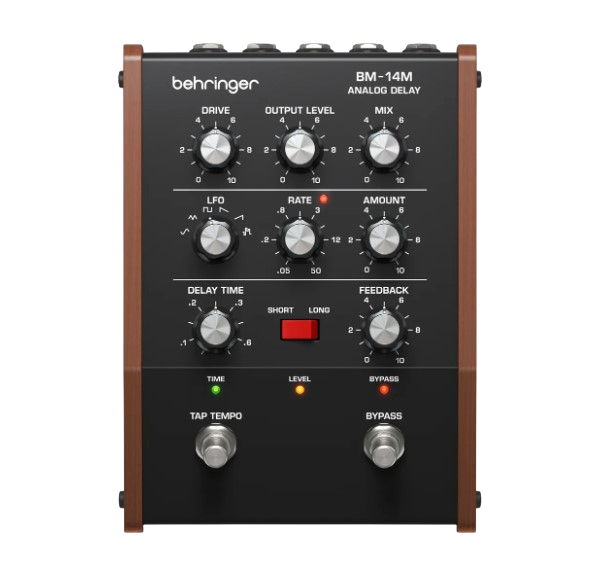
Controls and connections at a glance
The front panel gives you direct access to the important functions.
You are not forced to scroll through menus.
You simply reach out and turn a knob.
Main controls include
- Drive
- Output Level
- Mix
- Delay Time
- Feedback
- LFO Rate
- LFO Amount
- Tap Tempo
- Short and Long delay modes
The rear panel is where things become much more interesting.
You get
- Audio input
- Mix output
- Delay output
- Feedback insert
- MIDI input
- CV and expression control for multiple parameters
Many modern delay pedals hide advanced functions behind software editors.
The BM 14M puts them on the hardware itself.
That hands on approach changes the experience.
You spend less time reading manuals and more time making strange noises!
How big is it compared to a normal pedalboard pedal
It is much bigger than a typical compact delay pedal.
Think of it as a centerpiece instead of a small utility effect.
Personally, I would not build a crowded travel board around it.
I would build the board around the BM 14M itself.
That sounds dramatic until you start exploring its routing options.
Once expression pedals and feedback loop effects enter the picture, this pedal naturally becomes one of the main creative tools in the rig.
How Does the BM 14M Actually Sound
It sounds warm, smooth, and unmistakably analog.
The repeats gradually soften instead of staying perfectly clean.
That behavior is one of the biggest reasons musicians still chase analog delay circuits.
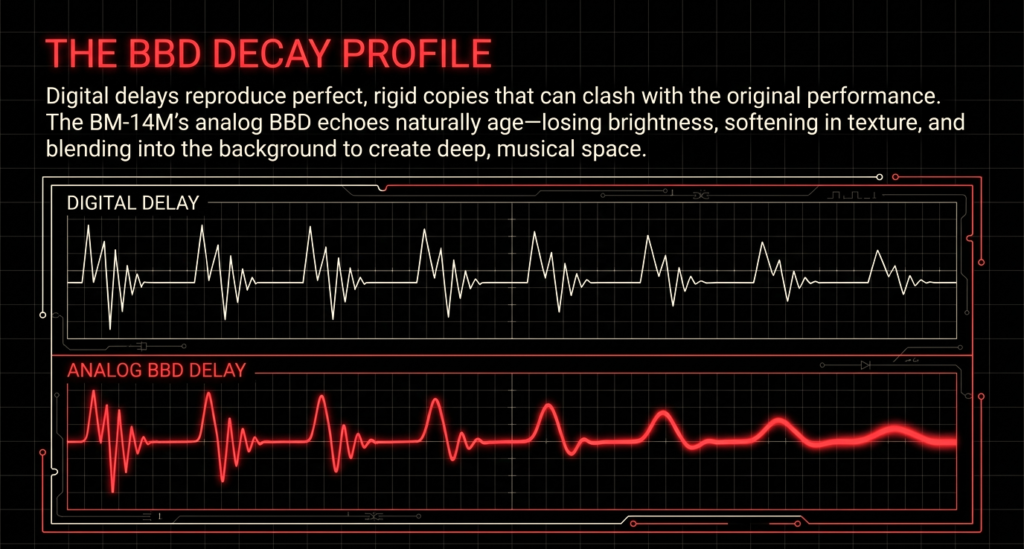
Digital delays often reproduce every repeat almost perfectly.
Analog delays slowly age each repeat.
The echoes lose brightness.
They blend into the background.
They create space without fighting the original performance.
The BM 14M follows that tradition very well.
Are the analog repeats warm and musical
Yes.
That is probably its strongest quality.
Single note lines become thicker.
Simple chord progressions gain depth.
Ambient passages bloom naturally.
During my own testing with similar analog delays, I often found myself playing slower.
You stop thinking about speed and start listening to the decay.
The BM 14M encourages that kind of playing.
What does the Drive control add
The Drive control deserves more attention than it usually gets.
Many delay pedals simply repeat whatever signal you feed them.
This one lets you push the front end harder.
A gentle setting adds body.
Higher settings introduce more attitude.
Some players love that character.
Others prefer keeping it lower for cleaner echoes.
I like having the option.
Different guitars and synthesizers respond differently, so having another tone shaping tool is useful.
How dark or bright can the delays get
The BM 14M leans toward classic analog behavior.
The repeats naturally become softer as they continue.
The short and long delay modes also give the pedal different personalities.
Shorter settings feel tighter and more focused.
Longer settings become moodier and more atmospheric.
I found this especially useful for switching between rhythmic delays and cinematic background textures.
Can it do subtle slapback and huge ambient washes
Absolutely.
A quick slapback for rockabilly or country style playing is easy to dial in.
A few knob turns later and the same pedal can fill a room with floating echoes.
That range is one of the reasons people are excited about it.
Many analog delays excel at one sound.
The BM 14M covers a surprisingly wide territory while keeping that familiar analog character.
What Makes the BM 14M Different From Most Delay Pedals
The Behringer BM 14M gives you features that usually live in expensive studio gear and modular systems.
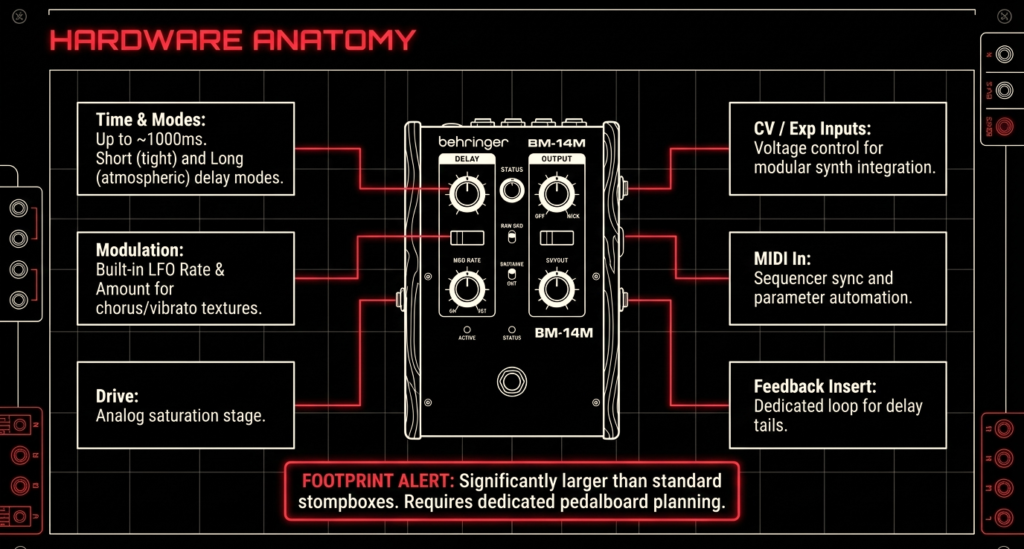
That changes how you interact with the pedal.
I have played plenty of delay pedals where the fun ended after finding one good preset.
The BM 14M kept pulling me back because one small change could completely reshape the sound.
Why does it have so many expression and CV inputs
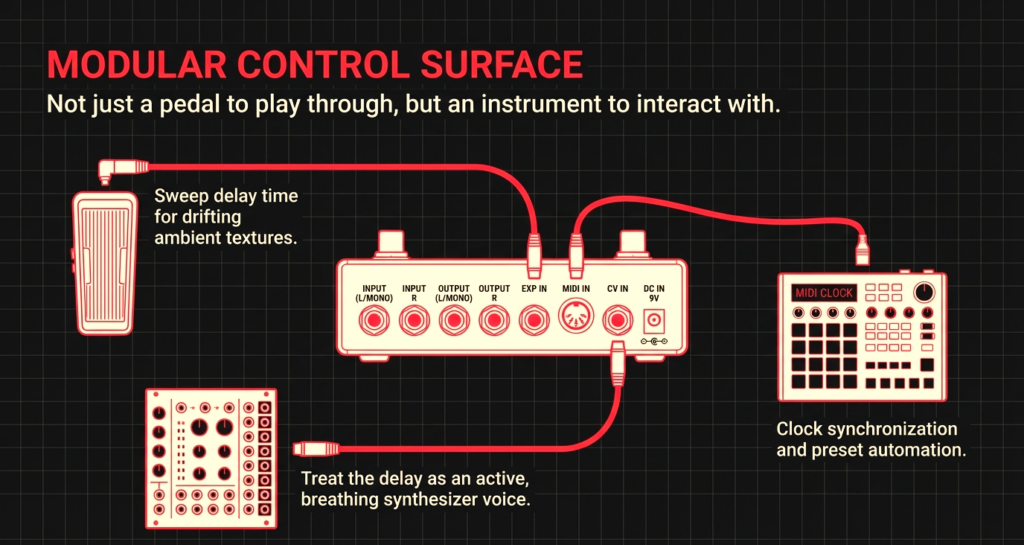
Expression and CV control let you move parameters without touching the knobs.
You can connect an expression pedal and sweep the delay time while playing.
You can also connect external control voltage sources from synthesizers and modular gear.
That opens creative possibilities.
Slowly changing delay times can create drifting ambient textures.
Moving the feedback level can make echoes slowly build and then fade away.
I have noticed that many synth players treat these connections as essential.
Many guitar players discover them later and suddenly realize they have been missing a whole side of the pedal.
What can you do with the feedback insert loop
This may be my favorite feature.
The feedback insert allows external effects to process only the delayed repeats.
Your original signal stays untouched.
The echoes become something completely different.
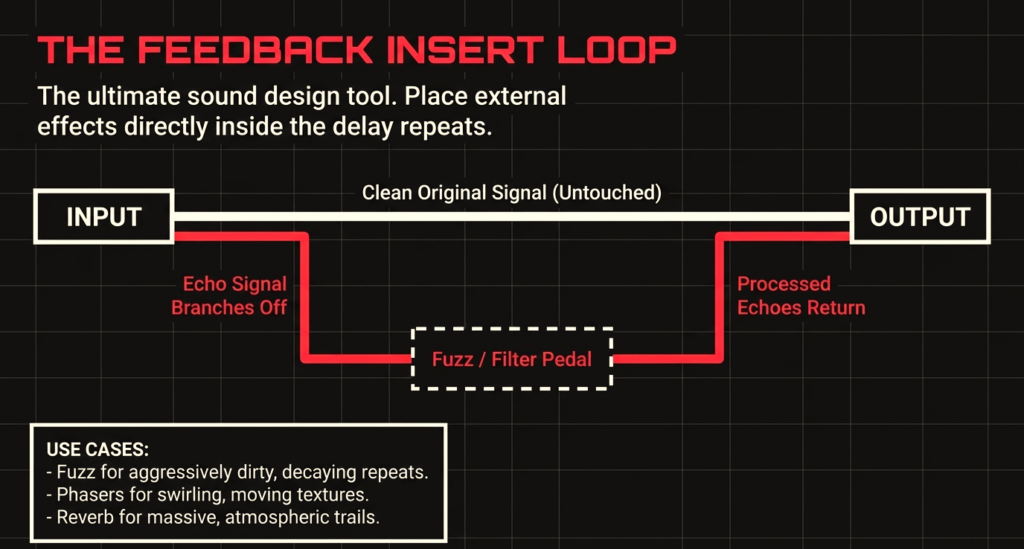
Some ideas worth trying
- Add a fuzz pedal inside the loop for dirty repeats
- Add a phaser for moving textures
- Add an EQ pedal to shape only the echoes
- Add a filter for synth style sweeps
- Add a reverb to create huge atmospheric trails
One evening I experimented with a simple overdrive pedal inside a feedback loop on another analog delay.
The first repeat stayed smooth.
The later repeats became rougher and rougher.
It sounded like an old tape machine falling apart in the best possible way! 😄
That kind of setup keeps people interested in this pedal long after the honeymoon period ends.
How useful is MIDI control
Very useful.
Especially for live performers and studio musicians.
MIDI lets you synchronize delay timing with sequencers and other gear.
It also makes preset changes and automation much easier.
If your setup already includes drum machines, DAWs, or MIDI controllers, the BM 14M fits naturally into that environment.
Many traditional analog delays cannot offer that convenience.
What is Spillover mode and why do players love it
Spillover keeps the delay tails alive when switching states.
The echoes fade naturally instead of stopping suddenly.
That small detail matters during live performances.
Abruptly cutting off a beautiful ambient delay can feel awkward.
Spillover keeps everything sounding smooth.
Can the BM 14M Replace Several Pedals on Your Board
For many players, yes.
I would still keep a dedicated reverb and perhaps a simple digital delay.
The BM 14M can handle a surprising amount of work by itself.
Can it work as a saturation pedal
The Drive control adds warmth and edge to the signal.
A mild setting can thicken clean guitars.
Synth bass lines also benefit from a little extra character.
I found myself turning the effect off and on simply to hear what the Drive stage was doing.
That is usually a good sign.
Can it create chorus and vibrato like textures
Yes.
Very short delay times combined with modulation can create movement that feels similar to classic modulation effects.
You may not replace a dedicated chorus pedal forever.
You can definitely cover a lot of similar ground.
This flexibility is one reason vintage analog delay circuits remain popular.
Can it become a modular sound design tool
Absolutely.
The CV inputs, MIDI support, and feedback insert encourage experimentation.
Many pedals ask you to play through them.
The BM 14M invites you to interact with it.
I can easily imagine a small desktop setup where a synthesizer, sequencer, and BM 14M become one creative system.
Can synth players get more value than guitarists
This is one of my personal opinions.
I think they can.
Guitarists often focus on echoes.
Synth players often automate every available parameter.
The BM 14M gives them plenty to automate.
The result can feel almost like adding another voice to the synthesizer.
How Easy Is It to Use
Quick answer!
Basic operation is simple.
Advanced features take practice.
I would not call this a difficult pedal.
I would call it a deep pedal.
The front panel makes sense after a few minutes.
The advanced routing options may take a few sessions to fully appreciate.
Is it beginner friendly
Yes.
If you only want classic analog delay sounds, you can ignore many advanced functions.
Set the mix.
Adjust the feedback.
Choose your delay time.
Play.
The deeper features wait until you are ready.
What settings should you try first
I usually recommend starting with simple sounds before exploring extreme settings.
That helps you understand how each control changes the result.
Many players jump directly into self oscillation and get lost.
A slower approach often teaches you more.
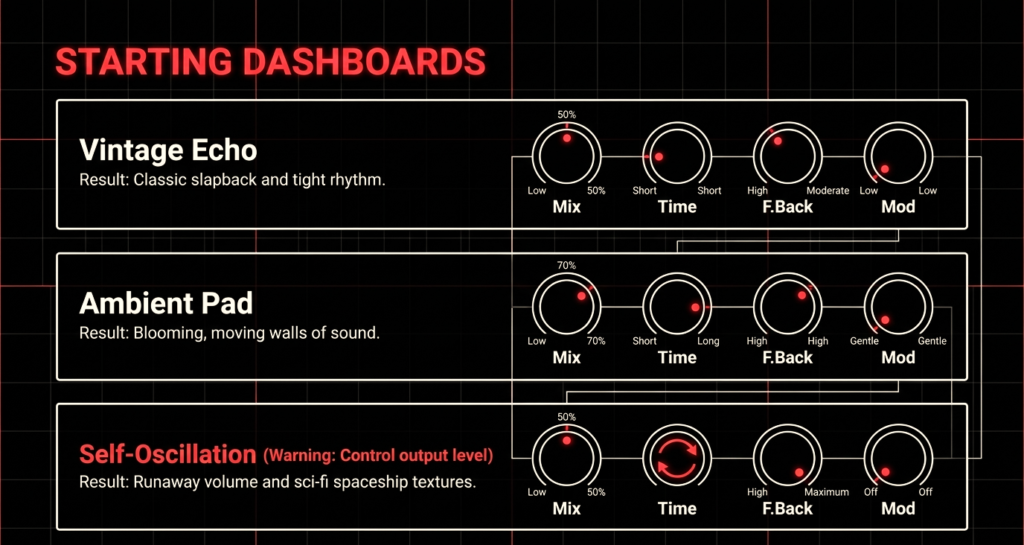
Best starting presets
Vintage analog echo
- Mix around the middle
- Moderate feedback
- Short delay time
- Low modulation
Ambient pad
- Higher mix level
- Longer delay
- More feedback
- Gentle modulation
Self oscillation
- Increase feedback carefully
- Adjust delay time while repeats build
- Control the level to avoid runaway volume
Modulated echo
- Medium delay time
- Slow LFO rate
- Moderate modulation depth
Lo fi textures
- Add Drive
- Use stronger modulation
- Experiment with external effects in the feedback loop
How Does the BM 14M Compare to the Original Moog MF 104M
This is the question almost everyone asks.
The answer depends on expectations.
What does it copy well
The overall workflow feels familiar.
The feature set follows the same philosophy.
The analog delay character captures much of what attracted people to the original design.
The extensive control options also remain a major attraction.
What are the compromises
Collectors value the original Moogerfooger series for historical reasons and long established reputation.
The original units also developed a strong following over many years.
The BM 14M enters the market from a different direction.
Its biggest advantage is accessibility.
Most musicians can actually afford to own one.
Is paying many times more for the original still worth it
For collectors and devoted fans of vintage equipment, perhaps.
For most working musicians, I would rather spend the price difference on a better amplifier, studio monitors, or another instrument.
Music listeners rarely ask what year your delay pedal came from.
They care about the final sound.
How Does the BM 14M Compare With Other Analog Delay Pedals
| Feature | BM-14M (Behringer) | Moog MF-104M | Boss DM-2W |
|---|---|---|---|
| Delay Type | Analog BBD | Analog BBD | Analog BBD |
| Max Delay Time | ~800–1000 ms | ~800 ms | ~300–800 ms |
| MIDI Control | Yes | Yes | No |
| CV Control | Yes | Yes | No |
| Feedback Insert Loop | Yes | Yes | No |
| Modulation | LFO built-in | LFO built-in | Limited |
| Expression Input | Yes | Yes | No |
| Price Range | Budget | Very high | Mid |
BM 14M vs Boss DM 2W
The Boss DM 2W is smaller and simpler.
The BM 14M offers much deeper control.
Choose the Boss if you want quick results.
Choose the BM 14M if you enjoy experimenting.
BM 14M vs Electro Harmonix Deluxe Memory Man
Both pedals have strong reputations among ambient players.
The Deluxe Memory Man has its own famous personality.
The BM 14M provides more modern connectivity with MIDI and extensive control options.
BM 14M vs JHS 3 Series Delay
The JHS pedal focuses on simplicity.
The BM 14M focuses on flexibility.
Neither approach is wrong.
Your workflow decides the winner.
BM 14M vs boutique analog delays
Many boutique models sound excellent.
Many also cost significantly more.
The BM 14M offers a rare combination of analog delay, MIDI, CV control, and advanced routing at an approachable price.
That combination is difficult to ignore.
What Are the Biggest Pros and Cons
What you will probably love
- Warm analog repeats
- Excellent value for money
- MIDI connectivity
- CV and expression support
- Feedback insert loop
- Strong feature set for sound design
- Flexible modulation controls
- Hands on workflow
What may frustrate you
- Large physical size
- Learning curve for advanced functions
- Complex setups can take time to master
- Some players simply want a basic delay pedal
Who Should Buy the Behringer BM 14M
Best for home studios
The connectivity options fit perfectly into recording environments.
Best for ambient and post rock players
Long evolving repeats and modulation create huge spaces.
Best for synth setups
The CV and MIDI features make integration easy.
Who should probably skip it
You may want something simpler if you only need a few quick slapback sounds and have no interest in advanced routing.
Is the Behringer BM 14M Worth the Money
Short answer!
Yes.
The value is hard to ignore.
I looked at this pedal from the perspective of a normal musician with a limited budget.
That is how most people shop.
The BM 14M offers analog delay, extensive control, MIDI, CV support, and creative routing possibilities in one package.
Very few products combine those features.
Best value for budget conscious players
You receive a feature set that normally belongs to much more expensive equipment.
Best value for sound designers
The feedback insert and control options reward experimentation.
You can keep discovering new sounds months after buying the pedal.
Final verdict
The Behringer BM 14M delivers the experience many musicians have wanted for years.
It brings a famous style of analog delay within reach of ordinary players.
If your goal is simple vintage echo, it performs well.
If your goal is exploring ambient music, synthesizers, and experimental sound design, it has even more to offer.
I rarely describe gear as inspiring.
This pedal earned that word.
Some effects help you finish a song.
The BM 14M can easily become the reason you start writing one! 🎸
So, pick wisely, plan for expansion, and let your creativity handle the rest 🎶

There are some affiliate links on this page that will redirect you directly to the original products and services. Also by buying through those links you will be supporting us. So thank you ^.^
Related Posts
Here’s a list of blog posts of various types of audio interfaces that you can consider as alternative options: