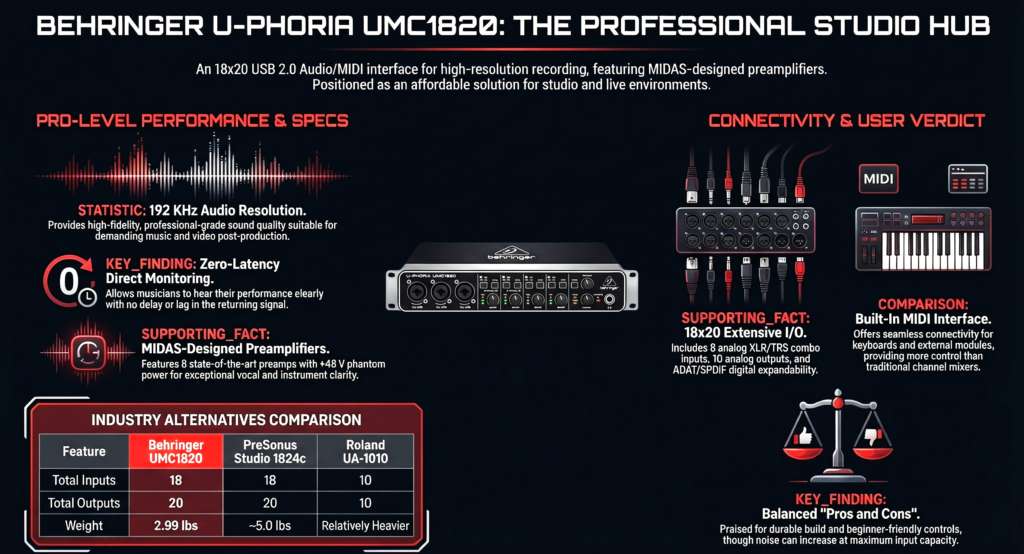
The Behringer UMC1820 gives you 8 Midas designed mic preamps and 18 inputs over USB for about $149 to $229. 🎚️
Add a Behringer ADA8200 over ADAT and you can reach 16 preamps at 44.1 and 48 kHz.
This Behringer UMC1820 review covers who should buy it, what the specs mean, and the limits most reviews skip.
It draws on Behringer’s manual, retailer listings and owner reports, then adds my take on who the specs suit.
Quick verdict
| Question | Answer |
|---|---|
| Best for | Drum recording, small bands, multi mic podcasts and hybrid studios |
| Skip it if | You record one mic or need a portable interface |
| Standout feature | 8 Midas designed preamps with ADAT expansion at a low price |
| Main limit | Phantom power switches in two groups, and it is a rackmount unit that needs wall power |
| Typical price | About $149 to $229 at retailers |
Affiliate links below. As an Amazon Associate I earn from qualifying purchases.

Is the Behringer UMC1820 still worth buying
Short answer.
Yes if you need many mic inputs on a small budget.
Most interfaces at this price give you two or four mic inputs.
The UMC1820 gives you eight, plus ADAT, S/PDIF and MIDI.
That is why it keeps coming up whenever someone needs to record drums, a band or a roundtable podcast.
What is the Behringer UMC1820 and who is it for
The UMC1820 is an 18 in 20 out USB 2.0 audio and MIDI interface in a 19 inch rack case, according to Thomann.
Thomann calls it a good choice for beginners who want to be ready for large recording sessions.
Who should buy the UMC1820
- Home studios that record drums with several mics
- Small bands that want to track together
- Podcasts with three or more hosts and guests
- Hybrid studios with synths, drum machines or outboard gear
Who should skip the UMC1820
- Solo singers and voiceover artists who use one mic
- Anyone who needs a portable interface
- Anyone who wants onboard effects processing
A small USB interface will be simpler and cheaper for one mic.
Our best 2 channel audio interface guide covers those.
Behringer UMC1820 specs
| Feature | Details |
|---|---|
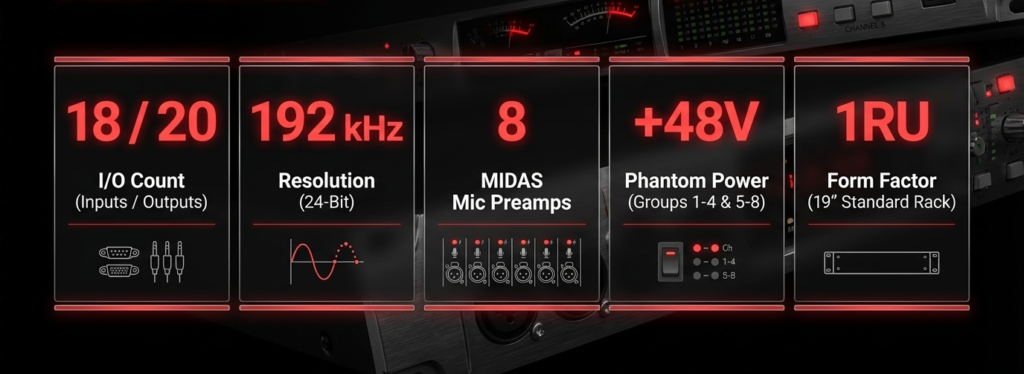
| Inputs and outputs | 18 in and 20 out over USB 2.0 |
| Mic preamps | 8 Midas designed preamps with +48V phantom power in two groups, inputs 1 to 4 and 5 to 8 |
| Analog inputs | 8 XLR and TRS combo inputs, 2 on the front and 6 on the rear, each with a pad switch and gain control |
| Analog outputs | 2 main TRS outputs, 8 TRS line outputs and 2 TRS headphone outputs |
| Digital I/O | ADAT optical in and out, switchable to S/PDIF, plus coaxial S/PDIF in and out |
| MIDI | MIDI in and out |
| Resolution | Up to 24-bit and 96 kHz |
| Input levels | Mic and line max 11 dBu, instrument max 18 dBu |
| Frequency response | 10 Hz to 85 kHz, +0 and -3 dB |
| Case and power | 19 inch 1U rack case with an external 12 V adapter, not USB bus powered |
| Computer support | Mac OS 10.9 and higher with no driver, Windows with Behringer’s driver |
Specs come from B&H, Gear4music and Behringer’s user guide.
Did You Know
A Behringer ADA8200 takes the UMC1820 to 16 mic preamps at 44.1 and 48 kHz. At 88.2 and 96 kHz, ADAT switches to S/MUX and carries only four channels, so the total drops to 12.
How do the Midas preamps sound
Behringer says the eight mic preamps are designed by Midas, the British console maker.
I have not measured them in a lab, so I will not invent sound impressions.
Owner feedback is more useful.
One Adorama customer reported no latency problems and called the preamps transparent for the price.
A Sweetwater reviewer described all eight channels as high quality preamps with optional phantom power.
That fits the price tier.
Expect clean, neutral preamps and not a colored sound.
When the preamp gain runs short
Low output mics such as ribbons and some broadcast dynamics need a lot of gain.
At the top of any budget preamp’s range, noise rises.
Check your mic against the interface’s gain range before you buy.
The free Signal Chain Builder runs that check for the mics and interfaces in its catalog.
An inline booster or an outboard preamp fixes the problem for hard to drive mics.
How many things can you record at once
Eight mics at once, straight out of the box.
With ADAT expansion you can reach 16 at 44.1 and 48 kHz.
Every input arrives in your DAW as its own track.
| Recording scenario | Typical mic inputs | Fits the UMC1820 |
|---|---|---|
| Podcast with 4 hosts | 4 | Yes |
| Full drum kit | 7 to 8 | Yes |
| Band rehearsal | 6 to 8 | Yes |
| Larger session with ADAT | Up to 16 at 48 kHz | Yes with an ADA8200 |
Recording a drum kit
A typical kit setup uses a kick mic, a snare mic, a hi hat mic, two tom mics, a pair of overheads and a room mic.
That is 8 mics, which matches the eight preamps exactly.
Smaller setups with four to six mics leave room for extras.
Recording a band
A band can use a vocal mic, a guitar amp mic, a bass DI, a stereo keyboard, drum overheads, a snare mic and a kick mic.
Every source becomes a separate track, so you can balance the mix later.
Eight inputs go quickly, which is where ADAT expansion helps.
Recording a podcast roundtable
Four hosts and two guests use six mics, which leaves two inputs free.
Separate tracks make editing easier because you can fix levels and noise for each speaker alone.
Our 3 person podcast setup guide covers the mic side.
How does ADAT expansion work
The optical port lets you add eight more preamps with a device like the Behringer ADA8200, which B&H and Amazon list as the way to reach 16 Midas designed preamps.
Here is how the channels map, per CameraTim’s review and Behringer’s manual.
| Sample rate | Optical in | Optical out |
|---|---|---|
| 44.1 and 48 kHz | ADAT channels 11 to 18 | ADAT channels 13 to 20 |
| 88.2 and 96 kHz | S/MUX channels 11 to 14 | S/MUX channels 13 to 16 |
Three practical notes.
- The front OPT I/O switch selects ADAT or S/PDIF, and the unit reboots when you change it, so close your DAW first
- Gearspace users report the ADAT ports only work through a computer and DAW, not as a standalone digital link
- Very old macOS releases such as 10.6 did not support ADAT, per CameraTim, while current macOS needs no driver
Read our Behringer ADA8200 review before you buy the expander.
What are the downsides of the UMC1820
Here are the trade offs the specs and owner reports make clear.
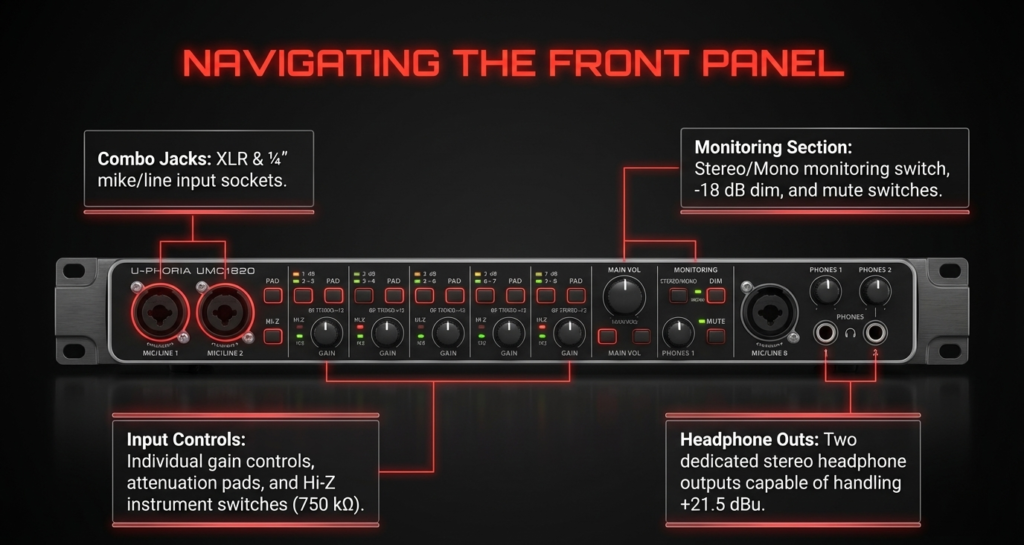
- Phantom power comes in two groups. One switch covers inputs 1 to 4 and another covers 5 to 8, so you cannot power one channel alone
- It is a rack unit. It is 19 inches wide, needs the included wall adapter and is not USB bus powered
- No onboard effects. The listings show direct monitoring but no built in processing, so reverb and compression come from your DAW
- 96 kHz is the ceiling. Higher sample rates are not supported
- Windows drivers deserve a test. One Sweetwater reviewer reports freezes with a recent driver while another calls it stable
The phantom power grouping matters if you mix condensers with ribbons.
Read our phantom power guide before you connect a ribbon mic.
This review does not include long term test data.
Check Behringer’s support page for current drivers.
UMC1820 vs other 8 channel interfaces
The UMC1820 wins on price per input.
Pricier interfaces tend to offer more polished software and higher sample rates.
Compare your options in our own guides.
- See the full field in our eight channel audio interface guide
- Need more inputs? Read the 16 channel audio interface guide
- Want fewer inputs? Try the Focusrite Scarlett 4i4 review
- Unsure about a mixer instead? Read interface vs mixer for recording
Is the UMC1820 worth the price
Retailers list it between about $149 and $229, with Sweetwater at $229.
Prices change, so check the current one.
That buys eight mic preamps, ADAT, S/PDIF and MIDI in one rack unit.
It is a strong deal if you will use many inputs, and wasted money if you only use one.
My final verdict
My take is simple.
The UMC1820 is one of the cheapest ways to get eight mic inputs and a real expansion path.
Buy it for drums, bands or multi mic podcasts.
Skip it for one mic, travel or onboard effects.
Frequently asked questions
Is the Behringer UMC1820 good for recording drums
Yes for most home kits.
Eight preamps cover a typical kick, snare, hi hat, toms, overheads and room setup.
Can the UMC1820 record eight microphones at the same time
Yes.
It has eight preamps and streams 18 inputs to your computer at once.
Can you expand the UMC1820 with more inputs
Yes, over ADAT with a unit like the Behringer ADA8200.
That gives 16 preamps at 44.1 and 48 kHz and 12 at 88.2 and 96 kHz.
Does the UMC1820 work with Mac and Windows
Yes.
Mac OS 10.9 and higher needs no driver, and Windows needs the driver from Behringer’s site.
Is the UMC1820 good for podcasting
Yes for multi host shows.
Eight mic inputs record to separate tracks, which makes editing easier.
As an Amazon Associate I earn from qualifying purchases. There are some affiliate links on this page that will redirect you directly to the original products and services. Also by buying through those links you will be supporting us. So thank you ^.^
Related Posts
- Eight Channel Audio Interface
- 16 Channel Audio Interface
- Behringer ADA8200 Review
- The Best 12 Input Audio Interface
- Focusrite Scarlett 4i4 Review
- Audio Interface vs Mixer for Recording
- Best Budget Audio Interface
- How to Connect an Audio Interface to a Computer
- What Is Phantom Power
- How to Reduce Latency When Recording