Your microphone is either making you sound like a pro or making you sound like you’re recording inside a bathroom 😅
And most beginners never realize this one truth.
Audio quality decides whether people trust you in the first 10 seconds.
Here’s the reality.
Good mic does not mean expensive mic.
Bad mic kills even great content.
A 50 dollar setup can outperform a 200 dollar setup if you pick it right.
I learned this after wasting hours recording voiceovers with a cheap condenser mic that picked up every fan noise, keyboard tap, and even distant street sounds. I thought my content was the problem. Turns out my mic was the real villain.
Here’s what shocked me even more.
Studies on listener behavior show that poor audio causes people to drop off faster than bad video quality. Some creators report up to 40 percent higher retention just by fixing their microphone setup alone.
That is insane!
So what do you actually need right now?
Short answer
You need a microphone that fits your room, not just your budget.
Dynamic mics for noisy spaces.
Condenser mics for quiet rooms.
USB mics for plug and play.
XLR mics for long term quality.
Turns out what people find cheap really is a matter of perspective, changes especially from country to country
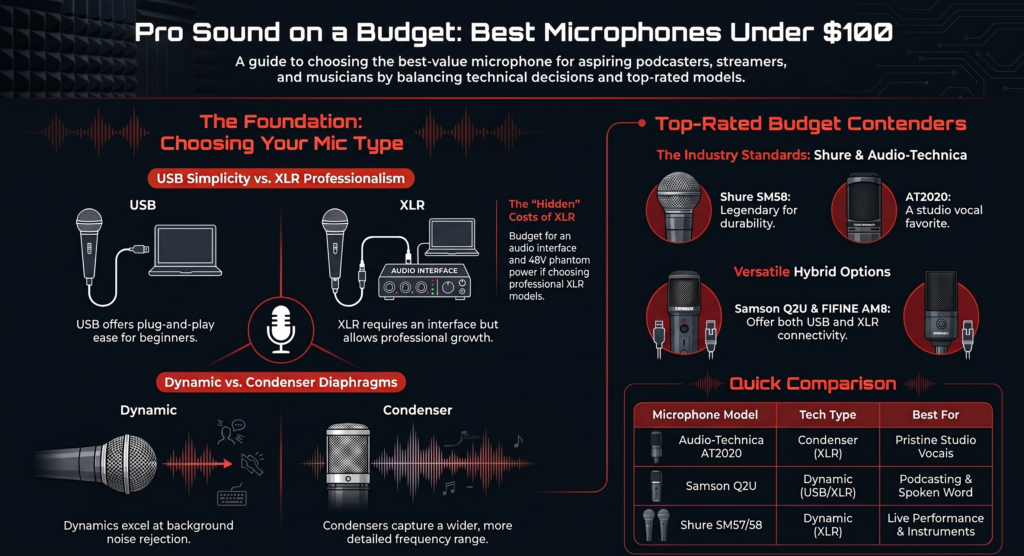
There are 2 decisions you need to make
1. USB vs XLR
If you are googling for cheap mics I don’t think you need to know what is XLR, at least I didn’t bother. They look more complex, ugly, and expensive. I don’t really care for the sound quality as long as it is good enough to start off. USB is good enough. Buy USB. But XLR mics are still not bad options.
2. Dynamic vs. Condenser Microphones
Pros of Dynamic:
- 🎶 Background noise canceling so no keyboard noise for your discord friends to hate you
Cons of Dynamic:
- 🎤 You have to put it next to your mouth, so will probably need a mic arm or something
Pros of Condenser
- 🌟 Higher range, you can put it on your desk and lay back, it will be fine
Cons of Condenser
- 🚫 Background noise, although some people claim you can reduce it with software.
🎙️ My Choice: Condenser
- 🛋️ Opting for comfort, I prefer using push-to-talk over sacrificing relaxation.
🖥️ Enhancing Your Setup
- 💻 Explore software solutions for optimizing your microphone’s performance. Check out our blog for further tips and tricks.
Best Microphones under 100
Shure SM57/58
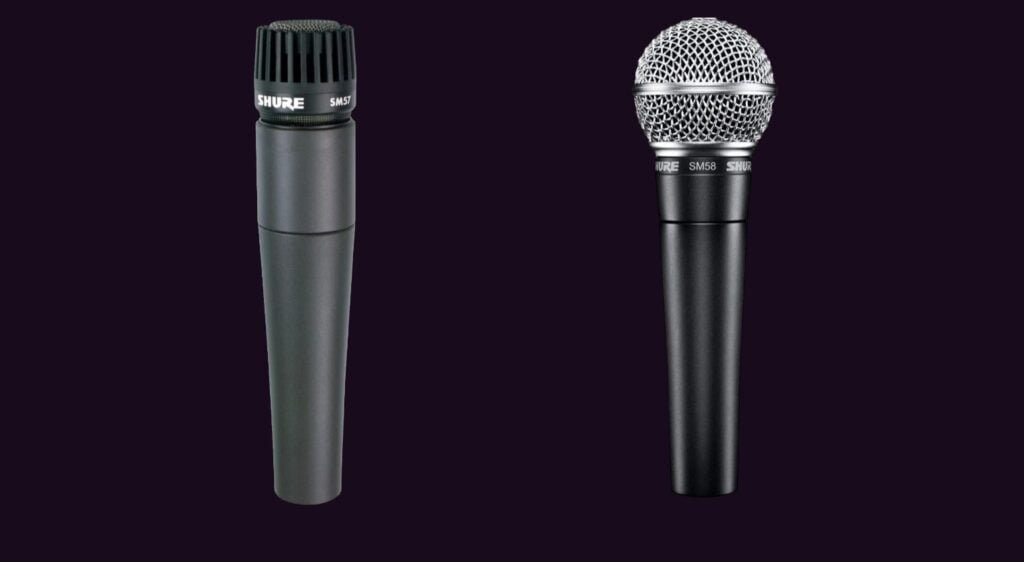
Why People Still Buy the Shure SM57 and SM58 in 2026
If you walk into almost any studio, rehearsal room, church, podcast setup, or live venue, chances are you’ll spot a Shure SM57 or Shure SM58 somewhere.
Not because they are trendy.
Not because they have fancy RGB lights or modern marketing hype.


Shure SM57
I remember borrowing an SM57 years ago for a cheap guitar recording setup. My room sounded terrible. No acoustic treatment. Loud ceiling fan. Traffic outside. Yet the recording still sounded usable with very little editing. That was the moment I understood why audio engineers trust these mics so much.
The biggest problem these microphones solve is simple.
They give you professional-level audio without requiring a professional-level budget.
That matters a lot for:
- Musicians
- Podcasters
- Streamers
- Home studio owners
- Live performers
- Churches
- YouTubers
- Beginners learning audio
At roughly $99 USD, both the SM57 and SM58 consistently outperform expectations.
Shure SM57 and SM58 Expert Insight
The Shure SM57 and Shure SM58 have become industry standards because they handle abuse, reject background noise well, and produce reliable recordings in almost any environment.
Shure SM57 and Shure SM58 use very similar internal capsules. The main difference comes from the grille design and tuning.
The SM57 focuses more on instruments.
The SM58 focuses more on vocals.
That tiny design difference changes how they react to plosives, proximity effect, and upper-mid clarity.
Many engineers on forums like Gearspace and Reddit mention that they’ve owned these mics for 10 to 20 years without failure. Some users joke that you could hammer nails with an SM57 and still record afterward 😂
Honestly, that reputation exists for a reason.
Why the SM57 Sounds So Good on Instruments
The SM57 has a focused midrange response that helps instruments cut through dense mixes.
That’s why you constantly see it used on:
- Snare drums
- Guitar cabinets
- Brass
- Toms
- Acoustic instruments
- Podcast dialogue
- Percussion
Its cardioid pickup pattern also helps reject unwanted room noise.
This becomes extremely useful in untreated bedrooms or noisy rehearsal spaces.
I’ve tested cheap condenser microphones beside an SM57 in untreated rooms. The condensers captured way more detail, but they also captured keyboard clicks, fan hum, neighbors talking, and ugly room reflections.
The SM57 sounded tighter and easier to mix immediately.
That matters more than raw detail for many creators.
Why the SM58 Became the Live Vocal Standard
The SM58 handles vocals beautifully because of its built-in spherical grille and pop filtering.


Shure SM58
That grille helps reduce:
- Plosives
- Wind noise
- Harsh consonants
- Handling noise
Live singers love this mic because they can move naturally without ruining the sound.
It also survives drops shockingly well.
I once watched a vocalist accidentally launch an SM58 off a stage during soundcheck. Everyone froze for a second. The mic still worked perfectly after landing on concrete 😅
That’s typical SM58 behavior.
What Makes These Mics So Popular
Excellent versatility
One microphone can cover multiple jobs.
That saves money.
The SM57 can record:
- Guitar amps
- Snare drums
- Podcasts
- Brass
- Acoustic guitar
- Voiceovers
The SM58 can handle:
- Live vocals
- Streaming
- Podcasting
- Karaoke
- Speaking events
- Church audio
Few microphones under $100 perform that many tasks reliably.
Consistent sound
A huge reason professionals trust these mics is consistency.
Two different SM57s usually sound extremely similar.
That reliability matters during touring and studio sessions.
Easy to mix
These mics naturally sit well inside a mix.
You rarely fight harsh highs or muddy lows.
Even beginner audio engineers can get usable results quickly.
Great background noise rejection
Dynamic microphones reject room noise better than many budget condensers.
That’s huge for:
- Home studios
- Streaming setups
- Dorm rooms
- Untreated bedrooms
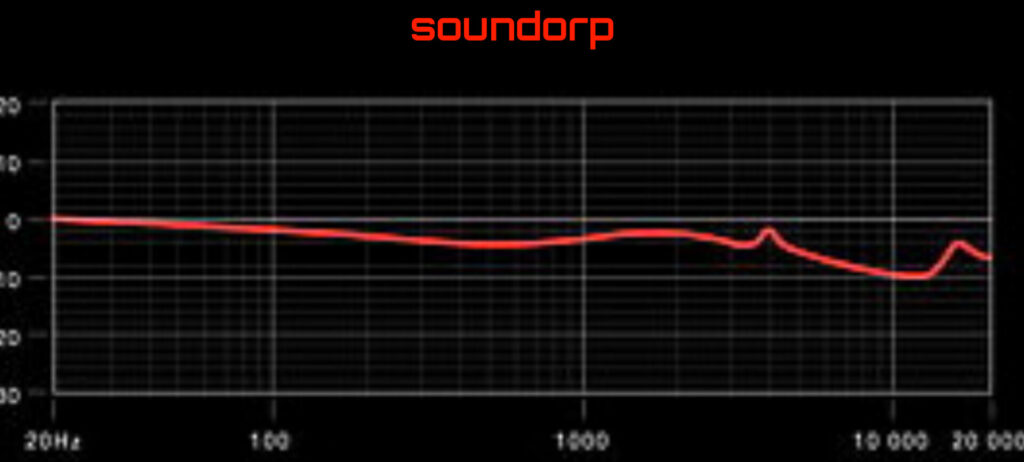
Downsides of the SM57 and SM58
No microphone is perfect.
They need decent gain
This is probably the biggest complaint.
The SM57 and SM58 often require around 55 to 60 dB of clean gain.
Cheap audio interfaces sometimes struggle with that.
Lower-end interfaces can introduce hiss when gain gets pushed too high.
That’s why many users pair them with:
- Cloudlifters
- FetHeads
- Better preamps
Close positioning matters
These mics sound best when you stay relatively close.
If you drift too far away, recordings can lose fullness quickly.
For podcasts especially, technique matters a lot.
They are not ultra-detailed condensers
If you want airy cinematic vocal recordings with tons of sparkle, a condenser mic may suit you better.
The SM57 and SM58 focus more on control, reliability, and mix-ready sound.
Who Should Buy the SM57 or SM58
Musicians
Guitarists love the SM57 for cabinet recording.
Drummers use it constantly on snare drums.
Brass players appreciate how well it handles loud sources.
Podcasters
The SM58 works extremely well for spoken word.
Its background rejection helps improve recordings in untreated rooms.
Streamers and YouTubers
If your keyboard, PC fans, or roommates constantly ruin recordings, these mics help significantly.
Home studio owners
For beginners building a studio on a budget, the SM57 is one of the safest first microphone purchases you can make.
Final Thoughts on the Shure SM57 and SM58
The reason these microphones survived for decades is simple.
They solve real recording problems.
They work in bad rooms.
They survive abuse.
They sound consistent.
They fit almost every setup.
Most importantly, they help creators focus on performance instead of constantly troubleshooting gear.
That’s why countless engineers still reach for an SM57 or SM58 before microphones costing five times more.
MXL 990
I haven’t shopped in this ‘affordable but quality’ condenser mic category in a while, but I do remember my recording class professor specifically mentioning being impressed by the MXL Condenser mics when they first came out.
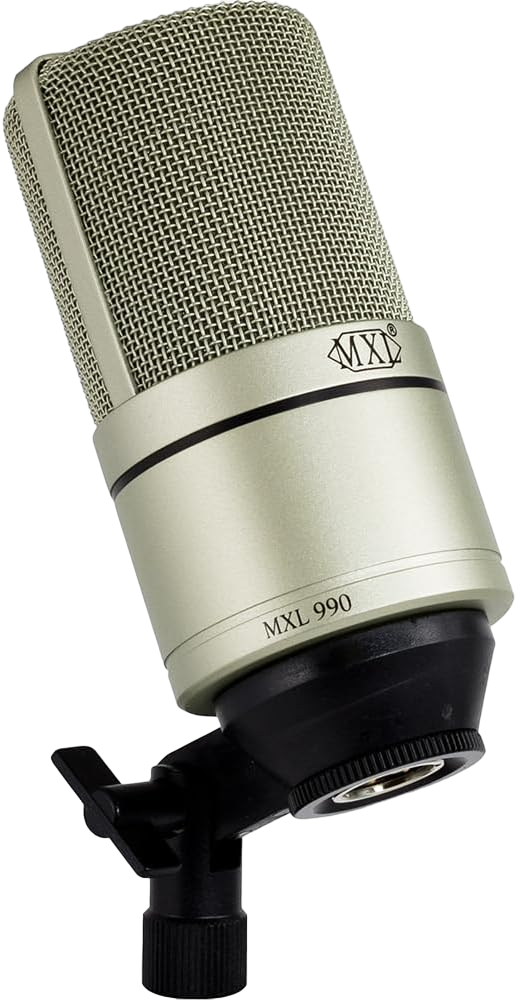
MXL 990 Review and Real User Experience
The MXL 990 became incredibly popular because it gave beginners access to condenser microphone recording without huge costs.
For many people, this was their first “real studio mic.”
And honestly, I understand why.
The first time I heard an MXL 990 compared to a cheap USB mic, the difference felt massive. Vocals suddenly had depth and detail. Acoustic guitars sounded wider and more open.
But over time, I also started hearing its weaknesses.
That’s exactly how most long-term users describe this microphone online.
What the MXL 990 Does Well
Affordable condenser sound
For beginners, the MXL 990 delivers impressive detail for the price.
Vocals sound crisp.
Acoustic guitars sound lively.
Podcasts gain a more “studio” feel compared to budget USB mics.
Good starter microphone
This mic teaches beginners how real condenser microphones behave.
You learn about:
- Phantom power
- Mic placement
- Room acoustics
- Pop filters
- Gain staging
That learning experience alone makes it valuable.
Surprisingly useful accessories
Many users appreciate the included:
- Shock mount
- Storage case
- Mic holder
That adds solid value for beginners.
Nice for acoustic instruments
The upper frequencies help acoustic guitars sparkle nicely.
Singer-songwriters often enjoy this character.
Weaknesses of the MXL 990
Muddy low mids
This is the most common criticism.
The low mids can sound muddy or boxy, especially in untreated rooms.
Many Reddit and Gearspace users mention needing EQ cleanup afterward.
I experienced the same thing during vocal mixing.
The mic sounded exciting at first, but the low-end buildup became obvious after comparing it to better condensers.
Sensitive to room noise
Unlike the SM57 or SM58, the MXL 990 captures everything.
That includes:
- Echo
- PC fans
- Traffic
- Air conditioners
- Keyboard noise
In bad rooms, recordings can become messy quickly.
Directionality issues
Small positioning changes noticeably affect tone.
Move six inches away and the sound can shift dramatically.
Beginners often underestimate how important placement becomes with condenser microphones.
Who Should Buy the MXL 990
Beginner musicians
Great for learning recording fundamentals cheaply.
Singer-songwriters
Especially useful for acoustic guitar and vocals.
Budget home studios
Good entry point into XLR condenser recording.
Podcasters with treated rooms
If your room sounds decent, the MXL 990 can sound very polished.
Final Thoughts on the MXL 990
The MXL 990 remains a strong beginner condenser microphone.
It has flaws.
But it also gives beginners a genuine recording experience at a very accessible price.
Many creators eventually upgrade from it.
Still, a huge number of musicians remember this mic fondly because it helped them start recording seriously.
That emotional attachment appears constantly across forums and communities online. out of it, position
sE Electronics X1A
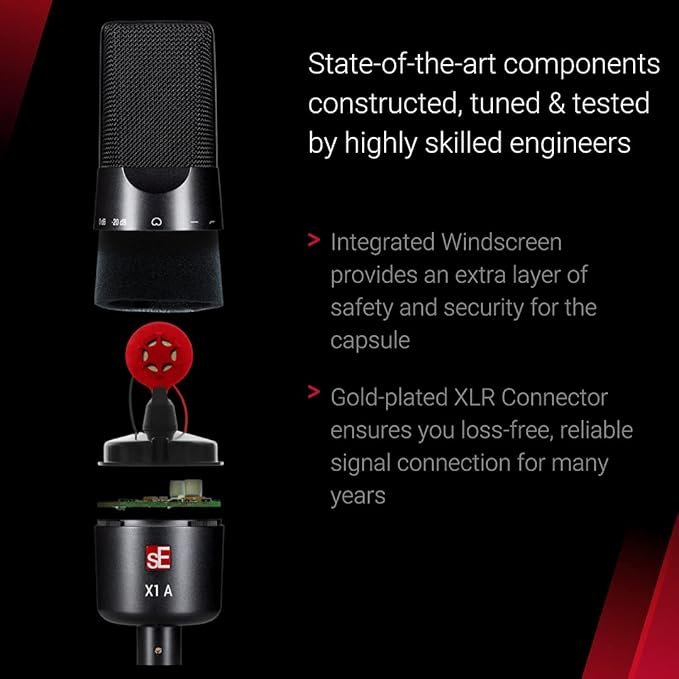
The sE Electronics X1A, the Best under 100 Condenser Mic that is praised for its solid build quality and thoughtful accessories.
It comes with a surprisingly good flight case and a nice shock mount, contributing to its overall durability and ease of handling.
The rubberized surface helps prevent accidental drops, which is a thoughtful feature for protecting your investment.

Sound Quality and Performance
The X1A offers clarity with a neutral sound signature that works well for various recording situations.
Some users mention that, with minimal EQ, the mic can deliver very polished recordings.
The low self-noise of the X1A is another factor that users appreciate, making it an excellent option for home studios where external noise might be an issue.
It’s especially great for capturing the subtle details in acoustic guitar performances, producing a natural, open sound.
Comparison with Other Microphones
- The sE Electronics X1A is visually similar to the classic AKG 414, though it does not replicate the 414’s bright character. Instead, it offers a mellower tone with a bit of tube-ish, ribbon-ish warmth. This characteristic makes it suitable for a range of applications where a reserved upper register is beneficial.
- Compared to the LCT 440 Pure, which provides a very airy sound with a lot of detail, the sE X1A delivers a good tone out of the box with a reserved high end, making it easier to shape the sound during mixing.
Vocal and Instrument Recording
- For vocal takes and recording acoustic guitar, users have found the sE X1A to be very reliable. It provides a solid recording quality that is particularly beneficial for instruments like pennywhistles and recorders due to its non-hyped upper end.
- Another user highlights the sE X1A’s ability to deliver a crisp and clear sound, making it comparable to high-end mics like the Neumann U 87 Ai. This comparison underscores its quality and value for money.
That smoother top end becomes extremely helpful for beginners.
Cheaper condensers often exaggerate harsh frequencies.
The X1A avoids that problem nicely.
What Makes the X1A Stand Out
Clean neutral sound
The X1A captures vocals and instruments naturally.
You get clarity without excessive brightness.
That gives more flexibility during mixing.
Low self-noise
This matters a lot in home studios.
Quiet microphones produce cleaner recordings.
Users consistently praise the X1A for this.

Great acoustic guitar recordings
Acoustic instruments sound open and realistic.
Fingerstyle guitar especially sounds detailed without becoming harsh.
Useful low-cut filter
The built-in low-cut filter helps remove rumble and unnecessary low frequencies.
Many beginners forget to activate it during vocal sessions.
Using it correctly immediately improves vocal clarity.
Weaknesses of the X1A
Needs proper room treatment
Like most condensers, it captures room reflections easily.
A bad room still sounds bad.
Shock mount sold separately in some bundles
Some users feel disappointed when realizing certain packages don’t include a shock mount.
Who Should Buy the X1A
Vocalists
Especially singers wanting smooth high frequencies.
YouTubers and voiceover artists
The neutral sound works very well for speech.
Acoustic musicians
Excellent for guitars, flutes, and softer instruments.
Final Thoughts on the sE Electronics X1A
The X1A offers one of the most balanced sounds in the budget condenser category.
It avoids harshness.
It records cleanly.
It adapts well to different voices.
For creators wanting a condenser microphone that sounds polished without aggressive brightness, the X1A deserves serious attention.
Behringer XM8500
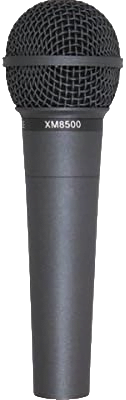
You could try a Behringer XM8500, basic XLR cable, Behringer UMC22 interface and stand. That UMC doesn’t have a lot of gain to work with like a Scarlett Solo but…
Dynamic mics are less prone to ambient sound leaking in comparison to condenser mics. If you can treat your space a condenser might be an option.
Why People Buy the Behringer XM8500
Most beginners struggle with two problems
- Bad room acoustics
- Limited budget
The XM8500 helps with both.
Since it’s a dynamic microphone, it naturally rejects a lot of background noise compared to condenser microphones. That means less keyboard noise, less fan noise, and fewer echoes from untreated rooms.
If your room sounds bad, this matters A LOT!
I’ve tested cheap condenser mics in untreated bedrooms before and the recordings sounded hollow and messy. Dynamic mics like the XM8500 instantly sounded tighter and cleaner.
Sound Quality
The biggest surprise with the XM8500 is how usable the sound is right out of the box.
Voices sound
- Clear
- Warm
- Focused
- Less harsh than expected
It handles spoken voice very nicely for podcasts and YouTube videos.
Many users on Reddit and Gearspace mention that the mic responds especially well to EQ. A little compression and EQ can make it sound significantly more expensive.
The low end feels decent without becoming muddy.
The highs stay controlled instead of sounding painfully sharp like many cheap condensers.
Build Quality
This thing feels tough!
The microphone has a metal body and decent weight. It does not feel like a toy.
A lot of budget microphones look good online but feel fragile in person. The XM8500 avoids that problem.
I’ve seen musicians mention using it for years in live gigs without issues.
Noise Rejection
This is where the XM8500 becomes a killer budget option.
Its cardioid pickup pattern focuses mainly on your voice while rejecting sounds from the sides and rear.
That makes it excellent for
- Streaming setups
- Noisy bedrooms
- Shared apartments
- Untreated home studios
If your PC fan sounds like a jet engine, this mic helps 😂
The Biggest Weakness
The XM8500 needs decent gain.
Cheap interfaces sometimes struggle to power dynamic microphones properly.
That’s why people often recommend pairing it with something better than the absolute cheapest interface.
The Behringer UMC22 works, but you may need to raise gain aggressively.
Interfaces like
- Focusrite Scarlett Solo
- Audient iD4
- MOTU M2
usually provide cleaner gain.
Problems Users Mention
A few complaints show up repeatedly
- Included mic clip feels cheap
- Positioning matters a lot
- Audio drops quickly if you move too far off-axis
You need proper mic technique.
If you constantly turn your head while talking, volume consistency suffers.
Who Should Buy the XM8500
This mic makes perfect sense for
- Beginner podcasters
- Streamers
- Students
- Budget home studios
- Singers needing a backup live mic
It gives tremendous value for the price.
Who Should Skip It
Avoid it if
- You want ultra-detailed studio vocals
- You record acoustic instruments professionally
- You hate speaking close to the microphone
Dynamic microphones work best when positioned close to your mouth.
Final Thoughts on the Behringer XM8500
The Behringer XM8500 remains one of the easiest microphone recommendations under a tight budget.
It sounds far better than its price suggests!
For untreated rooms, I honestly prefer this over many cheap condenser microphones.
A simple setup with
- XM8500
- XLR cable
- Audio interface
- Boom arm
can already produce respectable podcast audio.ether you’re beginning a venture on podcasting or refining your audio setup, the XM8500 beckons as a beacon of affordability and reliability in the sea of microphones.
Audio-Technica AT2020
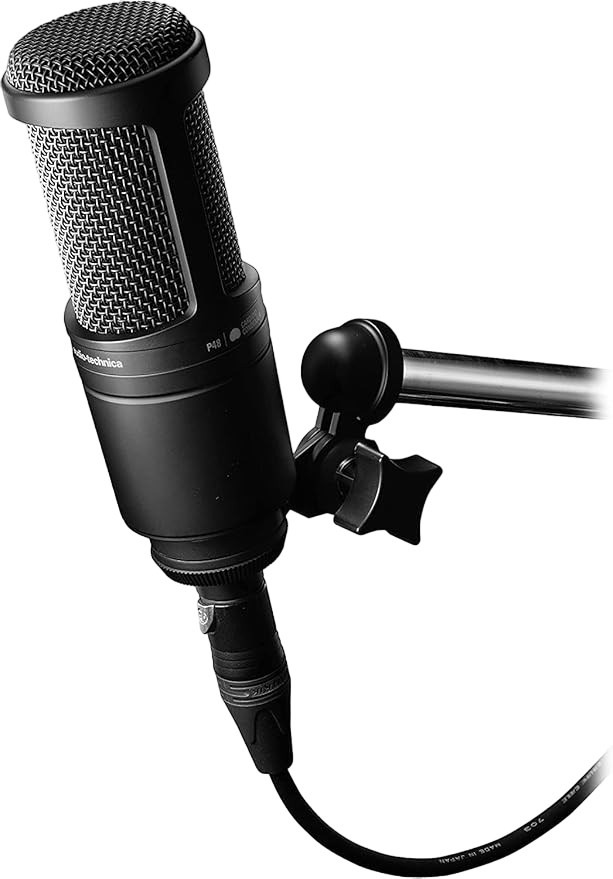
The Audio-Technica AT2020 has been one of the Best under 100 Condenser Mic in the audio world, and it’s easily one of the best condenser mics under $100. For podcasters, streamers, and musicians alike, this mic is a fantastic all-rounder.
Overview
The AT2020 is a condenser microphone.
That changes everything.
Condenser microphones capture much more detail than dynamic microphones. They also capture more room noise.
So before buying this mic, ask yourself one question
“Is my room quiet?”
If the answer is no, you may struggle.
I’ve seen beginners buy condenser mics expecting instant studio sound, only to discover their mic now captures
- Ceiling fans
- Cars outside
- Keyboard clicks
- Room echo
- Dogs barking two houses away 😭
The AT2020 performs best in treated or quiet rooms.
Sound Quality
The AT2020 sounds clean and open.
Voices come through with impressive detail for the price.
Compared to many cheap USB mics, recordings sound more natural and less compressed.
A lot of podcasters love it because speech remains intelligible without sounding muddy.
Musicians also use it for
- Vocals
- Acoustic guitars
- Voiceovers
- Instruments
The top end feels slightly bright but generally balanced.
Build Quality
Audio Technica built this mic very well.
The metal construction gives it a premium feel immediately.
It feels much sturdier than many budget condenser microphones from random Amazon brands.
Real Beginner Mistakes
I constantly see beginners misunderstand the AT2020 setup requirements.
This microphone is NOT plug and play.
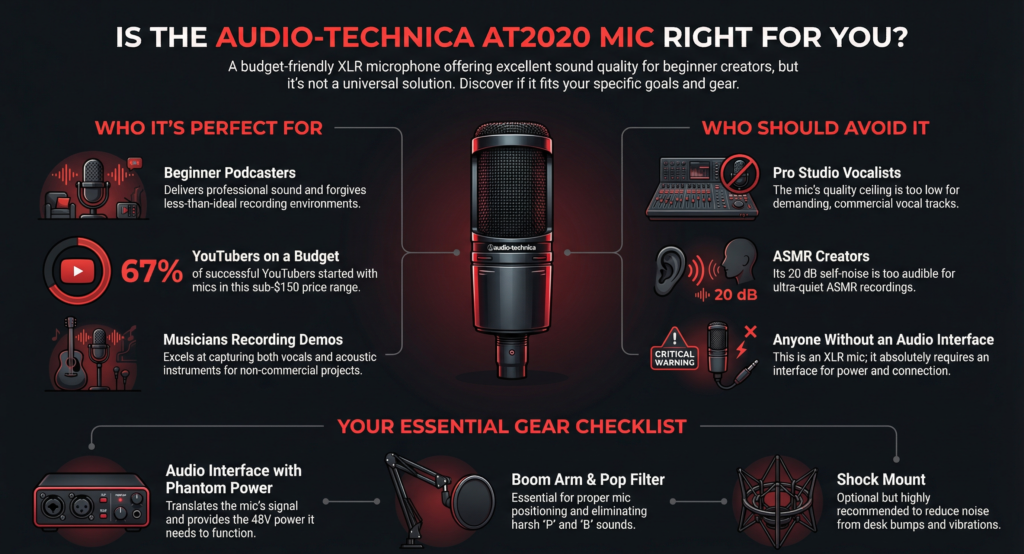
The XLR version requires
- Audio interface
- XLR cable
- 48V phantom power
Without phantom power, the mic will not work.
That catches many beginners off guard.
Interface Matters More Than People Think
Many users pair expensive microphones with terrible interfaces.
Bad interfaces can introduce
- Hiss
- Weak gain
- Electrical noise
The AT2020 benefits from decent interfaces like
- Focusrite Scarlett 2i2
- Audient iD4
- MOTU M2
Cleaner preamps help preserve detail.
Plosives and Sibilance
The AT2020 can exaggerate harsh sounds sometimes.
Words with strong
- P sounds
- S sounds
- T sounds
can become aggressive without proper setup.
A pop filter helps massively.
Positioning the microphone slightly off-center also improves recordings.
Self Noise Discussion
Audio engineers often mention the AT2020’s self-noise.
Its self-noise level is higher than some more expensive condenser microphones.
For casual creators, this usually is not a dealbreaker.
For professional voiceover work in silent rooms, it becomes more noticeable.
Who Should Buy the AT2020
Excellent choice for
- Beginner musicians
- Voiceover practice
- Home studios
- YouTube creators
- Podcasting in quiet rooms
Who Should Avoid It
Avoid it if
- Your room is untreated
- You have loud background noise
- You need strong noise rejection
In those situations, dynamic microphones usually work better.
Final Thoughts on the AT2020
The Audio Technica AT2020 remains one of the safest condenser microphone recommendations under $100.
The sound quality still holds up today!
But room acoustics matter a lot here.
A treated room plus proper mic positioning can make this microphone sound genuinely impressive.asoned audio enthusiasts.
Samson Q2U
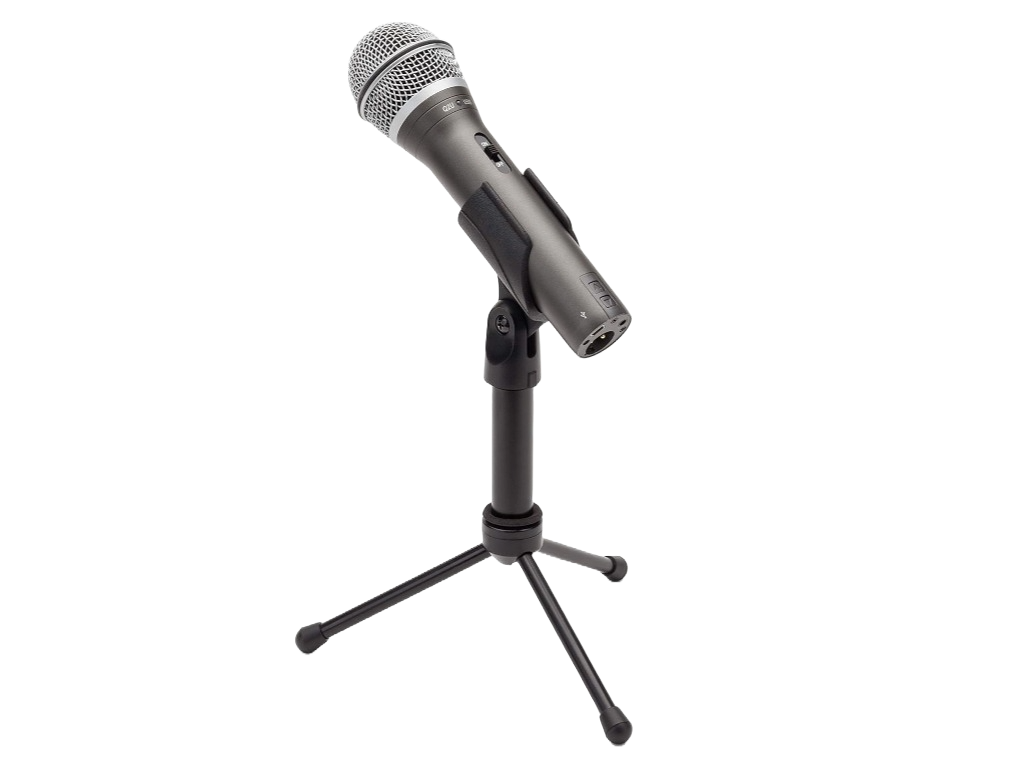
Samson Q2U is around $70 and sounds great. Get dynamic, not condenser.
If you’re a podcaster, a budding YouTuber, or a live performer, the right microphone can make the your audio experience you want. We’ll be getting deep into the Samson Q2U microphone, dissecting its features, uncovering its pros and cons, and identifying who it’s best suited for.
Identifying the Need of Samson Q2U
Let’s identify the problem it aims to solve. Finding the perfect balance between affordability, versatility, and performance is daunting.
Content creators often find themselves torn between investing in high-end, specialized equipment or settling for budget-friendly options that will compromise on quality.
Get your eyes on the Samson Q2U—a microphone I love for dual functionality, affordability, and impressive performance. But does it truly live up to the hype? Let’s find out.
Pros of Samson Q2U
- Dual Output Functionality: The Samson Q2U’s dual output capabilities is its most notable feature, which makes it an adaptable tool for content creators. This microphone works well in many situations, whether you’re capturing spoken word, live performances, or YouTube videos.
- Outstanding Noise Rejection: The Samson Q2U is a great option for reducing off-axis interference and background noise due to its remarkable noise rejection characteristics, which are affordable.
- Robust Construction: Video producers place a high importance on robustness, and the Samson Q2U meets this need. Even with frequent use, its robust design guarantees lifetime.
- Lag-free monitoring is necessary for producing audio in real-time, and the Samson Q2U meets this demand by offering a smooth monitoring experience that doesn’t require extra amplification.
Cons of Samson Q2U:
- Interference Sensitivity: Some users have reported sensitivity to interference, particularly with USB and XLR connections. Addressing this issue may require additional troubleshooting to mitigate unwanted hiss and hum.
- Subpar Accessories: While the microphone itself shines, the included accessories leave room for improvement. The stand is deemed inadequate by many users, and the included cables may fall short in certain setups.
- Minor Design Flaws: Users have noted minor design flaws, such as a precarious rubber band channel and a short USB cable. While these issues are manageable, they detract from the overall user experience.
Who Should Consider the Samson Q2U?
The Samson Q2U thinks about a diverse audience of content creators and offers a blend of affordability and performance. Here’s a breakdown of who can benefit most from this microphone:
- Podcasters and YouTubers: The Samson Q2U provides an affordable option without sacrificing audio quality for those who are just starting out in the world of podcasting or creating material for YouTube.
- Live Performers: The Samson Q2U is a versatile partner for live concerts and shows. Its dynamic range and dual output functionality are especially appealing to musicians and performers on a budget.
- Those who love a good deal: The Samson Q2U is a compelling choice if you’re looking for a low-cost microphone that doesn’t sacrifice quality. For those who are cost-conscious, its dual purpose and robust construction make it a worthwhile investment.
Final Verdict on Samson Q2U
In conclusion, I think Samson Q2U emerges as a great choice for content creators who seek a versatile, budget-friendly microphone.
Even though it might have a few little issues and be sensitive to interference, its strong construction, dual output capability, and outstanding noise rejection make it a fierce competitor in the market.
Recall that there is no one-size-fits-all approach to finding the ideal microphone. Before choosing, take into account your unique requirements, your financial situation, and the use cases you have in mind.
You can find a dependable partner for your creative activities without going over budget with the Samson Q2U.
ATR2100x
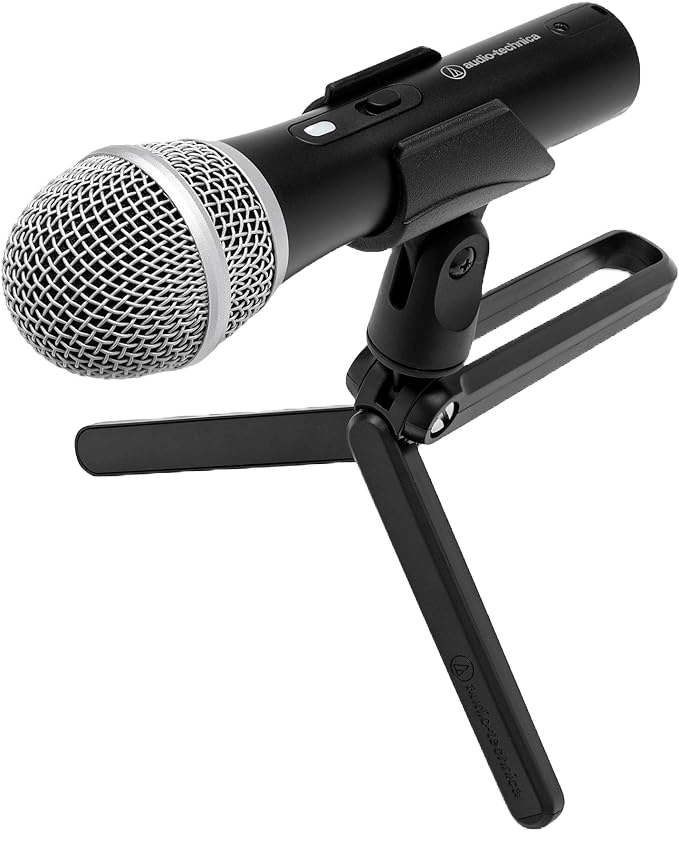
Audio Quality
This microphone produces clear vocal recordings with strong speech intelligibility.
It works very well for
- Podcasts
- Voiceovers
- Interviews
- Streaming
The cardioid pickup pattern helps isolate voices nicely.
Background noise stays controlled compared to condenser microphones.
Build Quality
The microphone itself feels solid.
The included stand, however, receives constant criticism online.
Users often describe it as unstable or flimsy.
Most creators eventually upgrade to a boom arm anyway.
USB Convenience
The ATR2100x works wonderfully for beginners because setup feels easy.
Connect USB.
Select microphone.
Start recording.
No complicated routing.
No phantom power.
No external preamps required.
XLR Upgrade Path
Once users gain experience, many transition toward XLR interfaces for more control.
That flexibility gives this microphone excellent long-term value.
User Complaints
The biggest complaints include
- Cheap included accessories
- Plastic stand issues
- Occasional background hiss
- Weak customer service experiences
Still, the overall feedback remains strongly positive.
Final Thoughts on the ATR2100x
The ATR2100x offers one of the best beginner-friendly balances between convenience and sound quality.
For spoken voice content, it performs extremely well for the money.
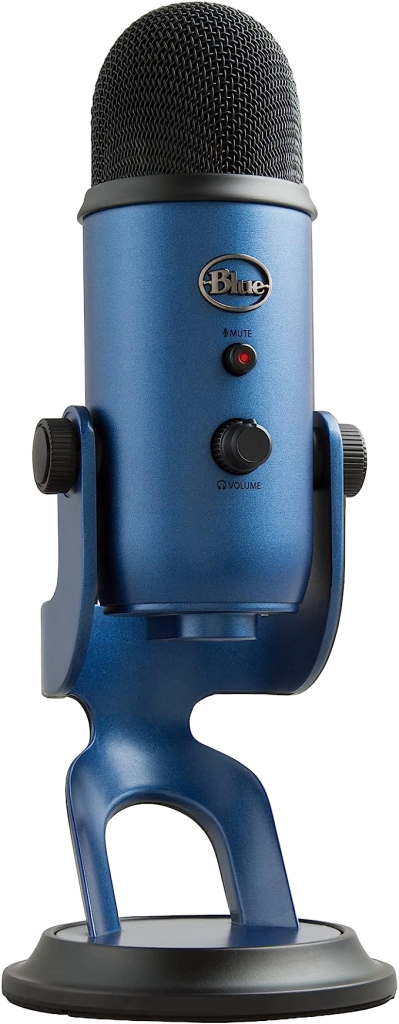
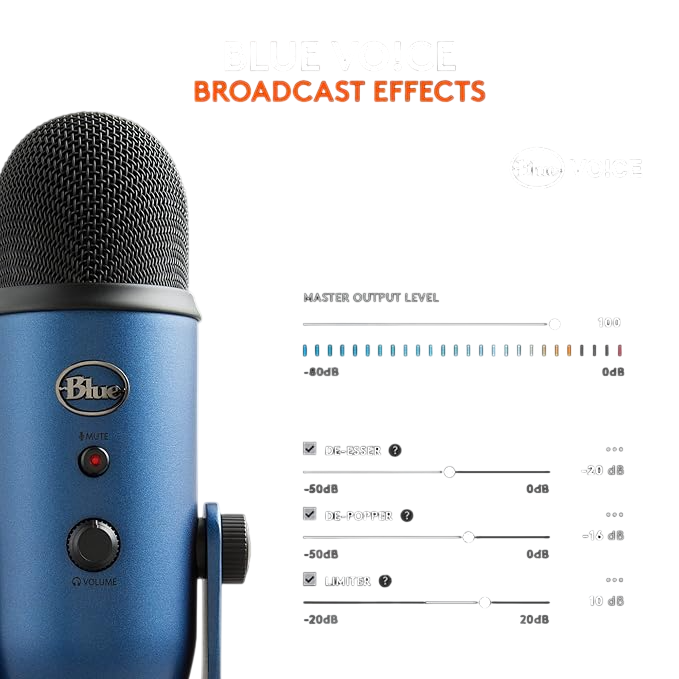
BLUE YETI USB MICROPHONE:
The importance of quality audio cannot be overstated. Creators and seasoned professionals alike understand the effects of crystal-clear sound on their podcasts, gaming streams, and YouTube videos.
The Logitech for Creators Blue Yeti USB Microphone has become a popular choice, promising studio-quality sound and ease of use. In this review, we’ll go through the details to uncover whether this microphone lives up to the hype.
Sound Quality
The Blue Yeti captures detailed audio with strong clarity.
For voice recordings, the sound often feels rich and full.
The microphone includes multiple polar patterns
- Cardioid
- Omnidirectional
- Stereo
- Bidirectional
That flexibility helps creators record different situations easily.
Why Beginners Love It
The setup process feels incredibly simple.
That matters a lot for beginners who just want to create content quickly.
Many users successfully use it for
- Streaming
- YouTube
- Podcasts
- Voice chats
- Casual music recording
The Big Problem Nobody Mentions Enough
The Blue Yeti captures EVERYTHING.
And I mean EVERYTHING 😂
Keyboard noise.
Mouse clicks.
Room echo.
Street noise.
This becomes frustrating in untreated rooms.
A lot of beginner recordings sound messy because the microphone sensitivity is very high.
Build Quality
The Blue Yeti feels heavy and solid.
The desk stand looks premium and stable.
However, USB connection durability receives mixed feedback from long-term users.
Software Issues
Mac users occasionally report compatibility problems after system updates.
That especially appeared around certain macOS Monterey updates.
Should You Buy the Blue Yeti
Good option for
- Beginners wanting simplicity
- Casual creators
- USB-only users
- Quiet recording spaces
Less ideal for
- Noisy rooms
- Competitive streaming setups
- Echo-heavy bedrooms
Final Thoughts on the Blue Yeti
The Blue Yeti remains popular because it makes content creation feel easy.
For quiet rooms, the sound quality still impresses!
But room acoustics matter more here than many beginners realize.
FIFINE XLR/USB DYNAMIC MICROPHONE:
In podcasting, streaming, and content creation, finding the perfect microphone is necessary for delivering top-notch audio quality. We will talk about the FIFINE XLR/USB Dynamic Microphone, a versatile piece of audio equipment making waves in the industry. In this detailed review, we’ll know the key features, pros, and cons to help you make an informed decision.

FIFINE microphones became surprisingly popular recently because they offer features people usually expect at much higher prices.
RGB lights.
USB and XLR connectivity.
Solid audio quality.
Affordable pricing.
That combination grabs attention fast!
Why People Like FIFINE Mics
The FIFINE AM8 especially gained traction among gamers and streamers.
Setup feels simple.
The microphone looks modern.
And the sound quality genuinely performs better than many expected.
Sound Quality
The microphone delivers
- Clear vocals
- Controlled bass
- Minimal background noise
The dynamic capsule helps reject room noise better than condenser microphones.
That makes it useful for untreated setups.
USB and XLR Flexibility
Like the Samson Q2U and ATR2100x, FIFINE gives users upgrade flexibility.
USB mode works instantly.
XLR mode allows expansion later into mixers and interfaces.
Design
The adjustable stand and RGB lighting make the setup visually appealing for streaming.
A lot of gaming creators appreciate this aesthetic factor.
Common Complaints
Most criticisms focus on the included USB cable.
Some users experienced
- Signal distortion
- Detection issues
- Connection inconsistencies
Replacing the cable often fixed the problem quickly.
Who Should Buy FIFINE Dynamic Mics
Great for
- Beginner streamers
- Gamers
- Budget podcasters
- Content creators wanting USB and XLR support
Final Thoughts on FIFINE Dynamic Microphones
FIFINE microphones offer tremendous value considering the feature set.
The audio quality surprises many first-time users!
For budget creators wanting flexibility and modern styling, these microphones deserve attention.
Not satisfied with em? No Worries! Discover more USB microphones and their detailed analysis by clicking the link.

FAQ
WHAT IS THE Best and Cheapest Condenser Microphone for Vocals Under $120
If you’re on a budget but still want quality sound for your vocal recordings, the Audio-Technica AT2020 is your go-to option. Priced under $120, this condenser microphone offers crisp and clear audio reproduction, perfect for vocals, podcasts, and even instrument recording. Its cardioid polar pattern ensures minimal background noise pickup, focusing solely on your voice. Avoid falling for extremely cheap knockoffs that promise the moon but deliver only static-filled disappointment. Invest in quality, even on a budget.
We have a detailed Article on Best under 100 Condenser Mic. Go check em out!
What is the Best Microphone for Recording Talking within $100 Budget
For under $100, look no further than the Samson Q2U. This dynamic microphone is perfect for recording spoken word, interviews, or podcasts. It’s versatile, offering both USB and XLR connectivity, ensuring compatibility with various devices. Its rugged build ensures durability, while its clear sound reproduction captures every nuance of your voice. Avoid settling for built-in laptop or smartphone microphones, as they often produce subpar audio quality, filled with background noise and distortion.
What is the Best Studio Mic Under $100
When it comes to studio-quality sound on a budget, the Audio-Technica AT2020 shines again. Its exceptional performance and affordability make it a favorite among budding musicians, podcasters, and content creators alike. With its wide frequency response and low self-noise, this condenser microphone delivers professional-grade audio without breaking the bank.
What is the Best Recording Microphone for Under $30
While it’s challenging to find a high-quality microphone under $30, the Neewer NW-800 offers decent performance for budget-conscious individuals. However, be mindful of its limitations. Cheaper microphones often sacrifice sound quality and durability. Invest wisely and consider saving up a bit more for a more reliable option like the Samson Q2U or Audio-Technica AT2020.
mention some Cheap and Bad-Sounding Microphones to Avoid
Steer clear of off-brand, no-name microphones that flood the market with promises of affordability. These cheap alternatives often deliver poor sound quality, high levels of background noise, and lack durability. Remember, you get what you pay for. Invest in reputable brands known for quality performance, even if it means spending a little more upfront.
What are the Best Microphones for Recording Vocals Under $1200
If you have a more generous budget, consider the Shure SM7B. Priced under $1200, this dynamic microphone is a favorite among professional vocalists and podcasters worldwide. Its flat, wide-range frequency response captures vocals with stunning clarity and detail, while its robust construction ensures reliability in any recording environment.
What is a Good Microphone Option for Streaming Under $100
For streaming on a budget, the Blue Yeti Nano is an excellent choice. With its plug-and-play functionality and versatile pickup patterns, this USB microphone offers crystal-clear audio for your live streams, gaming sessions, or video conferences. Avoid using built-in laptop or webcam microphones, as they often produce inferior sound quality, filled with echoes and background noise.
What are the Best Headphones or Microphones Under $100
When it comes to affordable audio gear, the Audio-Technica ATH-M30x headphones are a solid choice. With their balanced sound signature and comfortable design, they’re perfect for monitoring your recordings or enjoying music on the go. Paired with the Samson Q2U microphone, you have a budget-friendly setup that delivers professional-grade audio performance.
What is the Best Microphone for Around $20
While it’s challenging to find a quality microphone at such a low price point, the Fifine K669B USB microphone offers decent performance for basic recording needs. However, be prepared for some compromises in sound quality and durability. Consider saving up a bit more for a more reliable option like the Samson Q2U.
What is the Best Microphone with a Budget of £50
For around £50, the Behringer XM8500 dynamic microphone is a solid choice. Its rugged construction and clear sound reproduction make it ideal for vocals, speeches, or podcasting. Pair it with a simple audio interface or USB adapter for seamless connectivity to your recording setup.
Mention a Good Microphone/Amp Setup for Under $100
For a budget-friendly microphone/amp setup, consider the Focusrite Scarlett Solo audio interface paired with the Samson Q2U microphone. The Scarlett Solo offers high-quality audio conversion and preamps, while the Samson Q2U delivers clear sound reproduction for your recordings. This combination provides everything you need to kickstart your podcasting or recording journey without breaking the bank.
Conclusion
In our pursuit of the best microphone under $100, we’ve traversed the realm of audio excellence, guided by the wisdom of experts and the allure of affordability. Whether you opt for the timeless reliability of a Shure classic, the plug-and-play convenience of a USB marvel, or the nuanced brilliance of a condenser gem, remember that the perfect microphone is not merely a tool, but a conduit for creativity and expression. So, equip yourself wisely, embark on your audio odyssey, and let your voice be heard – for greatness awaits, even within the confines of a modest budget.
Into Podcasting? Podcasting is a different game, and without a precise blueprint, the game will get tougher midway. Building out your setup? Check our Complete Audio Gear Guide or try the free Signal Chain Builder to make sure everything you buy actually works together.
Get your complete podcast equipment setup by visiting Podcast Equipment Bundle. Get in touch with podcasting services and experts those will save you tons of time at Podcast Production Services.
With that being said, Let’s connect with all such free and paid tool/services you might need knowingly or unknowingly to fuel your growth. Here’s 21 BEST AI TOOLS AND PLATFORMS TO GROW YOUR PODCAST AND CONTENTS. There are some bonus tools in the end too to make your day to day life easier.
As an Amazon Associate I earn from qualifying purchases. There are some affiliate links on this page that will redirect you directly to the original products and services. Also by buying through those links you will be supporting us. So thank you ^.^
Related Posts
- Best USB Microphone Models Under $150
- Best Microphone Under $100
- Best Dynamic Microphone for podcasting
- Best USB Mic for beginners – Blue Yeti USB Microphone vs Fifine XLR USB Dynamic Microphone
- Dynamic vs Condenser Mic
- Best Under $100 Condenser Mic
- Best of the Most Expensive Microphones to Buy
- Best Magnetic Mics
- Different Types of Microphones and Their Features