I am a retired musician, and the first mic I ever bought under $100 taught me that cheap and bad are not the same thing 🎙️
Affiliate links below. As an Amazon Associate I earn from qualifying purchases.
Direct answer first. The best condenser mic under $100 depends on your room and your budget. For the most detail, the Audio-Technica AT2020 sits right at the $99 line. For the lowest real price, the Behringer C-1 runs about $50.
Here is the number that surprised me. The AT2020 and the C-1 cost about double apart, yet both use a genuine condenser capsule and need the same 48V phantom power to work.
By the end of this guide, you will know why condenser mics need phantom power, how all four compare, and which one fits your room.
This guide draws on manufacturer documentation, independent reviews, and retailer listings. It does not rest on bench testing, so I name the source whenever I share someone’s experience.
Quick Picks
| Pick | Needs phantom power | Best for | Price tier |
|---|---|---|---|
| Audio-Technica AT2020 | Yes, 48V | Treated rooms, detail | Around $99 |
| MXL 990 | Yes, 48V | Vocals and acoustic guitar | Around $90 |
| AKG P120 | Yes, 48V | Loud sources, pad and filter switches | $79 to $129 |
| Behringer C-1 | Yes, 48V | Lowest price entry point | $50 to $54 |
Buy the AT2020 if your room is quiet and you want detail. Skip all four if you have no interface or mixer and don’t want to buy one, since condenser mics need phantom power from somewhere.
Do You Need an Interface for a Condenser Mic?
Yes, always. A condenser mic needs 48V phantom power, which only comes from an audio interface or a mixer.
That is the tradeoff against a USB mic, but it also gives you more control and a clear upgrade path, since you can swap mics without buying new electronics each time. Our USB microphone vs audio interface guide breaks down that tradeoff in full.
If you already own a budget interface, check our best budget audio interface guide for a pairing that won’t bottleneck these mics. Want a dynamic mic instead? Our best XLR microphone under $100 guide covers that side.
Best Condenser Microphones Under $100
Four mics cover the real decision points under this price, from the most detailed to the cheapest real entry point.
Audio-Technica AT2020
The condenser most people land on at this price, and for good reason.
Amazon’s own listing puts the frequency response at 20 Hz to 20,000 Hz, a max SPL of 144 dB, 100 Ω impedance, and a requirement for 48V phantom power. It is a large diaphragm, side address, cardioid condenser aimed squarely at project and home studios.
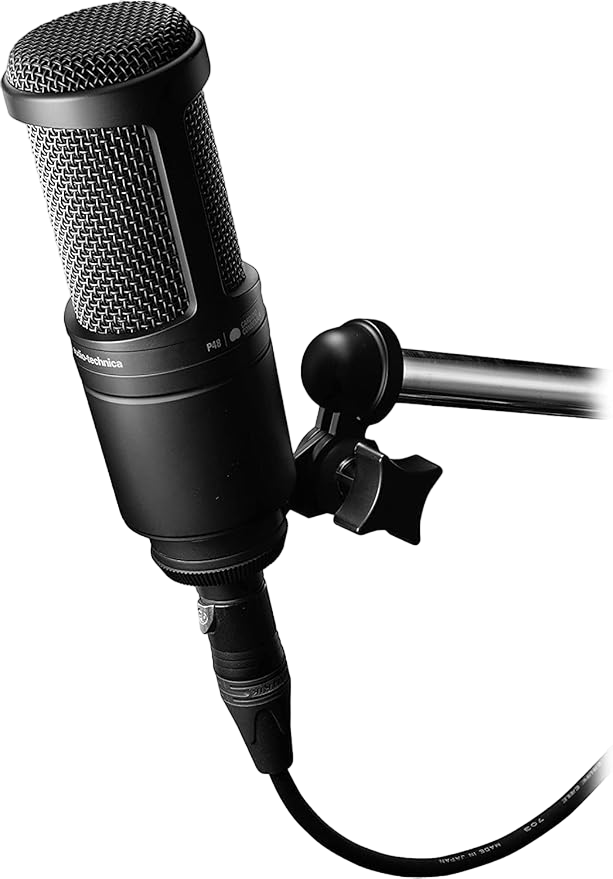
Podcastage’s reviewer puts the price plainly, right around $99 on Amazon, and flags the one thing every first time buyer needs to know. You need a proper audio interface and real 48V phantom power for this mic to work at all.
Our full AT2020 review goes deeper on how it handles different rooms and voices.
This review and sound test shows the AT2020 in actual use 👇
MXL 990
The mic MXL built to bring large diaphragm condenser sound under the triple digit price point.
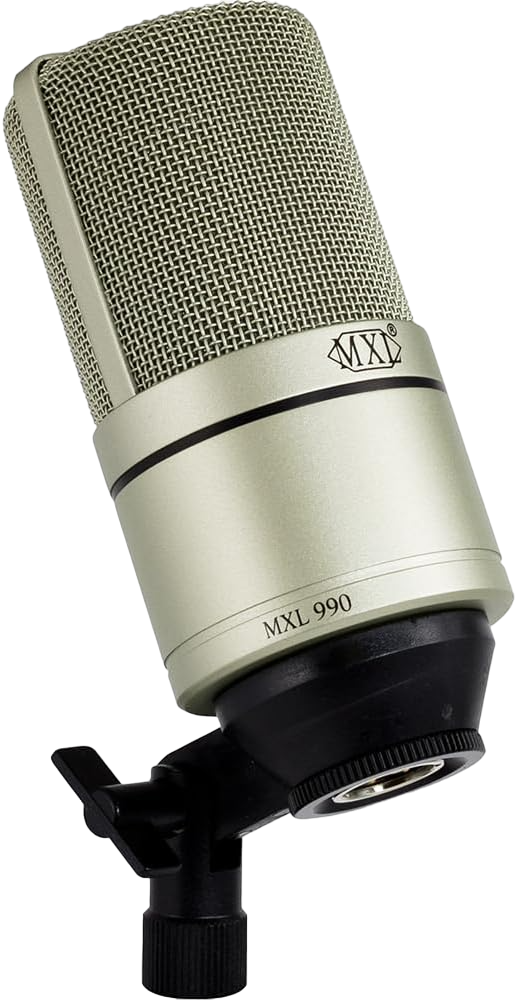
MXL’s own spec sheet lists a 22mm, 6 micron gold sputtered diaphragm, a cardioid pattern, 20 Hz to 20 kHz frequency response, 200 Ω impedance, and a 20 dB self noise rating. It ships with a shockmount, a mic stand adapter, and a carrying case.
A detailed writeup on MXL Microphones’ own fan site calls it the mic that brought large diaphragm condenser technology into the sub $100 range for the first time, a category where it had previously been uncommon.
My take as a musician. The 990 sits between the other two. Less refined than the AT2020, but a genuinely fair middle ground 🎸
AKG P120
A step up in build quality, with two physical switches most budget condensers skip entirely.
AKG’s own spec sheet lists a 2/3 inch true condenser capsule, 20 Hz to 20 kHz frequency response, 24 mV/Pa sensitivity, and an all metal body. A front mounted bass cut filter at 300 Hz tackles rumble and footfall, and a 20 dB pad lets you mic loud sources like drums or guitar cabs without distortion.
Equipboard’s pricing data shows real retailer prices as low as $79 on Amazon, well under the $129 list price. Recordinghacks notes a sharp presence peak around 12 kHz, giving it a brighter character than the flatter AT2020.
My take as a musician. The pad and filter switches are genuinely useful if you ever mic an amp or a loud acoustic source, not just vocals 🎤

Behringer C-1
The lowest real entry point into large diaphragm condenser recording.
Behringer’s own listing describes a 16mm diaphragm, cardioid pattern, transformerless FET circuitry for low noise, a die cast metal body, and a red LED phantom power indicator. Recordinghacks lists a 40 Hz to 20 kHz frequency response and 136 dB max SPL.
Street price sits around $50 to $54 at most retailers, roughly half the AT2020. Guitar Center’s own description calls it a versatile performer that sounds like it should cost far more.
The honest tradeoff is in the extras. No pad, no filter switch, and a plastic hardmount rather than a shockmount, based on recordinghacks’ build notes.
Which Condenser Mic Should You Buy?
Match the mic to your room and your gear, not just the price tag.
- Want the most detail. Buy the Audio-Technica AT2020
- Vocals and acoustic guitar, slightly warmer tone. Buy the MXL 990
- Want a pad and filter switch for loud sources. Buy the AKG P120
- Lowest price, no frills. Buy the Behringer C-1
Need the interface to go with it? Our best budget audio interface guide covers boxes under $100 built for exactly these mics.
What Should You Check Before You Buy?
Four quick checks before you commit.
- Confirm you own or will buy an interface or mixer with phantom power
- Check your interface actually supplies 48V on the input you plan to use
- Budget for a separate XLR cable, since none of these mics ship with one
- Treat your room first if you can, since a condenser picks up everything
Did You Know 🤯
The MXL 990 was the first mic to bring large diaphragm condenser technology into the sub $100 price range, a category where it had previously been uncommon, according to MXL’s own community page.
Best Condenser Mic Under $100 FAQ
Do I need an audio interface for a condenser mic?
Yes.
Condenser mics need an interface or mixer with 48V phantom power to work at all.
Is the AT2020 good enough for podcasting?
Yes, in a quiet room.
Its condenser capsule picks up detail well, but also picks up more room noise than a dynamic mic.
Why does my condenser mic need phantom power?
Condensers need voltage to charge their capsule.
48V phantom power from your interface supplies that, which dynamic mics never need.
Can I use these mics for singing?
Yes.
All four handle vocals well in a treated room, which gets the most out of any condenser.
So treat your room first, pick your condenser second, and start recording 🎶
As an Amazon Associate I earn from qualifying purchases. There are some affiliate links on this page that will redirect you directly to the original products and services. Also by buying through those links you will be supporting us. So thank you ^.^
Related Posts
Here is a list of microphone and interface posts you can consider as alternatives.