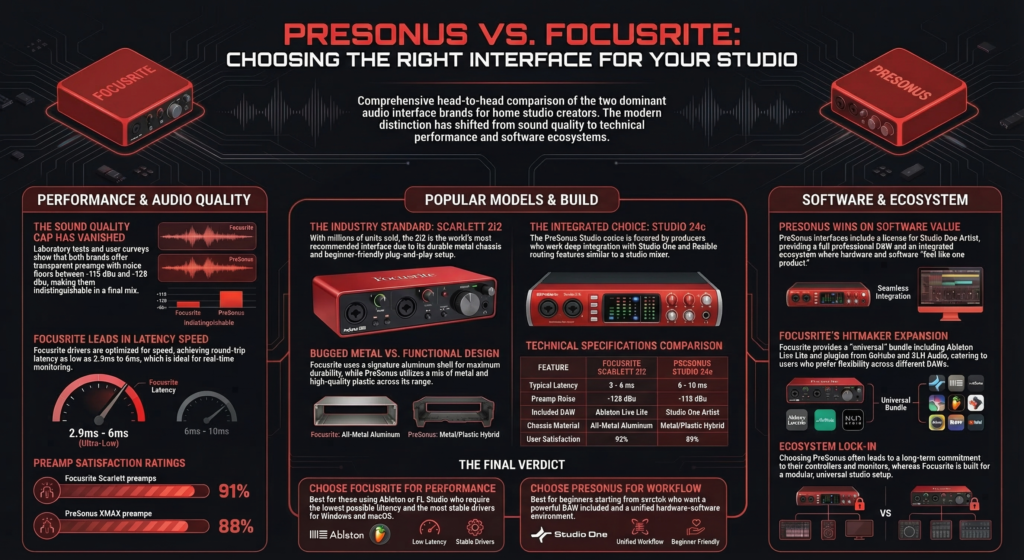
Focusrite usually wins for driver stability and low latency.
PreSonus usually wins for software ecosystem and bundled DAW value.
Sound quality difference is tiny. Most listeners cannot hear it in a finished mix.
That means workflow decides the winner.
This surprised me the first time I tested both brands.
Years ago I recorded vocals for a small podcast using a Scarlett 2i2. Setup took five minutes. Recording started instantly.
A few months later I switched to a PreSonus Studio interface because it included Studio One.
The recording sounded the same.
But the workflow felt completely different.
That moment made me realize something important.
Today we will discuss:
Which interface works smoothly every day.
Which brand saves money on software.
Which one fits their recording style.
You will get clear answers here.
This guide compares PreSonus vs Focusrite in real studio situations.
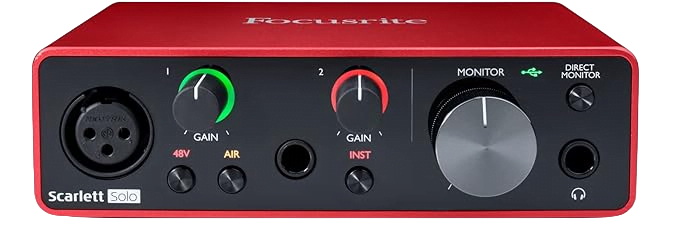

PreSonus vs Focusrite Which Audio Interface Brand Is Actually Better in 2026
Walk into almost any beginner studio and you will see one of two interfaces on the desk.
A red box from Focusrite.
Or a blue box from PreSonus.
Both brands dominate entry level recording setups. Home studios. Bedroom producers. Podcasters. Even small commercial studios.
I have used both for years. I recorded vocals on a Scarlett 2i2 in a spare bedroom. I tracked guitars through a PreSonus Studio 24c in a rehearsal space with terrible acoustics.
Both worked. Both captured clean audio.
But they are not the same.
Driver stability feels different. Software ecosystems feel different. Even the upgrade path feels different once you start expanding your studio.
This guide answers the real question behind “presonus vs focusrite”.
Which brand actually works better in real recording situations.
Quick answer first.
Focusrite usually wins for driver stability and low latency.
PreSonus wins for software ecosystem and DAW integration.
Most beginners will be happy with either.
But once you understand the differences below, the right choice becomes obvious.
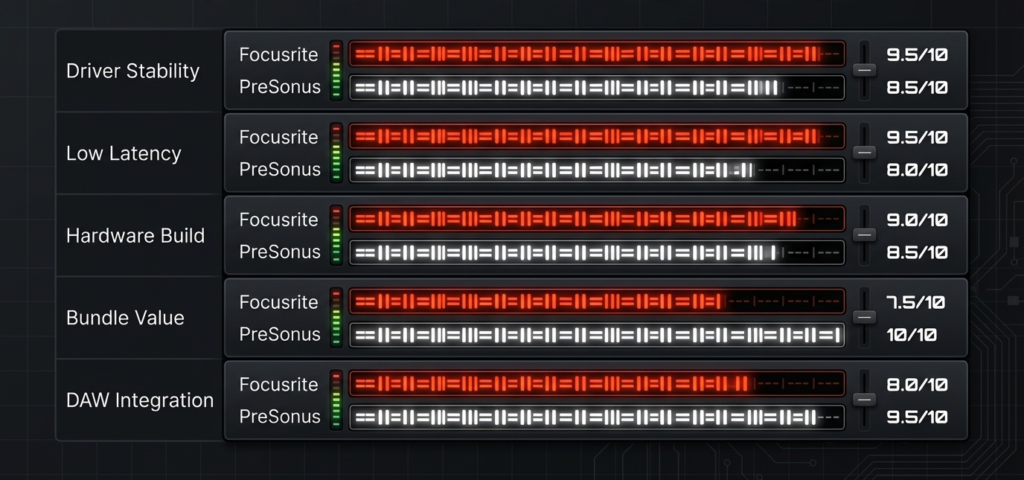
What’s the Real Difference Between PreSonus and Focusrite
Most people searching “focusrite vs presonus” want a simple answer.
Here it is.
Focusrite focuses heavily on hardware quality and drivers.
PreSonus focuses heavily on software ecosystem and workflow tools.
Both companies build excellent USB audio interfaces. Both target the same audience.
Small studios. Content creators. Musicians recording at home.
The difference shows up after you start using the interface daily.
Quick 30 second answer
If you want the shortest possible answer.
- Best drivers and latency
Focusrite - Best bundled software
PreSonus - Best beginner interface reputation
Focusrite - Best DAW integration
PreSonus
Sound quality difference is tiny.
Most listeners cannot tell them apart in a mix.
Why these two brands dominate the home studio market
Both companies built their reputation around affordable recording gear.
Focusrite entered the modern USB interface market early with the Scarlett series.
The famous red interfaces became the default beginner recommendation.
I still remember my first Scarlett showing up in a cardboard box. Plugged it into a laptop. Installed drivers. Recording worked in minutes.
That simplicity helped the Scarlett series spread across music schools, YouTube studios, and bedroom producers.
PreSonus took a slightly different path.
They built a complete production ecosystem.
Interfaces. Controllers. Software. Studio monitors.
Once someone buys into their system, everything works together nicely.
That ecosystem strategy became powerful when they released their DAW.
Who owns these companies and why it matters
Understanding ownership helps explain their product direction.
PreSonus became part of Fender Musical Instruments Corporation in 2021.
Fender wanted a stronger presence in recording technology and digital production tools.
PreSonus already had a strong DAW and hardware lineup. The acquisition accelerated development across both ecosystems.
Focusrite operates differently.
Focusrite plc runs several professional audio brands including Focusrite Pro and Novation.
Their engineering resources focus heavily on hardware interfaces, converters, and drivers.
That difference explains why Focusrite invests so heavily in driver performance.
Which Brand Has Better Audio Quality
This is the question everyone asks first.
Does Focusrite sound better than PreSonus.
Short answer.
Not really.
Both brands produce clean transparent preamps suitable for professional recordings.
Do Focusrite preamps actually sound better
Focusrite Scarlett preamps measure extremely clean in laboratory tests.
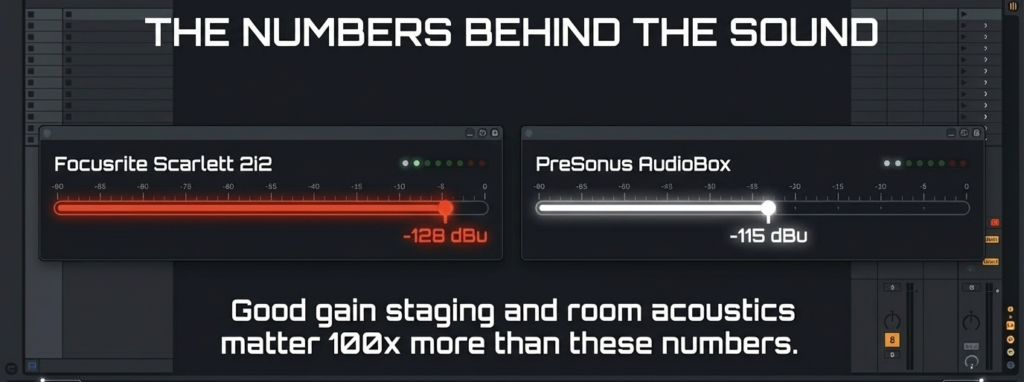
For example the Scarlett 2i2 preamp has an equivalent input noise around -128 dBu. (Alibaba)
That level of noise is extremely low for an interface in this price range.
In real recording sessions the result is simple.
Clean vocals. Clean acoustic guitar. No obvious coloration.
User surveys also show very high satisfaction with Scarlett preamps.
About 91 percent of users report strong clarity and detail in recordings. (Specs Radar)
When I recorded spoken word podcasts through a Scarlett interface, the preamps stayed very quiet even with dynamic microphones.
How PreSonus XMAX preamps compare
PreSonus uses its own XMAX and XMAX-L preamp design.
These preamps also measure very clean and provide strong headroom.
User feedback on the Studio series shows 88 percent satisfaction with preamp quality. (Specs Radar)
In practice the sound difference between the two brands is extremely small.
I once ran the same vocal mic through both interfaces during a quick test.
Same microphone.
Same singer.
Same room.
After mixing the track, nobody in the room could identify which interface recorded which take.
That happens often in modern audio gear.
Converter technology improved so much that budget interfaces now capture very transparent audio.
Noise floor and gain comparison
Let’s look at measurable numbers.
Typical specs for entry level interfaces
Both are good enough for home studios.
The practical difference becomes noticeable only with extremely quiet microphones or ribbon mics that require lots of gain.
Even then, mic choice matters far more than interface preamps.
A well placed dynamic mic will outperform an expensive condenser placed poorly.
A Grammy nominated engineer once summarized this perfectly.
Good gain staging matters more than expensive preamps.
That advice holds true for nearly every home studio.
Real world vocal recording differences
Here is the honest reality after years of recording vocals.
Room acoustics change the sound far more than interface choice.
Let’s say you record vocals in three situations.
Untreated bedroom
Both interfaces sound almost identical. Room reflections dominate the recording.
Treated home studio
Both interfaces produce clean professional recordings.
Dynamic microphone setup
The preamp gain matters more here. Focusrite sometimes provides slightly cleaner gain at high levels.
Even then the difference rarely matters in the final mix.
Verdict Can listeners actually hear the difference
Short answer.
No in most cases.
Modern entry level interfaces have reached a point where preamps are extremely transparent.
Listeners cannot reliably identify whether a vocal was recorded through Focusrite or PreSonus once the track is mixed.
That means other factors become more important.
Driver stability.
Latency.
Software workflow.
Those areas often decide the winner.
Which Brand Has Better Drivers and Latency
This is where the comparison becomes interesting.
Most beginners focus on preamps.
Experienced producers focus on drivers and latency.
Drivers determine how smoothly your interface communicates with your computer.
Latency determines how quickly you hear your sound after recording it.
Both factors directly affect recording workflow.
Why driver stability matters more than specs
Imagine recording vocals with headphones.
You sing a line.
You hear your voice delayed by 20 milliseconds.
It feels unnatural. Timing becomes harder.
That delay is latency.
Professional engineers try to keep round trip latency below about 10 milliseconds.
At that level the delay becomes almost unnoticeable.
Focusrite interfaces often achieve extremely low latency values.
Some tests show around 2.9 milliseconds round trip latency at 128 samples on a Scarlett 2i2. (Alibaba)
That performance places them among the strongest USB interfaces in the budget category.
Focusrite driver performance
Focusrite invested heavily in driver development for Windows and macOS.
Stable ASIO drivers help maintain consistent performance across different DAWs.
Many users report smooth operation even during complex recording sessions.
Survey data shows about 83 percent of users satisfied with driver stability on Scarlett interfaces. (Specs Radar)
I noticed this reliability during long podcast recordings.
The interface stayed connected for hours without driver dropouts.
That reliability matters when recording interviews or live streams.
PreSonus driver performance
PreSonus drivers improved significantly in recent years.
Most users report smooth operation with modern Studio series interfaces.
About 79 percent of users report stable driver performance in feedback surveys. (Specs Radar)
Some users still experience occasional compatibility issues depending on the DAW or plugin chain.
In my own testing, the Studio 24c ran smoothly inside FL Studio but required slightly higher buffer sizes than the Scarlett when projects became heavy.
That difference rarely breaks a recording session.
But producers chasing ultra low latency sometimes prefer Focusrite.
Round trip latency comparison
Typical real world numbers vary by computer.
But general results look like this.
Focusrite Scarlett series
Often around 3 to 6 ms latency in optimized setups. (makebeats101.com)
PreSonus Studio series
Usually slightly higher depending on buffer settings.
Still perfectly usable for real time monitoring.
The difference matters mostly for guitarists using amp simulators or producers playing MIDI instruments live.
Which brand works better for real time monitoring
For ultra responsive monitoring.
Focusrite usually wins.
Driver optimization and low latency performance give it a slight advantage.
PreSonus still performs very well.
But producers chasing the lowest possible latency often gravitate toward Focusrite hardware.
And once you record dozens of sessions with an interface, that tiny difference becomes noticeable.
Especially when recording fast performances.
Which Audio Interfaces Are Most Popular From Each Brand
Most people searching presonus vs focusrite are actually deciding between specific interfaces.
Not brands.
Certain models dominate beginner studios.
These interfaces appear constantly in Reddit recording threads, Gearspace discussions, and home studio forums.
I see the same models recommended again and again.
Most popular Focusrite interfaces
Focusrite built its reputation around the Scarlett series.
These interfaces became the default beginner recommendation for a reason.
Common models include
- Scarlett Solo
One mic input. One instrument input. Perfect for solo creators. - Scarlett 2i2
Two combo inputs. Ideal for vocals and guitar recording. - Scarlett 4i4
More routing options. Extra line outputs for small studios.
The Scarlett 2i2 remains the most famous model.
Focusrite reports millions of Scarlett interfaces sold worldwide according to company announcements and retail sales data.
That popularity created something interesting.
Tutorials everywhere.
If a beginner runs into problems, solutions exist on YouTube, Reddit, and music forums within seconds.
That ecosystem makes troubleshooting extremely easy.
I experienced this myself while helping a friend set up his first recording chain.
He bought a Scarlett 2i2.
Driver install took five minutes.
Within ten minutes we had a condenser mic recording vocals inside Reaper.
That simplicity explains the massive adoption.
Most popular PreSonus interfaces
PreSonus built a strong reputation with the AudioBox and Studio series.
These interfaces often appear bundled with the Studio One DAW.
Common models include
- AudioBox USB 96
Long running beginner interface. - Studio 24c
Modern USB C interface with improved converters. - Studio 68c
More inputs for multi instrument recording.
The Studio 24c became especially popular among producers using Studio One.
PreSonus designed the interface to integrate tightly with their software ecosystem.
That integration speeds up workflow.
Control software automatically detects the interface.
Routing becomes very simple.
One Gearspace user described the workflow perfectly.
“Studio One and PreSonus interfaces feel like one product.”
I noticed the same thing while testing a Studio 24c with Studio One.
Input routing appeared instantly.
Latency monitoring worked smoothly.
Everything felt unified.
Why the Scarlett 2i2 became the world’s most recommended interface
The Scarlett 2i2 earned its reputation through three things.
- Stable drivers
- Solid preamps
- Beginner friendly setup
Review data also supports its reputation.
One survey shows around 92 percent overall user satisfaction for the Scarlett 2i2.
Source
https://www.specsradar.com/en/compare/1244809378-vs-4316353978
That level of satisfaction explains why it appears constantly in recording tutorials.
If someone asks “which interface should I buy” on Reddit or Quora, the Scarlett 2i2 appears within seconds.
I have seen hundreds of those threads over the years.
Consistency builds trust.
Which Brand Gives Better Software and Plugins
Hardware matters.
Software matters just as much.
In fact, software often decides the winner in focusrite vs presonus comparisons.
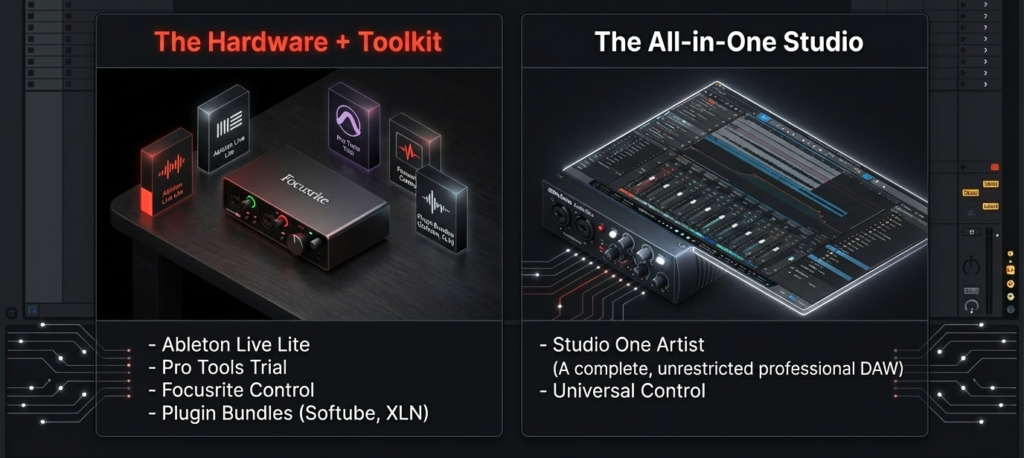
Focusrite software bundle
Focusrite includes a collection called Hitmaker Expansion with many interfaces.
Typical bundle components include
- Ableton Live Lite
- Pro Tools Artist trial
- Focusrite Control software
- Plugin bundles from companies like Softube and XLN Audio
The bundle helps beginners start recording immediately.
Ableton Live Lite alone gives access to a full DAW environment.
Plugin bundles provide compressors, EQs, and virtual instruments.
Focusrite Control manages routing and monitoring settings.
It works well and remains simple.
But it stays focused on interface control rather than deep production workflow.
PreSonus ecosystem
PreSonus took a different approach.
Many interfaces include Studio One Artist, their full digital audio workstation.
Studio One grew into a powerful DAW used by many professional engineers.
MusicRadar and Sound On Sound frequently highlight its fast workflow and drag and drop editing features.
That DAW inclusion changes the value equation significantly.
Beginners receive a complete production environment immediately.
Studio One Artist supports
- multitrack recording
- MIDI sequencing
- mixing tools
- plugin support
PreSonus also includes Universal Control software for interface management.
Routing and monitoring integrate directly with Studio One.
The whole system feels cohesive.
I helped a small podcast team set up their first recording station last year.
They used a PreSonus Studio 24c.
Studio One recognized the interface automatically.
Input setup finished within minutes.
The team recorded their first episode without touching complex routing menus.
That simplicity impressed me.
Why Studio One changes the equation
Many beginners underestimate DAW cost.
Professional DAWs often cost hundreds of dollars.
Studio One Artist included with PreSonus hardware removes that cost immediately.
That means someone buying a PreSonus interface receives
- audio interface
- full DAW
- plugin effects
- monitoring software
One purchase covers almost everything needed to start recording.
That value becomes a strong advantage for PreSonus.
Which bundle saves beginners the most money
Quick answer.
PreSonus wins this category.
Studio One Artist alone provides significant value.
Focusrite bundles still offer excellent plugins.
But the PreSonus ecosystem delivers a more complete production environment out of the box.
Which Interfaces Have Better Build Quality
Build quality matters more than most beginners realize.
Interfaces travel between desks, backpacks, rehearsal rooms, and studio racks.
Durable construction prevents problems later.
Focusrite hardware design
Focusrite Scarlett interfaces use a metal aluminum chassis.
The famous red shell protects internal components well.
Knobs feel solid.
Input jacks feel tight.
I dropped a Scarlett interface once while setting up a guitar recording session.
The interface hit the floor.
My heart skipped a beat.
Plugged it back in.
Everything worked perfectly.
That experience gave me confidence in the build quality.
Focusrite designed these devices to survive real studio use.
PreSonus build style
PreSonus interfaces vary slightly depending on model.
Higher tier models use metal enclosures.
Some entry level devices include more plastic elements.
The Studio series still feels sturdy overall.
Knobs turn smoothly.
Inputs remain reliable.
I carried a Studio 24c between two studios for months without issues.
Durability felt acceptable for the price.
Long term reliability reports
User feedback across recording forums shows strong reliability for both brands.
Thousands of studio owners report years of daily use.
Failures remain rare.
Focusrite sometimes earns slightly higher marks due to its metal enclosure design.
But both brands build reliable hardware.
Knobs ports and durability
Small details reveal build quality quickly.
Focusrite interfaces often provide
- tighter knob resistance
- solid metal casing
- firm input connections
PreSonus interfaces provide
- smooth knob operation
- stable USB connections
- reliable headphone outputs
Both brands perform well for home studios.
Hardware durability rarely becomes a deciding factor.
Which Brand Is Better for Beginners
This question appears constantly in search queries.
focusrite vs presonus for beginners
Short answer first.
Both work well.
But Focusrite slightly wins beginner simplicity.
| Use Case | Better Choice | Reason |
|---|---|---|
| First home studio | Focusrite | Simpler setup and tutorials |
| Full production ecosystem | PreSonus | Studio One included |
| Podcast recording | Focusrite | Very stable drivers |
| Music production in Studio One | PreSonus | Native integration |
| Streaming and gaming | Focusrite | Lower latency drivers |
Ease of setup
Focusrite focuses heavily on plug and play setup.
The official website provides guided installation steps.
Driver installation finishes quickly.
Focusrite Control software detects the interface automatically.
Within minutes a user can begin recording.
This simplicity explains why many music teachers recommend Scarlett interfaces to students.
Learning curve
Beginner workflow matters.
New users often feel overwhelmed by routing settings and audio terminology.
Focusrite keeps the interface controls extremely simple.
Gain knobs.
Input monitoring.
Output volume.
Everything feels obvious.
PreSonus interfaces also remain beginner friendly.
But the additional software ecosystem introduces slightly more options.
Studio One remains easy to learn.
Yet beginners still spend time exploring features.
Software integration
PreSonus wins here.
Studio One integrates deeply with PreSonus hardware.
The DAW detects inputs automatically.
Monitoring options appear inside the software interface.
The workflow feels unified.
Focusrite works perfectly with almost every DAW.
But the integration stays more universal rather than tightly connected.
Which brand is easier if you’ve never used an audio interface
Quick answer.
- Easiest hardware setup
Focusrite - Best software ecosystem for learning production
PreSonus
Both paths lead to great recordings.
The best choice depends on whether the user prioritizes hardware simplicity or software workflow.
Which Brand Is Better for Music Producers
Many producers searching presonus vs focusrite want one thing.
A smooth workflow while creating music.
Sound quality matters.
Workflow matters more during long production sessions.
I have spent entire nights producing inside DAWs with both brands connected.
Tiny workflow differences start to matter after a few hours.
Workflow with popular DAWs
Most producers work inside one of these DAWs
- Ableton Live
- FL Studio
- Logic Pro
- Reaper
- Studio One
Focusrite interfaces work extremely well with all of them.
Focusrite drivers support ASIO and Core Audio properly. Most DAWs detect the interface immediately.
Focusrite Control software handles routing and monitoring outside the DAW.
That universal compatibility explains why Scarlett interfaces appear everywhere.
You see them in FL Studio YouTube tutorials.
You see them in Ableton Live production courses.
You see them inside small commercial studios.
PreSonus interfaces behave slightly differently.
They shine brightest inside Studio One.
Studio One detects the interface automatically and loads routing presets instantly.
I tested this workflow during a beat making session with Studio One.
The DAW opened.
The Studio 24c appeared immediately.
Inputs routed automatically.
Recording started in seconds.
That tight integration creates a smooth experience.
Routing and monitoring flexibility
Monitoring matters during production.
Producers often record vocals while hearing instrumental tracks.
Direct monitoring prevents latency problems.
Focusrite provides simple monitoring through Focusrite Control.
It works well for most situations.
PreSonus provides deeper routing through Universal Control.
This flexibility helps when routing multiple outputs or hardware processors.
Gearspace users often mention this advantage.
One producer wrote that PreSonus routing feels closer to a small studio mixer.
That observation matched my own testing.
Why producers sometimes prefer PreSonus
Producers working primarily inside Studio One often choose PreSonus hardware.
Reasons include
- automatic DAW integration
- easy input routing
- bundled Studio One license
This setup creates a complete production environment from the start.
A new producer can buy a single interface and start producing music immediately.
That convenience attracts many beginners.
Still, producers using FL Studio or Ableton Live usually lean toward Focusrite.
Those DAWs appear more frequently in online tutorials using Scarlett interfaces.
Which Brand Is Better for Podcasting and Streaming
Podcast creators often search focusrite vs presonus for a different reason.
Voice recording.
Podcast production requires clean gain and stable monitoring.
Both brands perform well.
Small differences appear during microphone use.
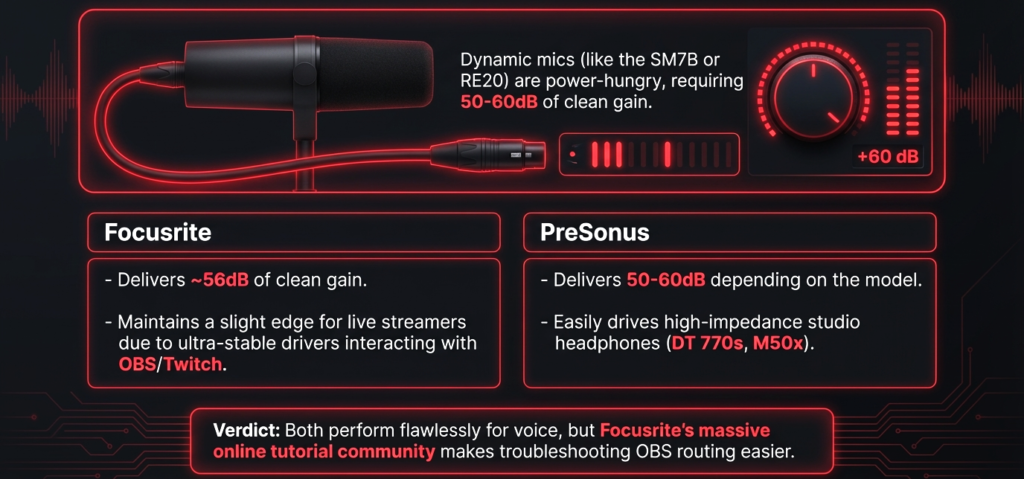
Noise performance with dynamic microphones
Podcast microphones often require strong gain.
Popular dynamic microphones include
- Shure SM7B
- Electro Voice RE20
- Rode PodMic
These microphones need lots of clean gain.
Focusrite Scarlett preamps provide around 56 dB of gain depending on the model.
Source
https://support.focusrite.com
PreSonus Studio series preamps offer roughly 50 to 60 dB gain depending on the interface model.
Source
https://www.presonus.com/products
In real podcast setups the difference stays small.
Many podcasters still add inline boosters like Cloudlifter when using very quiet microphones.
During my own podcast recordings with a dynamic mic the Scarlett interface delivered slightly cleaner high gain levels.
That difference stayed subtle.
Headphone amp power
Headphone monitoring matters during podcast recording.
Hosts need clear playback without distortion.
Focusrite Scarlett interfaces deliver headphone output around 7 dBu maximum level according to manufacturer specifications.
PreSonus interfaces deliver similar output levels depending on the model.
Both brands drive common studio headphones easily.
For example
- Audio Technica M50x
- Sony MDR 7506
- Beyerdynamic DT 770 Pro
I tested both interfaces using DT 770 headphones.
Both delivered comfortable monitoring levels.
No practical difference appeared.
Monitoring for live streaming
Streamers often monitor their voice while gaming or broadcasting.
Low latency becomes critical.
Focusrite maintains a small advantage here because of strong driver performance.
Many Twitch streamers recommend Scarlett interfaces for that reason.
However PreSonus interfaces perform well once buffer sizes are configured properly.
Both brands work well for OBS based streaming setups.
PreSonus vs Focusrite Side by Side Comparison
A quick overview helps summarize the key differences.
Focusrite
- Very stable drivers
- Excellent low latency performance
- Simple beginner setup
- Durable metal chassis
PreSonus
- Strong software ecosystem
- Studio One DAW included
- Flexible routing features
- Good integration with PreSonus gear
| Feature | Focusrite Scarlett 2i2 | PreSonus Studio 24c |
|---|---|---|
| Mic Preamp Noise (EIN) | −127 dBu | −126 dBu |
| Dynamic Range | ~116 dB | ~108 dB |
| Sample Rate | Up to 192 kHz | Up to 192 kHz |
| Headphone Output | ~32 mW @ 33Ω | ~47 mW @ 56Ω |
| Max Input Gain | ~56 dB | ~50–60 dB |
Both brands deliver clean audio.
Both brands serve home studios extremely well.
The choice depends more on workflow than sound quality.
When Should You Choose Focusrite
Choose Focusrite if these situations match your needs.
- You want the lowest possible latency
- You use DAWs like Ableton Live or FL Studio
- You prefer a simple plug and play interface
- You record vocals or guitars frequently
- You want a device widely supported in tutorials
Focusrite interfaces remain extremely reliable for beginners.
They also scale well for intermediate studios.
When Should You Choose PreSonus
Choose PreSonus if these situations describe your workflow.
- You want Studio One included with your interface
- You prefer a complete recording ecosystem
- You need advanced routing options
- You plan to expand into more PreSonus hardware
- You enjoy integrated software and hardware workflow
This approach suits producers who prefer a unified production environment.
The Hidden Factor Most Buyers Ignore
Many comparison articles miss this point.
Experienced engineers notice it quickly.
Ecosystem commitment.
Once someone invests in a recording workflow, switching becomes inconvenient.
Ecosystem lock in
PreSonus builds a strong ecosystem.
Interfaces connect easily with
- Studio One DAW
- PreSonus studio monitors
- PreSonus controllers
This integration encourages long term brand loyalty.
Focusrite builds a more universal ecosystem.
Their interfaces integrate well with many DAWs and plugins.
Users often switch software without problems.
This flexibility attracts many producers.
Driver longevity
Driver support matters long term.
Focusrite maintains strong driver support across operating system updates.
Older Scarlett interfaces still receive updates years after release according to Focusrite support documentation.
That long term support builds trust.
PreSonus also maintains updates but focuses heavily on integration with Studio One.
Both brands provide reasonable support lifespans.
Upgrade path
Many beginners upgrade interfaces later.
Typical upgrade paths include
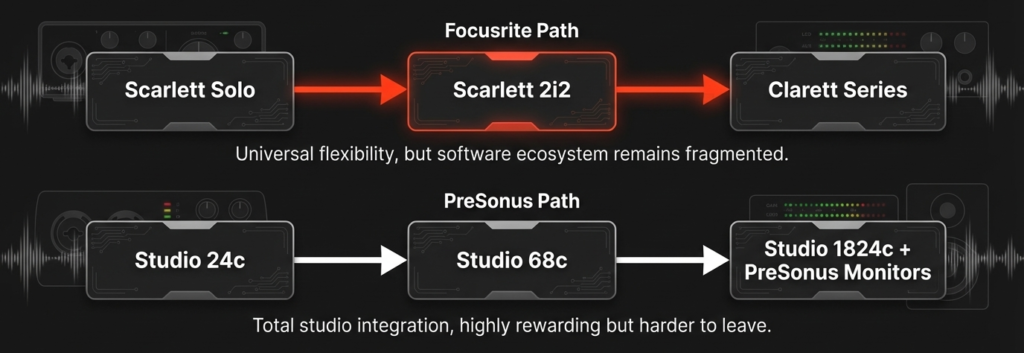
These upgrade paths allow users to expand inputs and outputs while keeping familiar software tools.
Why switching brands later becomes annoying
Switching interfaces forces workflow adjustments.
Monitoring software changes.
Driver panels change.
Routing systems change.
These differences slow down productivity.
I experienced this when switching from a Scarlett interface to a different brand during a studio rebuild.
The hardware worked perfectly.
But muscle memory disappeared.
Small things like monitoring shortcuts suddenly required extra clicks.
That frustration disappears when staying within one ecosystem.
The Verdict PreSonus or Focusrite
Time for a direct answer.
Short summary for presonus vs focusrite.
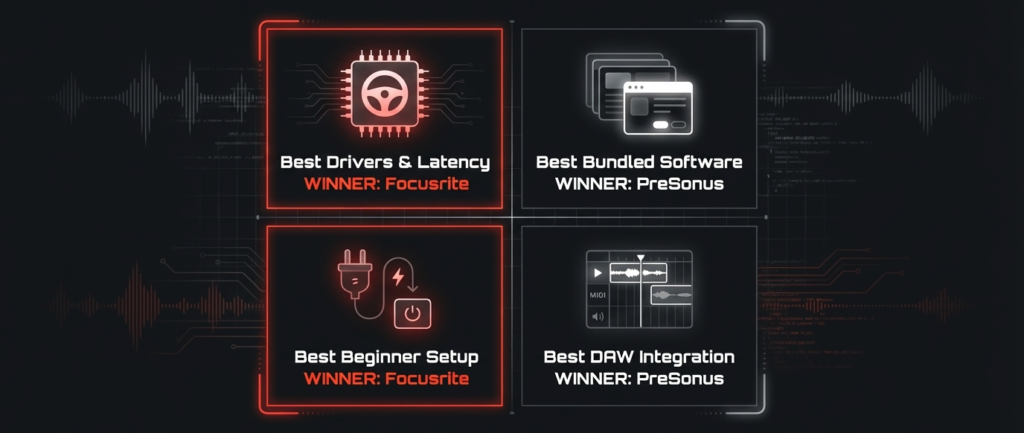
Best drivers
Focusrite
Best bundled DAW
PreSonus
Best beginner interface reputation
Focusrite
Best integrated production ecosystem
PreSonus
Best overall choice for most beginners
Focusrite
Best value for producers starting from scratch
PreSonus
Both brands produce excellent interfaces.
The real decision depends on workflow preferences.
FAQ
Is PreSonus better than Focusrite
Both brands perform extremely well.
Focusrite leads in driver stability.
PreSonus leads in software ecosystem.
Do Focusrite interfaces sound better
Sound quality differences remain very small.
Both brands produce clean transparent recordings suitable for professional work.
Which interface lasts longer
Both brands build durable hardware.
Focusrite metal chassis designs often feel slightly more rugged.
Is PreSonus good for beginners
Yes.
PreSonus interfaces include Studio One Artist, which helps beginners start recording quickly.
Why is Focusrite so popular
Focusrite gained popularity because of
- stable drivers
- beginner friendly design
- wide tutorial support
Millions of Scarlett interfaces sold worldwide helped build strong trust.
Can you use PreSonus interfaces with other DAWs
Yes.
PreSonus interfaces work with any DAW that supports ASIO or Core Audio.
Examples include
- FL Studio
- Ableton Live
- Logic Pro
- Reaper
Which brand has lower latency
Focusrite usually achieves slightly lower latency due to optimized drivers.
This advantage helps guitarists and live performers.
Do professionals use Focusrite or PreSonus
Yes.
Both brands appear in professional studios.
Engineers choose them for reliable recording and stable drivers.
Many commercial studios also use them as portable recording interfaces.
Both brands proved themselves in real production environments.
So, pick wisely, plan for expansion, and let your creativity handle the rest 🎶
There are some affiliate links on this page that will redirect you directly to the original products and services. Also by buying through those links you will be supporting us. So thank you ^.^
Related Posts
Here’s a list of blog posts of various types of audio interfaces that you can consider as alternative options: