Every week, thousands of students type “podcast topics for students” into Google — not because they’re out of ideas, but because they don’t know what actually works.
Here’s the truth: you don’t need fancy gear or a huge following to start a podcast that people listen to. You just need the right idea. And that’s exactly what you’ll get here.
In this post, I’ll help you:
✅ Find relatable podcast topics made for students (not generic “talk about motivation” junk)
✅ Pick a niche that fits your personality and schedule
✅ See real examples of student podcasts that went viral from dorm rooms
Let’s start with a wild fact: 62% of Gen Z now listens to podcasts weekly, and more than half of them say they’d rather hear “real stories from students” than “influencers” (source: Edison Research). That’s your opportunity — right now.
When I started my first podcast, I had zero listeners, an old phone, and an echoey dorm room. But one episode — “How I Survived Finals Week Without Coffee” — blew up on campus. Why? Because it was real. It was something every student felt but never said out loud.
So if you’re wondering “what should my student podcast be about?” or “will anyone even listen?” — stay with me.
Why Should Students Even Start a Podcast in the First Place?
A podcast isn’t just a hobby anymore.
It’s a modern portfolio that shows initiative, creativity, and leadership.
Employers now look for students who can communicate and manage projects, and hosting a podcast checks both boxes.
It also sharpens your voice.
When I began my first student podcast, I could barely talk for two minutes without stumbling.
But by episode ten, I was recording in one take.
That’s how fast you grow when you commit to speaking regularly.
It’s also incredibly fun.
You get to share your thoughts, frustrations, and daily wins while building a community around your ideas.
And here’s the big one: the world is listening.
According to Edison Research (2024), 62% of Gen Z listen to podcasts weekly, and most prefer student or independent creators over mainstream shows.
That’s proof students aren’t just making podcasts they’re shaping the podcasting future.
Did You Know?
According to Spotify for Podcasters (2024), over 30% of the fastest-growing new shows are hosted by students or recent graduates. That means the “college podcast wave” is one of the most dominant new voices online right now!
Yes, a student podcast can absolutely get listeners.
People love authentic voices, not perfect production.
One of my favorite examples is Dorm Room Diaries.
Two roommates recorded honest conversations about campus stress and messy dorm life with basic USB mics.
Within a few months, they were averaging thousands of plays per episode.
Why?
Because listeners connected with their honesty.
Consistency and clarity matter more than expensive gear.
How to Pick a Podcast Topic That Fits You
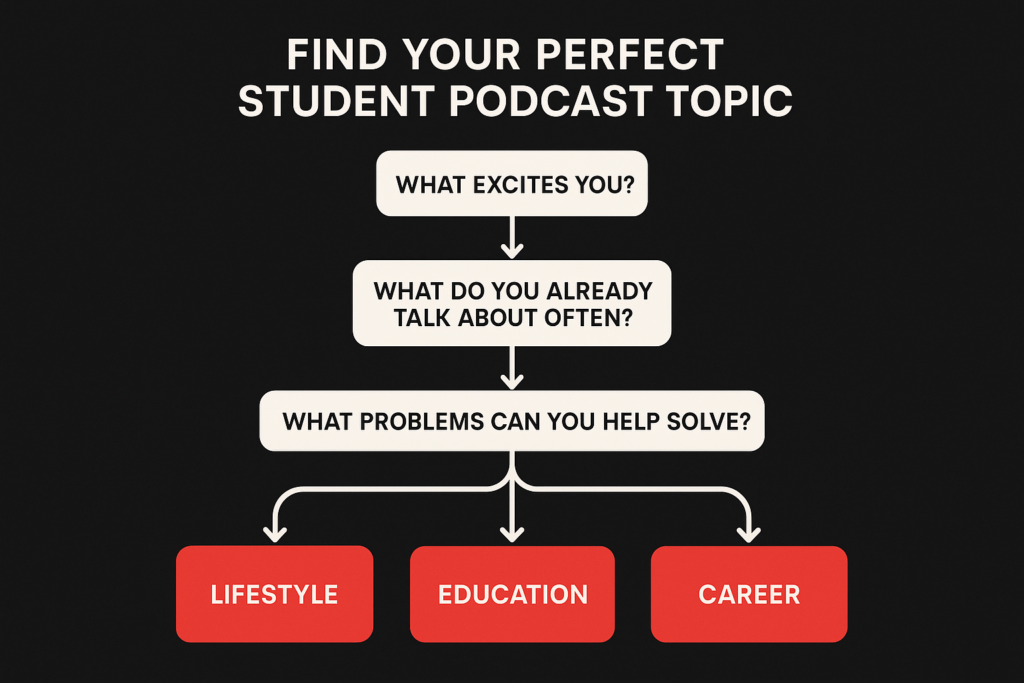
Finding your topic starts with self-awareness.
Ask yourself three simple questions.
What do I love talking about, even if no one’s listening?
What do my friends always come to me for advice about?
And what’s something unique about my campus or lifestyle that others would find interesting?
When I answered these for myself, I realized my passion wasn’t “tech” in general—it was how students use affordable gear to sound professional.
That small shift completely changed my podcast direction.
Don’t chase trends.
Chase what you’d talk about even after a long day of classes.
That’s your real topic.
Avoid broad, generic ideas.
Go micro-niche instead.
Instead of a show about “student life,” focus on “engineering students surviving finals week.”
Instead of “mental health,” go for “how architecture students handle design stress.”
Specific stories attract real engagement.
The smaller your niche, the faster you grow, because you’ll connect deeply with one group instead of half-heartedly with everyone.
Before locking in your topic, record a 2-minute test episode.
If you sound genuinely excited, that’s your sign to go for it.
If you’re forcing energy, change direction.
Your tone never lies.
| Topic Type | Lifespan (How Long It Stays Relevant) | Why It Works / Fails |
|---|---|---|
| Trends & Hot Topics | 1–3 months | Quick traffic, but fades fast |
| Educational & Skill-Based | 1–3 years | Timeless and SEO-friendly |
| Personal Stories | 6–12 months | Emotional connection but needs freshness |
| Interview Series | 1–2 years | Evergreen if guest insights age well |
| Comedy & Lifestyle | Ongoing | Works if humor stays relatable |
What Are the Best Podcast Topics for Students?
These student podcast topics work because they’re relevant, personal, and easy to sustain long-term.
Educational Yet Fun Topics
- “How I Passed My Exams Without Losing My Mind” – Mix humor and real strategies. Share fails too; it builds trust.
- “The Science Behind Procrastination” – Use psychology research. Harvard Business Review found that 88% of students procrastinate not due to laziness but due to emotional regulation.
- “Study Hacks That Actually Work (Tested by Real Students)” – Try methods like Pomodoro, Focusmate, and summarize results.
- “AI Tools I Use Daily as a Student” – Talk about ChatGPT, Notion AI, and how they genuinely help (or hurt) productivity.
Lifestyle & Campus Life Topics
- “Dorm Room Confessions” – Real stories from your dorm. The fun, the awkward, the lessons.
- “Budget Living as a Broke Student” – Discuss cheap recipes, hacks, and side hustles that actually pay.
- “Dating and Drama on Campus” – Keep it light, honest, and respectful. Listeners love relatable chaos.
- “The Real Freshman Experience (No Filter)” – Perfect for first-year students who crave real talk.
Career & Self-Improvement Topics
- “Finding Internships That Don’t Suck” – Share experiences, good and bad. Link advice to real platforms like Handshake or LinkedIn.
- “Student Entrepreneurs: How I Started My Side Hustle” – Use your own story or interview friends. Forbes (2024) reports that 39% of Gen Z students already run or plan to start a side business.
- “The Reality of Switching Majors” – Honest, under-discussed, and relatable.
- “My Journey from Student to Creator” – A behind-the-scenes look at personal growth through podcasting itself.
Creative & Niche Ideas
- “Campus Myths and Conspiracy Theories” – Great for entertainment; research local legends.
- “Professors Say the Wildest Things” – Keep it anonymous and funny.
- “Life After 2 A.M. (Late Night Thoughts)” – Deep, reflective, raw. Works beautifully as short solo episodes.
- “Movie Soundtracks That Deserve More Credit” – Blend culture, creativity, and student passion.
| Category | Ideal For | Example Episode Idea | Difficulty Level |
|---|---|---|---|
| Study Tips & Productivity | College & high school students | “How to Beat Procrastination Before Finals” | Easy |
| Mental Health & Motivation | Any student | “Why I Stopped Comparing My Grades” | Medium |
| Career & College Life | University seniors | “Internship Horror Stories & Lessons” | Medium |
| Pop Culture & Student Life | All students | “Campus Gossip That Made Headlines” | Easy |
| Science & Curiosity | STEM students | “AI Explained in 10 Minutes” | Hard |
Expert Note:
Podcast strategist Tom Webster once said,
“The podcasts that win are the ones that sound like a friend talking, not a lecture.”
This applies perfectly to students. Speak casually. Keep it raw. Your personality is your brand.
🎧 “In podcasting, your voice is your fingerprint. Don’t try to sound like anyone else—sound like yourself.”
— Sarah Ellis, Podcast Growth Coach, 2024
What Makes a Student Podcast Stand Out From the Crowd?
Listeners forgive bad audio.
They don’t forgive fake energy.
Authenticity beats polish every single time.
A quiet dorm or cafeteria echo won’t ruin your podcast if your story is engaging.
But reading a lifeless script will.
Perfection isn’t the goal—connection is.
One of my early episodes had background noise from a campus lawn mower, but it became my most streamed episode because people loved the raw feel.
Consistency matters too.
Publishing once a week is enough if you stick to it.
Think of it like building a muscle.
Every upload strengthens your audience’s trust.
I’ve seen students with ten loyal listeners grow to hundreds in a semester because they showed up every week.
Use social media wisely.
Short, casual clips on TikTok or Instagram get more engagement than full trailers.
Behind-the-scenes photos or “how I record in my dorm” posts show relatability.
That’s what spreads.
Don’t forget sound design.
Add light background music or subtle ambient sounds from your campus.
When I started recording, I often captured quiet moments before lectures—those sounds became my signature style.
Little things like that make your podcast feel alive.
Real Student Podcast Examples That Worked
“Dorm Room Diaries” tells true campus stories with unfiltered honesty.
Their success came from natural humor, not high-end editing.
“STEM Sessions” breaks down complex topics into simple, digestible conversations.
Its creator started with zero audience but grew by explaining what classmates were too afraid to ask in lectures.
“The Broke Student’s Guide” uses humor and personal finance hacks that students instantly share.
The host’s casual tone makes financial talk approachable.
“The Internship Chronicles” documents every awkward, funny, or valuable moment during internship experiences.
Listeners come back because they see their own journey mirrored.
All of these shows work because they focused on one strong idea and told stories around it.
They didn’t act like experts.
They acted like curious students learning in public—and that’s what listeners love most.
How to Start Your Student Podcast Without Expensive Gear
You don’t need a studio to start.
When I recorded my first episode, I used my phone mic, a blanket over my head, and Audacity for editing.
It worked.
Focus on clarity, not cost.
Start small and upgrade only when needed.
Essential tools for beginners
Mic: Hollyland Lark M2. Compact, reliable, and budget-friendly.
Platform: Spotify for Podcasters. Free, beginner-proof, and analytics-ready.
Editing Software: Audacity or CapCut. Simple tools that let you polish quickly.
3-step fast start guide
Step 1: Pick your topic and name. Keep it short and searchable.
Step 2: Record your first episode. Publish it, even if it feels rough. Improvement follows action.
Step 3: Share it. Ask friends to post it in group chats or class pages. Word of mouth is still powerful.
Your first listener could be yourself.
Your tenth could be a future employer.
Start today, stay consistent, and let the learning curve work for you.

Common Mistakes Student Podcasters Make (and How to Avoid Them)
Every new student podcaster makes mistakes. I did too.
The key is not to avoid them all but to learn fast and adjust. Here’s what usually holds beginners back and how you can skip those roadblocks right away.
Talking About Everything at Once
The biggest mistake I made was trying to cover too many topics. One day I’d talk about productivity, the next about movies.
My audience got confused. Focus on one clear theme and build your content around it.
Niche podcasts grow faster because they attract loyal listeners who know exactly what to expect.
Skipping Editing
Raw audio is fine if it’s clean, but cutting out dead air and repetitive phrases improves flow dramatically.
I use Audacity for quick trims. It takes me 10 minutes and instantly makes the episode sound professional.
A study by Podchaser Insights (2024) found that podcasts with basic editing had 32% higher listener retention than those uploaded raw.
Ignoring SEO and Show Notes
Search engines also listen to podcasts now. Platforms like Spotify and Apple index titles, descriptions, and transcripts.
Write detailed show notes with relevant keywords like “student podcast ideas” or “how to start a college podcast”.
This tiny step boosts discovery and helps you appear in AI summaries too.
Not Asking for Feedback
Your audience knows what works. I learned this the hard way when my downloads dipped for two months.
After running a simple Google Form survey, I realized people wanted shorter episodes. Always ask!
Poll your listeners or drop a question box on Instagram. Feedback keeps your podcast evolving.
Quitting Too Early
Most podcasts fade after 6 episodes, according to Buzzsprout (2024). It takes time to find your rhythm.
Treat the first 10 episodes as practice. Don’t chase perfection, chase progress.
I promise your tenth episode will sound 5x better than your first.
| Mistake | Impact | Quick Fix |
|---|---|---|
| Copying existing shows | Sounds generic | Add your personal experience |
| Poor audio quality | Low retention | Use a mic like Hollyland Lark M2 |
| No structure | Hard to follow | Create bullet-point outlines |
| Ignoring audience feedback | Missed growth | Ask for reviews and comments |
| Inconsistent uploads | Lost listeners | Set a realistic posting schedule |
How to Keep Your Podcast Alive During Exams or Busy Weeks
Staying consistent is tough when assignments and deadlines pile up. But it’s doable with smart planning.
Batch Record When You’re Free
I record 3–4 episodes in one sitting before exams start. It saves time and lets me focus fully on studies later.
Schedule releases in advance using Spotify for Podcasters or Podbean. It’s one of the simplest hacks to stay active without stress.
Bring in Co-hosts or Guests
If you’re busy, invite friends or classmates to share stories. They add variety and take off some workload.
Listeners enjoy different perspectives, and you get a break from solo recording.
Use AI Tools to Speed Up Workflows
AI helps more than people realize. I use ChatGPT for brainstorming scripts, Descript for quick edits, and CapCut for social clips.
It cuts my production time by half. Even NPR Training recommends using AI tools to assist editing, not replace creativity.
Keep It Short and Sustainable
Long episodes drain both you and your listeners. During exams, switch to 10–15 minute mini-episodes.
I’ve found shorter ones get more complete listens, according to my Spotify analytics.
The goal is consistency, not length.
Repurpose Content
Turn your old episodes into highlight reels or quick recaps. Reusing content is smart, not lazy.
It helps you stay visible even during hectic months.

FAQs: Podcast Topics for Students
What are the easiest podcast topics for students?
Start with something you live daily. Study hacks, campus stories, and tech tools are easiest because you already know them.
You don’t need research, just your voice and experience.
Do I need professional gear to start a student podcast?
No. Even a smartphone mic works if you record in a quiet room.
The Hollyland Lark M2 or BOYA BY-M1 are good budget upgrades when you’re ready.
I began with a phone, and listeners still cared more about my honesty than my audio quality.
How long should each episode be?
Between 10 to 20 minutes is perfect for student attention spans.
Spotify Data (2024) shows that episodes under 25 minutes have 40% higher completion rates among Gen Z listeners.
Can I make money from a student podcast?
Yes, but not instantly. Once you have consistent listeners, try affiliate links, sponsorships, or even custom merch.
I started earning through small affiliate partnerships after episode 20. Focus on building trust first, money later.
How do I stay motivated when no one listens?
Every podcaster starts with zero. Record for yourself first.
I remember celebrating my first 10 downloads like it was 10,000. Growth is exponential once you improve your storytelling and stay consistent.
Final Thoughts
Podcasting as a student isn’t just creative fun—it’s a career-building skill.
It teaches storytelling, branding, and communication while letting you share your world authentically.
I’ve met students who turned their shows into media portfolios that landed them jobs in marketing, journalism, and entertainment.
If there’s one thing I’ve learned, it’s this: your story matters more than your setup.
Speak honestly, learn fast, and keep going even when it feels slow.
People crave real voices. Yours could be the one they’ve been waiting to hear! 🎧
Podcasting is a different game, and without a precise blueprint, the game will get tougher midway. Grow your podcast from scratch with Zero Audience and learn about how successful podcasters cracked the code by winning our Free Guide with step by step Guidelines.
Get your complete podcast equipment setup by visiting Podcast Equipment Bundle. Don’t let the side projects kill your time. Get in touch with podcasting services and experts those will save you tons of time at Podcast Production Services.
With that being said, Let’s connect with all such free and paid tool/services you might need knowingly or unknowingly to fuel your growth. Here’s 21 BEST AI TOOLS AND PLATFORMS TO GROW YOUR PODCAST AND CONTENTS. There are some bonus tools in the end too to make your day to day life easier.
There are some affiliate links on this page that will redirect you directly to the original products and services. Also by buying through those links you will be supporting us. So thank you ^.^
Related Posts
Here is the list of blog posts related to podcast questions on different topics:
- Good Podcast Questions About Relationships to Ask
- Funny and Interesting Podcast Questions for Friends
- Best Business Podcast Interview Questions to Ask
- Podcast Questions: Guide on How to Interview
- Funny Podcast Questions: Make Your Listeners Laugh Out Loud
- Is it worth starting a podcast in 2025?
- How to do Podcasting with Iphone
- How to Start a Sports Podcast in 2025: The Beginners Guide
- How to Start a True Crime Podcast in 2025: Full Guide