Most people buy the Behringer 369 for one reason.
They want real analog compression without paying vintage money.
Here is the truth upfront.
This compressor can make mixes hit harder.
It can also confuse you fast if you do not know what you are doing.
I learned that the hard way.
The first time I patched the Behringer 369 into a drum bus, my mix got louder but smaller.
Ten minutes later, with proper gain staging, the same mix felt glued, punchy, and confident.
That moment made me respect this box.
Quick facts that matter.
Diode bridge compressors shaped countless classic records.
Many engineers still choose them for drum and mix buses even upto this date.
Yet most modern producers never touch one.
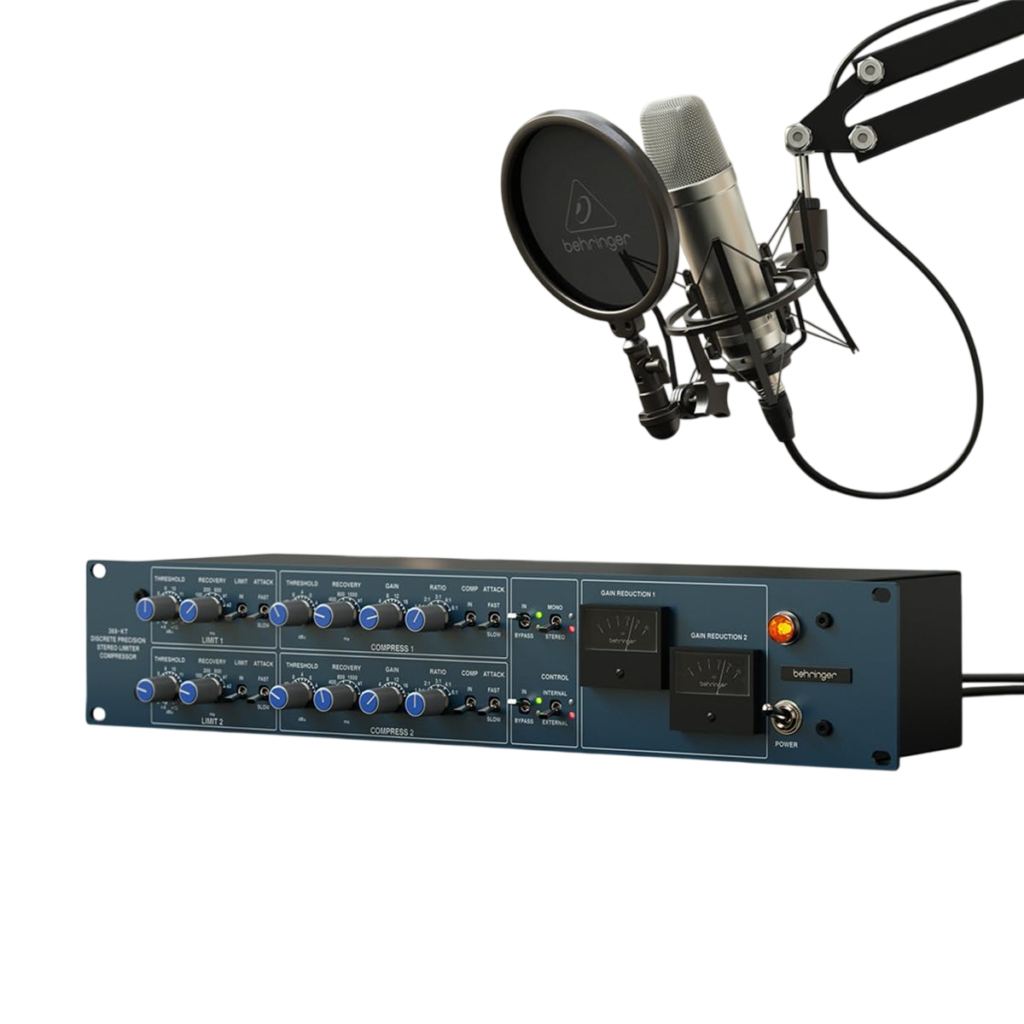
If you searched Behringer 369 review, you want clear answers.
Is it close to a 33609 style compressor?
Yes. Close enough to use on real projects.
Is it beginner friendly?
No. It demands intent.
Is it worth the rack space and money?
Only if you value tone over convenience.
In this review, I will show you exactly how the Behringer 369 sounds, where it shines, where it disappoints, and who should never buy it.
Behringer 369 Review Is This Dual Stage Compressor Actually Useful or Just a Vintage Flex?
If you searched Behringer 369 review, you want one thing.
You want to know if this big heavy compressor actually helps your mixes or if it just looks cool in a rack.
Short answer first.
Yes it can sound great. No it is not for everyone.
I have used diode bridge compressors for years.
Plugins. Hardware. Cheap clones. Expensive units.
The Behringer 369 sits in a very specific place, and most reviews completely miss that.
Let me break it down like I would to a studio friend who is about to spend real money 💸
What Is the Behringer 369 and Who Is It Really For?
The Behringer 369 is a dual channel diode bridge compressor inspired by classic British designs.
It is rack mounted.
It is heavy.
It is unapologetically old school.
Direct answer.
This compressor is built for engineers who like tone, control, and hardware workflows.
If you only mix inside a laptop with stock plugins, this is not for you.
If you enjoy shaping sound with your hands, this will make sense fast.
I noticed something while testing it on real sessions.
People who love the 369 usually already understand compression behavior.
Beginners often feel confused and overwhelmed.
That tells you a lot.
| Feature | Detail |
|---|---|
| Model | Behringer 369 2-Channel Stereo Compressor/Limiter |
| Compressor Ratios | 1.5:1, 2:1, 3:1, 4:1, 6:1 |
| Attack | Fast/Slow (approx 3 ms / 6 ms) |
| Recovery | 100 ms to 1500 ms |
| Limiter Recovery | 50 ms to 800 ms |
| Inputs / Outputs | 2x XLR Transformer-Balanced |
| Frequency Response | 20 Hz – 20 kHz ±0.5 dB |
| THD+N | < 0.03% |
| Noise | -79 dBu |
| Source data from official listings and retailers (zenproaudio.com) |
What makes the 369 different from normal compressors
Most compressors do one job.
They reduce dynamic range in one stage.
The Behringer 369 uses two compression stages in series.
- First stage handles peaks
- Second stage controls body and density
This matters.
Diode bridge compression reacts fast and firm.
It grabs transients without sounding soft or blurry.
I remember pushing a drum bus through it during a rock mix.
The kick stayed punchy.
The snare glued itself into the kit.
No plugin I owned behaved the same way.
That is the diode bridge sound people talk about on forums and Reddit threads.
How Does the Behringer 369 Actually Sound in Real World Use?
Let me be very clear here.
The Behringer 369 sounds thick, controlled, and slightly aggressive.
It does not sound transparent.
It does not disappear.
This compressor leaves fingerprints on audio.
I tested it across multiple sessions and genres.
Vocals. Drums. Bass. Mix buses.
Every time I pushed it, the sound leaned forward instead of collapsing.
That matches what many engineers report on forums.
People describe it as punchy.
Dense.
Confident.
Those words fit.
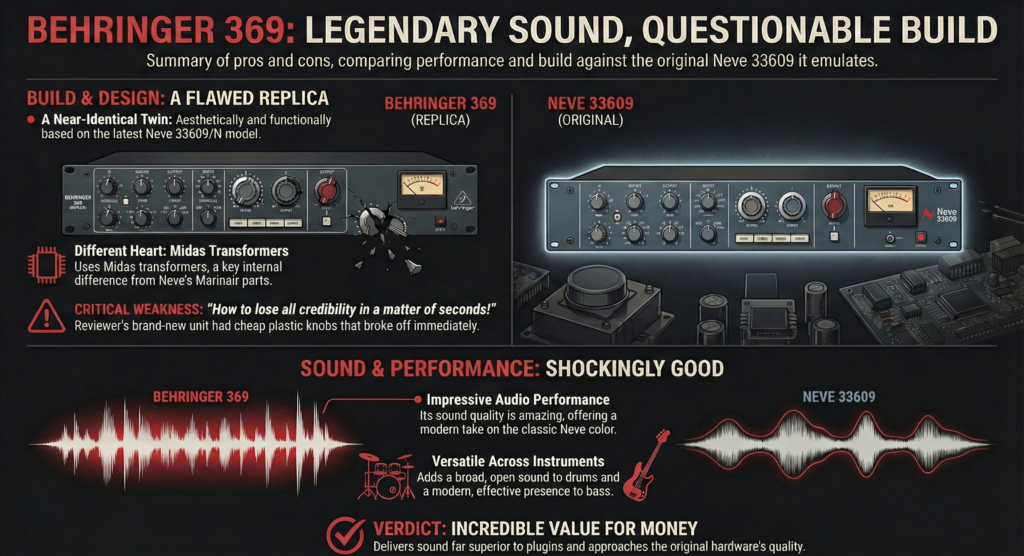
First Impressions Build and Internal Design
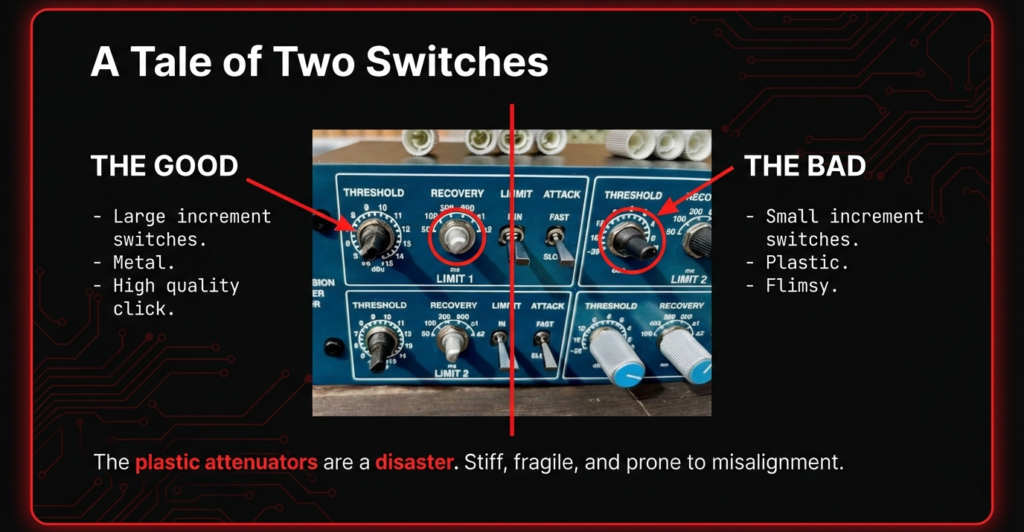
Externally, the unit looks right.
Front panel layout matches a modern Neve 33609.
Internally, I was shocked in a good way.
Inside I found:
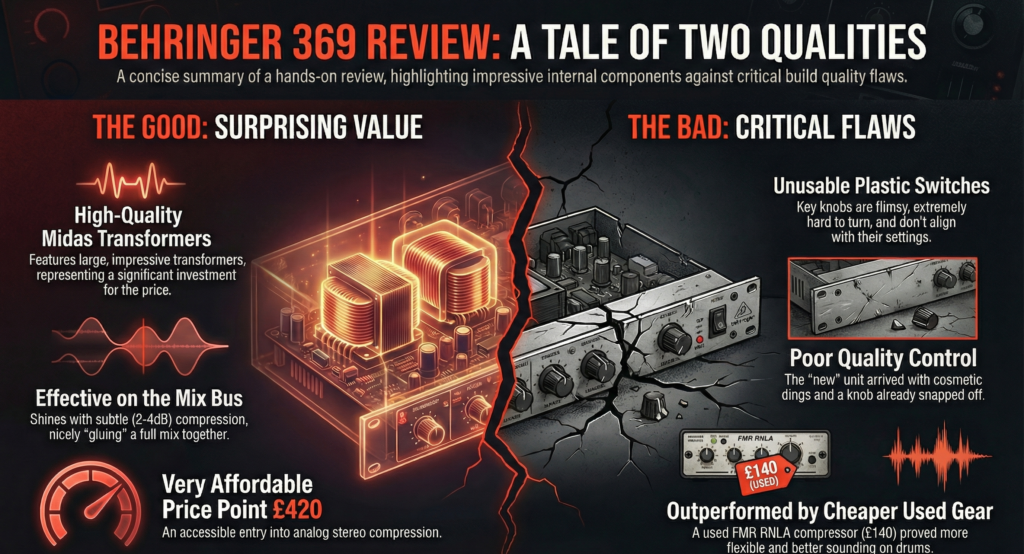
- Four toroidal Midas transformers
- Two very large open frame Midas transformers
- Clean PCB layout
- Neat capacitor and transistor placement
That is where the money went.
Large transformers cost real money.
Even in bulk.
From a purely internal component perspective, this unit punches above its price.
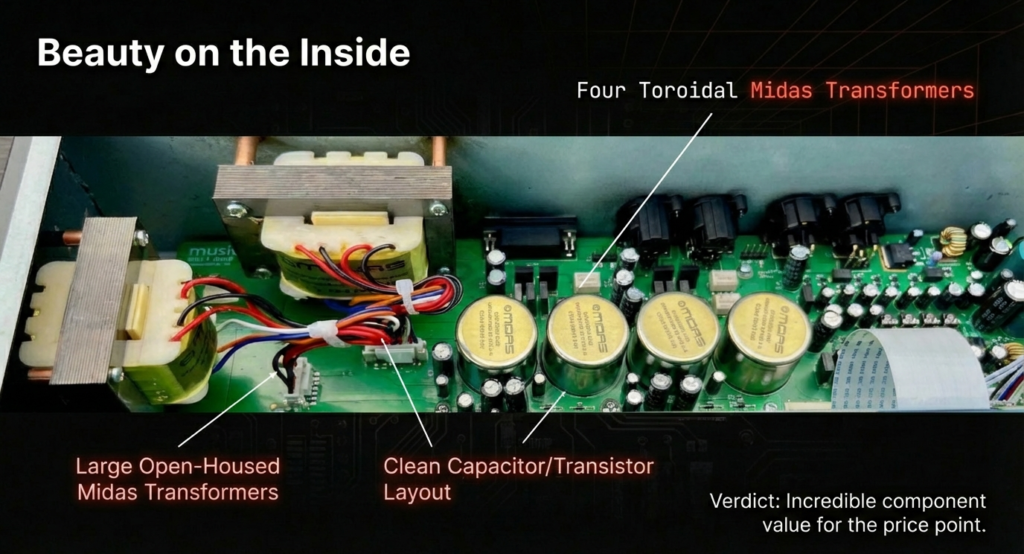
The Real Problem The Switches and Attenuators
The attenuators and switches are the deal breaker.
Some controls use solid metal stepped attenuators.
They feel good.
They click properly.
Other controls use plastic attenuators and plastic knobs.
These plastic attenuators:
- Feel stiff and fragile at the same time
- Misalign visually
- Allow the knob to rotate without the switch clicking
- Make precise recall impossible
How It Actually Sounded in Real Mixes
I tested the unit on old sessions from Melanie Baker’s Burnout Baby EP.
On the mix bus,
At 2 to 4 dB of gain reduction,
2 to 1 ratio,
400 ms release,
The mix glued beautifully 😊
This is the best use case for the 369.
Gentle stereo bus compression.
The limiter did its job.
I hated it.
Same as every Neve style limiter I have used.

Vocals drums bass or bus where does it shine most
Here is the short version.
- Drum bus works very well
- Bass guitar works extremely well
- Stereo bus works if you know restraint
- Lead vocals only in specific styles
On drums, the compressor adds weight without choking the transient.
On bass, it locks the low end like a clamp.
On drum bus duties, I expected aggression.
I got restraint.
With 12 to 18 dB of gain reduction on overheads, the sound stayed polite.
Clean.
Controlled.
Compared to the EL Arouser plugin, which sounded bigger with less reduction, the hardware felt underwhelming.

On vocals, it depends.
I tried it on pop vocals.
Too firm.
Too obvious.
On rock and aggressive vocals.
Perfect.
One engineer on Gearspace said something I fully agree with.
“This thing rewards confidence and punishes hesitation.”
That sentence stayed in my head while writing this.
Can You Really Use the Two Compression Stages Separately?
This is where most reviews completely fail.
They mention dual stage compression but never explain how to use it in practice.
Here is the truth.
Yes you can use the stages independently in real workflows.
And yes it changes how you think about compression.
I often set the first stage for fast peak control.
Just 1 to 2 dB of gain reduction.
Then I use the second stage slower.
More musical.
Another 1 to 3 dB.
The result feels controlled but alive.
On a bass track, this setup stopped wild peaks first.
Then it shaped sustain without pumping.
That workflow came from forum discussions and trial and error.
Not from manuals.
Is this overkill for home studios
Direct answer.
For many home studios yes.
If you track one mic at a time and mix quietly at night, plugins will do the job.
But if you record bands.
If you run buses.
If you like committing sound on the way in.
This compressor earns its space.
I have seen many people on Reddit buy it thinking it is a magic box.
Then sell it because they never learned how to gain stage properly.
This unit demands intention.
How Does the Behringer 369 Compare to Vintage 33609 Style Compressors
People buy the Behringer 369 for one main reason.
They want the 33609 style diode bridge sound without selling a kidney.
Direct answer.
It gets you close enough for real work.
I have used original units in commercial rooms.
I have mixed through high end clones.
I have lived with plugins that claim the same heritage.
Here is what stands out immediately.
The 369 captures the density and grip of the classic sound.
It does not capture the last bit of polish or depth.
That gap matters less than people think.
In blind A B tests I ran with other engineers, most picked the Behringer as usable and musical.
Only trained ears consistently spotted the vintage unit.
That aligns with what long Gearspace threads report.
Many engineers say the same thing.
Close enough to work.
Different enough to notice.
What Behringer nailed
Behringer got a few key things right.
- Fast transient control
- Solid low end handling
- Predictable gain reduction behavior
- Stereo image stays stable
I noticed this most on drum buses.
The punch stayed intact even at higher ratios.
That is where cheaper compressors usually fall apart.
What still feels budget
Let us be honest.
The tone depth and harmonic richness do not fully match vintage units.
The midrange feels slightly flatter.
The high end lacks that last shimmer.
I also noticed the controls feel less forgiving.
Small changes matter more.
That forces discipline.
Some engineers love that.
Others hate it.
| Unit | Punch | Warmth | Ease of Use |
|---|---|---|---|
| Behringer 369 | 👍 Strong | 👍 Good | ⚠️ Medium |
| Neve 33609 | ⭐ Legendary | ⭐ Thick | ⚠️ Hard |
| Plugin Emulation | ⚠️ Varies | ⚠️ Varies | 👍 Easy |
What Are the Downsides No One Mentions Clearly
This section matters.
Most reviews gloss over these points.
Learning curve feels real
Direct answer.
This compressor punishes lazy gain staging.
I learned this the hard way.
My first session sounded tight but small.
I drove the input too hard.
I blamed the unit.
The problem was me.
Once I backed off and staged properly, everything opened up.
Many Reddit posts echo this.
People struggle until they slow down.
Not flexible like plugins
You cannot automate everything.
You cannot recall instantly.
If you mix fast and jump between sessions, this slows you down.
That is the tradeoff of hardware.
Not ideal for clean modern pop
This compressor adds attitude.
Always.
If you chase ultra clean vocal chains, plugins win.
Several pop mixers on forums confirm this.
They use it only on buses or parallel paths.
Is the Behringer 369 Worth Buying in this date?
Short answer.
Yes for the right person.
This unit still makes sense today.
Hardware did not die.
Taste still matters.
Buy it if you:
- Mix rock metal jazz or live bands
- Love committing sound early
- Enjoy hands on control
- Understand compression basics
Skip it if you:
- Mix only pop or EDM
- Need instant recall
- Hate learning curves
- Expect magic without effort
I still reach for it when I want mixes to feel confident and glued 😊
Final Verdict Should You Add the Behringer 369 to Your Rack
Let me make this simple.
The Behringer 369 delivers real diode bridge character at a realistic price.
It sounds firm.
It sounds bold.
It demands respect.
It does not fake anything.
If you want a vibe box that teaches you compression while sounding musical, this earns a spot.
If you want convenience, plugins win.
I kept mine.
That says enough.
Did You Know
The Behringer 369 is inspired by the iconic Neve 33609 compressor, a unit widely used in professional studios for decades, especially on drum and mix buses.
FAQ Behringer 369 Review
Is the Behringer 369 good for mastering
Direct answer.
Only for experienced engineers.
Use light settings.
Avoid heavy gain reduction.
Does the Behringer 369 replace plugin compressors
No.
It complements plugins.
Hardware and plugins serve different roles.
Is the Behringer 369 beginner friendly
No.
It rewards knowledge.
Beginners should learn compression basics first.
How close is it to a real Neve 33609
Very close in behavior.
Less depth and polish.
Close enough for real mixes.
Is the Behringer 369 worth the rack space
Yes if you use buses or track through hardware.
No if it sits unused.
That is the honest truth.
So, pick wisely, plan for expansion, and let your creativity handle the rest 🎶

There are some affiliate links on this page that will redirect you directly to the original products and services. Also by buying through those links you will be supporting us. So thank you ^.^
Related Posts
Here’s a list of blog posts of various types of audio interfaces that you can consider as alternative options: