A mixer released years ago still appears in churches, concert venues, schools, theaters, rental companies, and recording spaces across the world.
That fact alone should make you curious.
Most audio gear disappears after a few years.
The Behringer X32 Producer did the opposite.
It became one of the most widely adopted digital mixers ever built.
So the big question is simple.
Does the X32 Producer still deserve your money in this date?
Or are newer digital mixers finally offering better value?
I asked myself the same thing recently while helping a friend choose a mixer for a live production setup.
I expected newer products to make the decision easy.
They didn’t.
After comparing specs, talking with engineers, digging through years of user experiences, and looking at real world deployments, one thing became clear.
The X32 Producer continues to show up in places where reliability actually matters.
That says a lot.
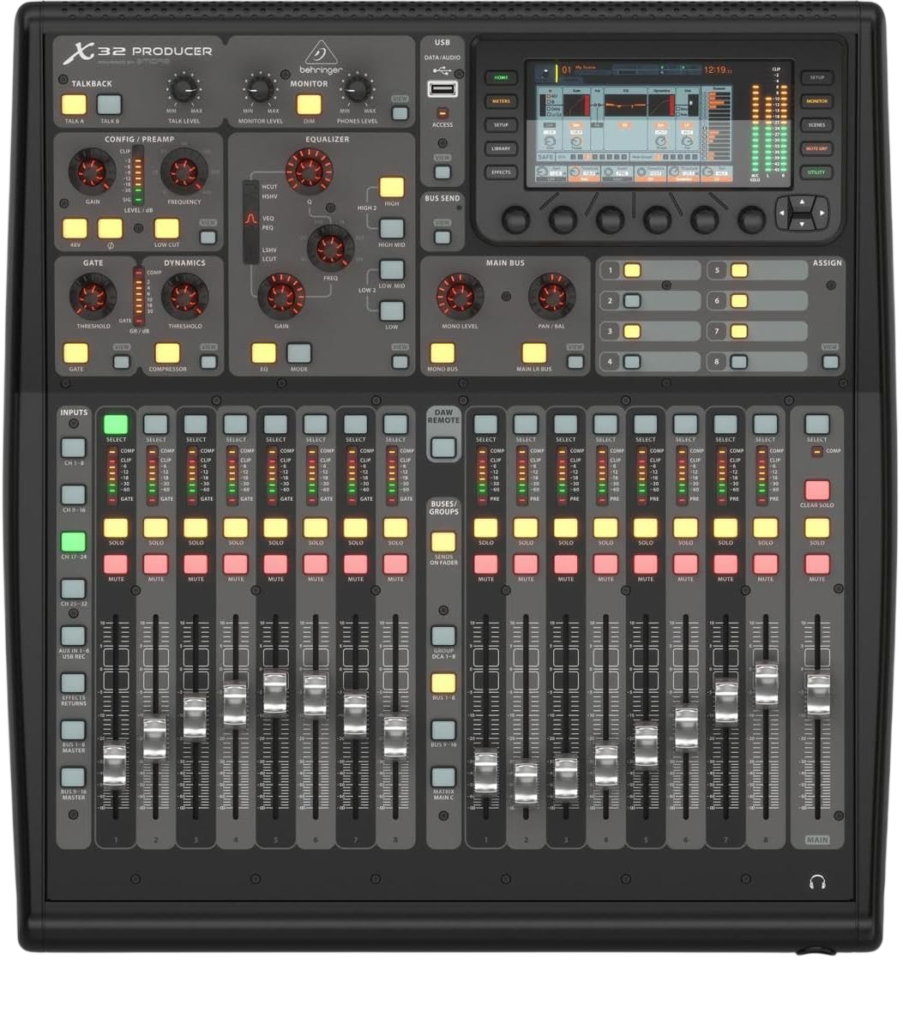
In this review, you’ll learn exactly what the Behringer X32 Producer does well, where it falls short, how it compares to modern competitors, whether it works for studio recording, and whether buying one used is a smarter move than buying something newer.
You’ll also discover the hidden reason many venues keep choosing X32 systems year after year.
Quick Verdict (For People in a Hurry)
The Behringer X32 Producer remains one of the best-value digital mixers you can buy in 2026.
It delivers professional live sound mixing, multitrack recording, remote control, scene management, and expansion options at a price point that many competitors still struggle to match.
Buy it if you need a mixer for live events, houses of worship, rental companies, schools, or hybrid studio and live production setups.
Skip it if you only record podcasts, stream from a bedroom setup, or need a compact mixer with a modern touchscreen interface.
Rating Summary
- Sound Quality ★★★★☆
- Features ★★★★★
- Workflow ★★★★☆
- Expandability ★★★★★
- Reliability ★★★★☆
- Value for Money ★★★★★
After spending years around digital mixers, I still find myself recommending the X32 series surprisingly often. Not because it is the newest option.
Because it solves real problems efficiently.
That distinction matters.
Many newer mixers look more modern. Few offer the same combination of channel count, routing flexibility, stage box compatibility, recording capability, and ecosystem support at this price.
What Exactly Is the Behringer X32 Producer?
The Behringer X32 Producer is a compact version of the famous X32 digital mixing platform.
It uses the same core processing engine found throughout the X32 family.
That means you get the same audio processing power, effects engine, routing architecture, scene management system, and networking capabilities found in larger X32 models.
The difference comes from the physical layout.
Behringer reduced the number of faders and controls to create a smaller mixer that fits tighter spaces while keeping most of the important functionality intact.
For many users, that tradeoff makes perfect sense.
Where Does It Sit in the X32 Lineup?
The X32 family contains several versions designed for different environments.
- X32 Full Size
- X32 Compact
- X32 Producer
- X32 Rack
- X32 Core
The Producer sits near the middle of the lineup.
It offers more hands-on control than the Rack version.
It takes up less space than the Compact and Full Size versions.
Many engineers view it as the sweet spot between portability and usability.
What Makes the Producer Version Different?
The biggest difference is the control surface.
The X32 Producer includes:
- 16 motorized faders
- 17 fully automated fader tracks
- 5-inch color display
- Dedicated channel controls
- Full X32 processing engine
You still get access to:
- 40 input processing channels
- 25 mix buses
- 8 DCA groups
- 8 effects engines
- Scene recall
- AES50 networking
In practical use, very little changes sonically between the Producer and larger X32 models.
The audio path remains essentially the same.
The workflow changes.
I have mixed events on both the X32 Compact and X32 Producer. After a few shows, the smaller surface stopped bothering me. The custom layers and assignable controls compensate for much of the reduced physical space.
Who Was It Originally Designed For?
The Producer targeted users who wanted professional digital mixing without carrying a large console.
Typical buyers included:
- Churches
- Portable sound companies
- Small venues
- Touring musicians
- Educational institutions
- Event production companies
That audience remains largely unchanged today.
In fact, the rise of hybrid production workflows has arguably made the Producer even more useful.
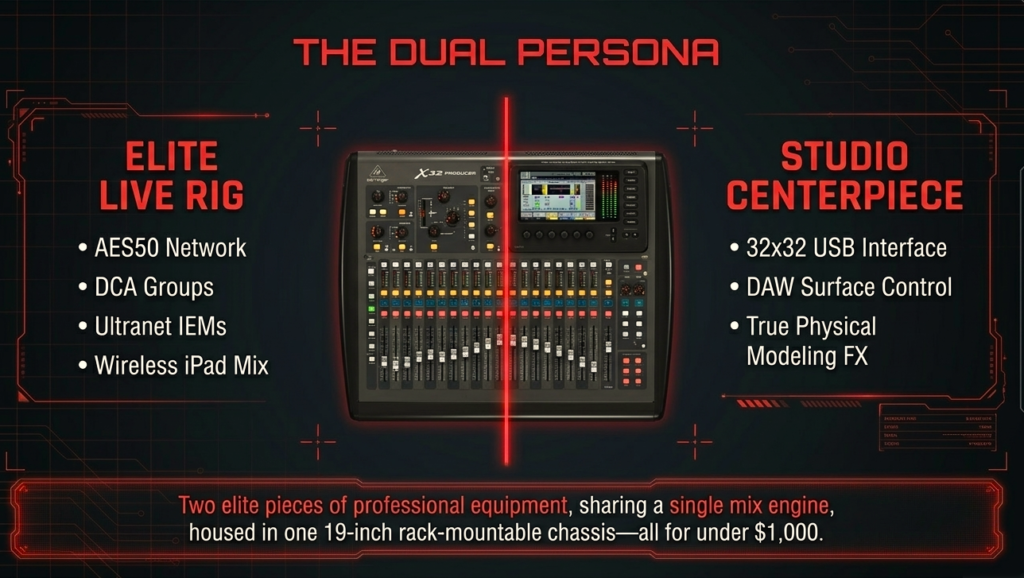
What Do You Get Inside the Box?
The X32 Producer packs a surprising amount of hardware into a relatively compact chassis.
Many buyers look at photos and assume it is a stripped-down digital mixer.
That assumption disappears quickly once you start exploring the routing menus.
Main Hardware Overview
The mixer includes:
- 16 MIDAS-designed microphone preamps
- 17 motorized faders
- LCD scribble strips
- Color display
- Dedicated section controls
- Built-in effects processing
- USB audio interface functionality
The motorized faders deserve special mention.
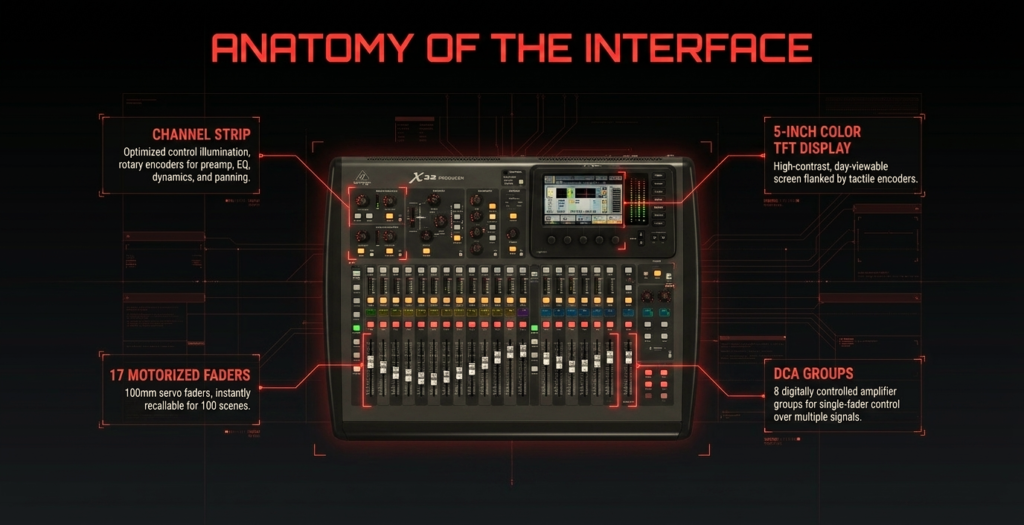
If you have never worked with scene recall before, seeing the entire console instantly reconfigure itself during a show feels almost magical! 😄
One tap.
Every channel setting changes.
Every fader moves automatically.
That capability alone saves enormous amounts of setup time.
A lot more about the X32 Producer is provided in X32 PRODUCER DIGITAL MIXER User Manual.
Connectivity Options
Connectivity remains one of the strongest parts of the X32 platform.
The Producer includes:
- AES50 networking ports
- Ultranet connectivity
- USB recording interface
- MIDI implementation
- Ethernet remote control
- Analog outputs
- Digital expansion options
AES50 is particularly important.
Many buyers underestimate its value during purchase research.
Then a year later they add a stage box and suddenly realize why professionals care so much about digital snake systems.
A single cable can carry dozens of channels between devices.
Cable management becomes dramatically easier.
Build Quality Impressions
The chassis feels solid.
The knobs provide good resistance.
The faders generally hold up well under regular use.
I have encountered X32 units that spent years in churches, schools, and rental inventories while continuing to operate reliably.
The most common wear points tend to be:
- Encoders
- Buttons
- Displays
- Power supplies in heavily used units
Most failures appear after extensive professional use rather than normal ownership.
That track record partly explains why used X32 mixers remain in high demand.
How Does the X32 Producer Actually Sound?
This is the question most buyers care about.
The answer is straightforward.
The X32 Producer still sounds very good in 2026.
Are the MIDAS Designed Preamps Still Competitive Today?
Yes.
The MIDAS-designed preamps helped establish the X32’s reputation when it launched.
Modern premium consoles can certainly outperform them in certain situations.
That does not mean the X32 sounds outdated.
The preamps provide:
- Good headroom
- Low noise performance
- Clean gain structure
- Consistent results
In live sound environments, they remain entirely professional.
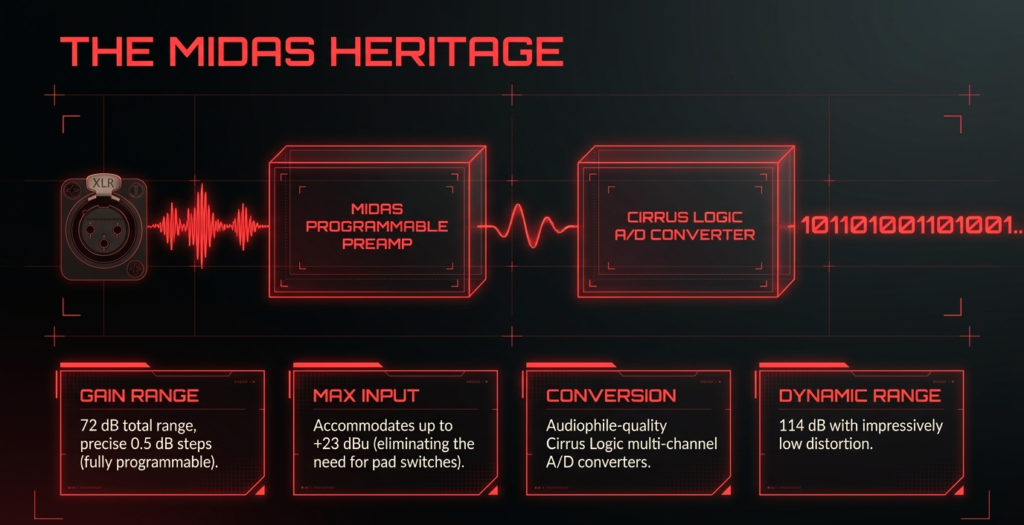
I have heard vocals, drums, acoustic instruments, and speech systems through X32 preamps that sounded excellent.
Audience members rarely care which preamp generated the signal.
They care whether the mix sounds good.
The X32 gives engineers the tools to achieve that.
How Clean Are the Converters?
The converters remain perfectly suitable for professional applications.
Are there interfaces with better specifications?
Absolutely.
Will most listeners hear a meaningful difference during a live event?
Usually not.
The practical reality is that room acoustics, speaker deployment, microphone placement, and mix decisions influence sound quality far more than converter differences in most situations.
Many engineers spend thousands chasing tiny converter improvements while ignoring much larger issues elsewhere in the signal chain.
Does It Sound Noticeably Better Than Analog Mixers?
Compared with budget analog mixers, yes.
The difference often comes from processing flexibility rather than raw audio quality alone.
With the X32 Producer you gain access to:
- Parametric EQ on every channel
- Compression on every channel
- Gates on every channel
- Recallable settings
- Digital effects
- Precise routing
Those tools allow engineers to build cleaner, more consistent mixes.
Consistency matters.
A great analog mix today means little if you cannot recreate it tomorrow.
The X32 solves that problem.
What Does It Sound Like in Real World Live Events?
This is where the mixer earns its reputation.
I have spoken with church volunteers, venue operators, touring musicians, and production technicians who continue using X32 systems after years of ownership.
A common theme appears repeatedly.
The mixer becomes predictable.
You know how it behaves.
You know how to troubleshoot it.
You know how to build a reliable show file.
That familiarity translates into confidence.
And confident engineers usually produce better mixes.
The X32 Producer delivers clean vocals, controlled dynamics, useful effects, and reliable routing.
That combination explains why thousands of venues still depend on it every week.
How Easy Is It to Mix a Live Show on the X32 Producer?
The X32 Producer rewards preparation.
Once configured properly, it becomes a fast and efficient live mixing platform.
| Stage | Time Required | Difficulty |
|---|---|---|
| Basic Mixing | 1 to 3 days | Easy |
| Scene Management | 1 week | Medium |
| Advanced Routing | 2 to 3 weeks | Hard |
| Full System Mastery | 1 to 2 months | Expert |
Learning Curve for Beginners
The learning curve is moderate.
Complete beginners may initially feel overwhelmed.
The routing menus contain substantial depth.
The terminology can feel intimidating.
Fortunately, most users only need a small portion of the available features during their first few shows.
Start with:
- Inputs
- EQ
- Compression
- Effects sends
- Main outputs
Then expand from there.
Most owners become comfortable within a few weeks of regular use.
Workflow During Live Events
The workflow focuses on efficiency.
Common tasks remain easy to access.
You can quickly:
- Adjust channel EQ
- Change compressor settings
- Recall scenes
- Manage monitor mixes
- Control effects
The dedicated controls reduce menu diving significantly.
That matters when something unexpected happens during a live event.
Can You Make Adjustments Quickly Under Pressure?
Yes.
This is one area where the X32 platform continues to impress.
The combination of:
- Motorized faders
- Channel strip controls
- Assignable buttons
- User layers
- Scene recall
Allows rapid adjustments without disrupting the show.
Live sound rewards speed.
The X32 Producer provides it.
What Features Save the Most Time?
Several features consistently save hours over the course of a year.
Custom Layers
Custom layers place your most important channels exactly where you need them.
User Assign Buttons
Frequently used functions become instantly accessible.
Scenes
Entire show setups can be recalled in seconds.
Snippets
Specific settings can be recalled without affecting the rest of the console.
For churches running multiple services, rental companies supporting recurring clients, and venues hosting repeat performers, these features become invaluable.
The time savings accumulate surprisingly fast.
Can the X32 Producer Replace an Audio Interface in the Studio?
Yes. For many studios, it absolutely can.
The X32 Producer includes a built-in USB audio interface capable of multitrack recording.
For musicians recording bands, worship teams, rehearsals, live performances, and demo sessions, the mixer can serve as both the recording front end and the live console.
Recording Over USB
The USB implementation remains one of the strongest features of the X32 platform.
You can send multiple channels directly into your DAW without additional hardware.
Common DAWs work well with the X32 including
- Pro Tools
- Reaper
- Cubase
- Studio One
- Logic Pro
- Ableton Live
I have seen countless churches and small venues use the X32 as their primary recording interface for years.
The workflow is simple.
Connect the mixer.
Select channels.
Hit record.
Multitrack Recording Performance
Multitrack recording remains reliable even by modern standards.
Recording every microphone separately creates enormous flexibility later.
You can:
- Fix mistakes
- Remix performances
- Create virtual soundchecks
- Build training sessions for volunteer engineers
Virtual soundcheck alone can justify the purchase for many venues.
Instead of waiting for a band rehearsal, engineers can replay a previous service and practice mixing anytime.
That feature saves hundreds of hours over the life of the mixer.
Latency and Monitoring
Monitoring performance remains very good.
The mixer handles monitoring internally.
Performers hear themselves immediately.
The experience feels similar to dedicated hardware monitoring solutions.
Most users never encounter latency issues during normal operation.
Is It Practical for Hybrid Studio and Live Setups?
Absolutely.
This is where the X32 Producer shines.
Many competing products excel at recording.
Others excel at live sound.
The X32 Producer handles both jobs effectively.
That flexibility continues to attract schools, churches, production companies, and musicians who need one device to serve multiple purposes.
How Powerful Are the Built In Effects?
The built-in effects remain surprisingly useful.
Many first-time buyers assume they will eventually need external processors.
Most never do.
| Feature | Real Usage Frequency | Value in Real Life |
|---|---|---|
| Reverb FX | Very High | Essential for vocals |
| Compression | Very High | Controls live dynamics |
| Gate | High | Removes bleed noise |
| Advanced Routing | Medium | Used in complex setups |
| Internal FX Rack | High | Replaces external gear |
Reverbs
The reverbs sound good.
Very good, actually.
Several reverb models remain common choices in live sound environments.
Vocals benefit immediately.
Speech applications sound more natural.
Worship music gains depth and space.
I still hear X32 reverbs in venues every week without anyone questioning their quality.
Delays
The delay processors cover most real-world requirements.
Useful applications include:
- Vocal delays
- Instrument effects
- Slapback echoes
- Tempo synchronized effects
Setup remains straightforward.
Engineers can create polished results quickly.
Dynamics Processing
Every channel receives:
- Compressor
- Gate
- Expander
- Dynamics controls
This dramatically improves mix consistency.
Vocals stay controlled.
Drums become tighter.
Speech remains intelligible.
Many budget analog mixers simply cannot offer this level of processing across every channel.
EQ Quality
The channel EQs provide excellent flexibility.
Each channel receives a fully parametric equalizer.
That means engineers can:
- Remove feedback frequencies
- Improve vocal clarity
- Shape instruments
- Correct room problems
Good EQ decisions often improve a mix more than expensive microphones.
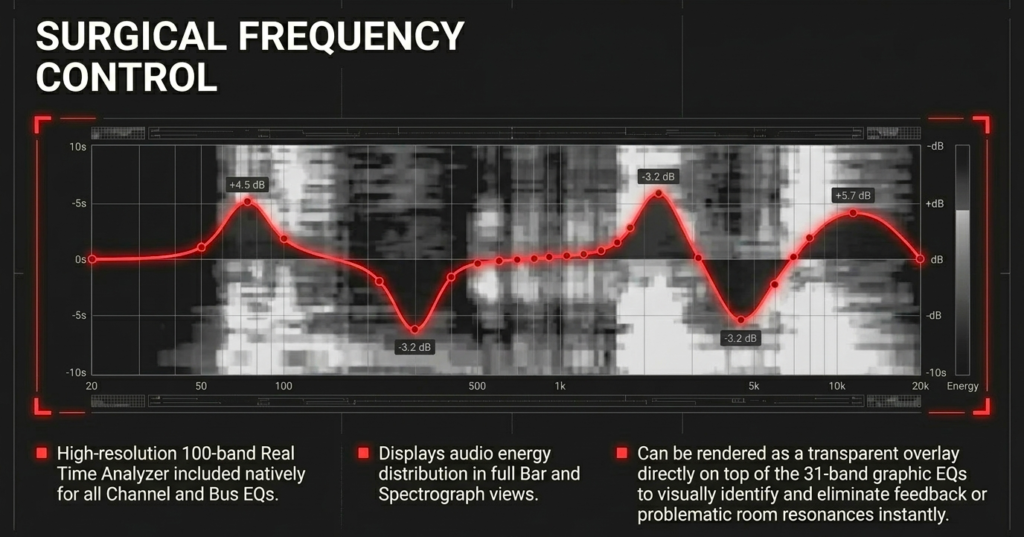
The X32 gives you the tools to make those decisions.
Which Effects Are Genuinely Useful?
The effects I see used most often include:
- Hall reverbs
- Plate reverbs
- Vocal delays
- Graphic EQs
- Compressors
- Gates
These processors handle the majority of live sound requirements effectively.
How Expandable Is the X32 Ecosystem?
This section explains why the X32 platform continues to survive year after year.
The ecosystem remains one of its biggest strengths.
Why Do So Many Professionals Stay Inside the X32 Ecosystem?
Because expansion is easy.
Because replacement parts exist.
Because training resources exist.
Because thousands of engineers already know how to operate the platform.
Those advantages create long-term value.
I frequently encounter venues that have standardized their entire audio infrastructure around X32 products.
Compatible Stage Boxes
Popular options include:
- S16
- SD16
- SD8
These stage boxes allow users to place inputs close to performers while keeping the mixer elsewhere.
Cable runs become simpler.
Setup times decrease.
Troubleshooting becomes easier.
Personal Monitoring Options
Ultranet connectivity supports personal monitoring systems.
Musicians gain more control over their own mixes.
Engineers spend less time handling monitor requests.
Everyone benefits.
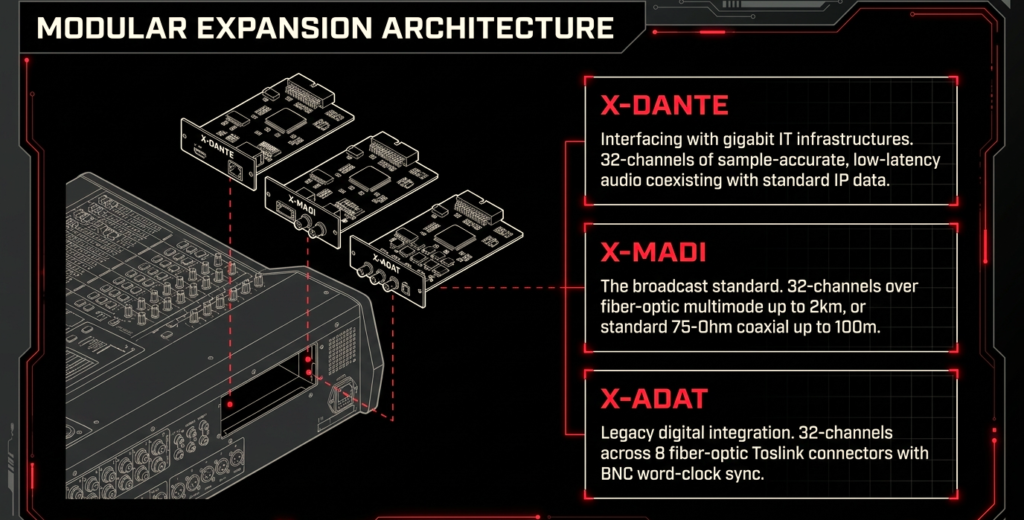
Networked Audio Possibilities
AES50 networking remains extremely valuable.
Large channel counts can travel over a single cable.
Expansion becomes straightforward.
Many systems grow gradually over time without requiring a complete replacement.
How Expensive Is Expansion Compared to Competitors?
Expansion costs remain competitive.
That matters.
Some consoles appear affordable until expansion enters the picture.
The X32 ecosystem often remains financially attractive even after adding stage boxes and monitoring systems.
What Problems Do Owners Commonly Run Into?
No mixer is perfect.
The X32 Producer has weaknesses.
Understanding them helps buyers make informed decisions.
Screen Issues
Some older units develop display problems.
Brightness may decrease over time.
This issue appears more frequently on heavily used units.
Encoder Wear
Rotary encoders receive constant use.
Years of operation can eventually create wear.
Used buyers should test every encoder carefully.
Firmware Frustrations
Firmware updates occasionally introduce learning curves.
Most updates improve functionality.
Some users delay updates intentionally before important events.
That approach remains common throughout professional audio.
Fan Noise Concerns
Certain owners notice fan noise in extremely quiet recording spaces.
Live sound users rarely care.
Studio owners may pay more attention.
Reliability After Years of Use
The overall reliability record remains good.
Very good, actually.
One reason used X32 mixers continue selling quickly is their proven track record.
Many units have operated successfully for a decade or more.
Is the X32 Producer Still Worth Buying Used?
Yes. This may be the smartest way to buy one.
The used market creates tremendous value.
Current Used Market Pricing
Used units frequently sell for substantially less than new models.
That discount often makes the X32 Producer one of the strongest values in professional audio.
Prices vary by region and condition.
Local availability influences pricing significantly.
What Should You Inspect Before Purchasing?
Check:
- Every fader
- Every encoder
- Every button
- Every input
- Every output
- Screen condition
- Network ports
- Firmware operation
Spend time testing.
A careful inspection can prevent expensive surprises.
Common Red Flags
Avoid units showing:
- Liquid damage
- Missing knobs
- Non-functioning channels
- Random crashes
- Physical abuse
Rental inventory is not automatically bad.
Poor maintenance is.
How Long Can an X32 Realistically Last?
Based on field reports and owner experiences, many units continue operating beyond ten years.
Several early production models remain active today.
That longevity contributes heavily to the mixer’s strong reputation.
Does It Hold Resale Value?
Yes.
The X32 ecosystem remains large.
Demand remains strong.
Parts remain available.
Those factors support resale prices.
How Does It Compare to Similar Digital Mixers?
X32 Producer vs X32 Compact
The Compact offers more physical controls.
The Producer saves space.
The audio performance remains largely identical.
Choose based on workflow preference.
X32 Producer vs X32 Rack
The Rack maximizes portability.
The Producer provides physical faders.
Most live engineers prefer having real faders available.
X32 Producer vs M32R
The M32R offers premium construction and branding.
The core architecture remains extremely similar.
Many users choose based on budget.
X32 Producer vs Allen and Heath CQ Series
The CQ series offers a more modern user experience.
The X32 ecosystem remains larger.
Expansion options remain broader.
X32 Producer vs Soundcraft Ui24R
The Ui24R focuses heavily on remote control.
The X32 Producer provides physical control surface advantages.
The better choice depends on workflow requirements.
Which Mixer Gives The Best Value Today?
For channel count, processing power, expansion options, recording capability, and ecosystem support, the X32 Producer remains one of the strongest values available.
What Do Real Owners Love Most About the X32 Producer?
Several themes appear repeatedly across user communities and long-term ownership reports.
Features That Keep People From Upgrading
Owners consistently praise:
- Reliability
- Familiar workflow
- Stage box support
- Scene recall
- Multitrack recording
- Strong community support
Many users simply do not feel pressure to upgrade.
The mixer continues accomplishing its job effectively.
Why Some Engineers Still Tour With It
Touring environments reward reliability.
Engineers appreciate equipment they understand thoroughly.
The X32 Producer benefits from years of field testing across countless events worldwide.
That history builds confidence.
What Frustrates Owners The Most?
Things That Feel Outdated In 2026
Some users would like:
- Larger screens
- Faster processors
- More modern graphics
- Improved touchscreen integration
Competitors have advanced in these areas.
Features Competitors Now Do Better
Certain modern mixers provide:
- Better touchscreen workflows
- Faster navigation
- More advanced networking options
These improvements matter for some buyers.
Situations Where The X32 Producer Struggles
The mixer feels less attractive for:
- Solo creators
- Small podcast studios
- Users needing ultra-portable solutions
Many buyers simply do not need this much capability.
Who Should Buy The Behringer X32 Producer?
Excellent choices include:
These users typically extract the most value from the platform.
| Use Case | Fit Level | Why It Works |
|---|---|---|
| Churches | Very High | Scene recall + multichannel routing |
| Live Bands | Very High | Fast mixing + monitor control |
| Home Podcast | Low | Too complex for small setups |
| Small Studio | Medium | Works but overkill for simple recording |
| Rental Companies | Very High | Rugged ecosystem + familiarity |
Who Should Skip The X32 Producer?
Consider alternatives if you are:
- A solo podcaster
- A streamer
- A creator needing only a few channels
- A user wanting a touchscreen-first experience
Smaller products may serve those needs more efficiently.
The Hidden Advantage Nobody Talks About
The biggest advantage is not the mixer itself.
The biggest advantage is the surrounding ecosystem.
Why The Mixer Is Only Part Of The Value
Owners gain access to:
- Stage boxes
- Training resources
- Tutorials
- Community knowledge
- Replacement parts
Those assets become increasingly valuable over time.
The Economics Of Stage Boxes
Adding inputs later remains affordable.
Many competing ecosystems become expensive quickly.
The X32 platform scales comfortably.
Availability Of Replacement Parts
Long-term support matters.
The availability of replacement components helps extend product lifespan.
Community Support And Tutorials
Finding help is easy.
Thousands of videos, guides, forum discussions, and troubleshooting resources already exist.
That support network reduces frustration dramatically.
Why Many Venues Standardize On X32 Systems
Consistency.
Training becomes easier.
Technicians become familiar with the workflow.
Equipment can move between locations without major adjustments.
Those operational benefits save real money.
Final Verdict
The Behringer X32 Producer remains an excellent digital mixer in 2026.
It delivers strong sound quality.
It offers extensive routing.
It supports multitrack recording.
It integrates with a mature ecosystem.
It continues proving itself in real-world environments every week.
If You Are Buying New
The X32 Producer remains a safe purchase for professional live sound applications.
If You Are Buying Used
The used market often provides the best value.
Inspect carefully and buy confidently.
If You Are Upgrading From Analog
The improvement in workflow, recallability, processing, and flexibility will feel substantial.
If You Are Choosing Between X32 Models
The Producer offers one of the best balances of size, features, and usability.
My Recommendation
I would happily use the Behringer X32 Producer for churches, schools, venues, touring rigs, and hybrid recording environments today.
That statement remains true even with newer competitors available.
The platform continues earning its place through practical performance, proven reliability, and outstanding value.
That says a lot.
Behringer X32 Producer FAQ
Is the X32 Producer discontinued?
No. The model remains part of the X32 ecosystem and continues to be widely used.
Does the X32 Producer have MIDAS designed preamps?
Yes. It includes 16 MIDAS designed microphone preamps.
Can the X32 Producer record multitrack audio?
Yes. It supports multitrack USB recording.
How many channels can it record simultaneously?
The mixer supports extensive multitrack recording capabilities suitable for live production and studio work.
Does the X32 Producer work as an audio interface?
Yes. It functions as a USB audio interface.
Can I connect an S16 stage box?
Yes. AES50 networking supports compatible stage boxes such as the S16.
Is the X32 Producer good for churches?
Yes. It remains one of the most popular church audio mixers available.
Is the X32 Producer good for studio recording?
Yes. Many users successfully record bands, rehearsals, and live performances with it.
What is the difference between the X32 Producer and X32 Compact?
The Compact provides more physical controls and faders. The Producer occupies less space.
Is the X32 Producer worth buying used?
Yes. Well-maintained units often provide exceptional value.
How long does an X32 Producer typically last?
Many units continue operating successfully after ten years of service.
What are the best alternatives to the X32 Producer?
Popular alternatives include the M32R, Allen and Heath CQ series, and Soundcraft Ui24R.
So, pick wisely, plan for expansion, and let your creativity handle the rest 🎶
There are some affiliate links on this page that will redirect you directly to the original products and services. Also by buying through those links you will be supporting us. So thank you ^.^
Related Posts
Here’s a list of blog posts of various types of audio interfaces that you can consider as alternative options:
- Behringer U Phoria UMC1820 Review
- Low Latency Audio Interface
- Audio Interface for Mac
- PreSonus vs Focusrite
- DC-Coupled Audio Interfaces
- Eight Channel Audio Interface
- iPhone Audio Interface
- 16 Channel Audio Interfacee
- Good Audio Interface for Home Studio
- 12-Input Audio Interface
- Audio Interfaces with Bluetooth