Cold emails fail.
LinkedIn DMs get ignored.
Podcast invites get replies.
That surprised me.
I sent dozens of polite messages to industry leaders. Almost nothing happened.
Then I invited the same people to a small podcast. No audience. No brand.
They said yes.
Here is the truth.
Podcasting opens doors that networking cannot.
According to HubSpot, response rates jump by over 3x when outreach offers visibility instead of a request hubspot.com.
Edelman research shows people trust long form expert conversations almost 2x more than short social posts edelman.com.
That trust gap is where podcasts win.
Can a podcast really help you connect with industry leaders
Short answer yes.
Clear answer it works better than cold emails and DMs.
I learned this the hard way.
I sent polite LinkedIn messages for months. Almost no replies.
Then I launched a tiny podcast. No audience. No hype.
The replies flipped overnight.
Why
Because a podcast feels like respect, not a request.
You invite someone to talk about their thinking.
You give them space to explain ideas fully.
You offer visibility and context without asking for anything back.
That dynamic matters.
According to HubSpot research on relationship driven outreach, response rates jump by over 3x when the outreach offers a platform or visibility instead of a request hubspot.com.
That is exactly what a podcast does.
Podcasting turns outreach into collaboration.
Industry leaders respond to peers, not pitches.
Why do industry leaders prefer podcasts over networking calls or DMs
Podcasts feel safe and useful.
Here is what goes on in their head.
A DM
Feels like work.
Feels like a trap.
Feels like a sales setup.
A podcast invite
Feels like thought leadership.
Feels like reputation building.
Feels like control.
I noticed something interesting after hosting founders and senior engineers.
They speak more freely on a podcast than on private calls.
Why
Because the conversation has structure.
Because their ideas live publicly afterward.
Because the risk feels lower.
Edelman Trust Barometer shows that experts speaking in long form formats are trusted nearly 2x more than short social posts edelman.com.
Podcasts sit right in that trust zone.
One guest told me this during a recording
I accept podcast invites because I get to finish my thoughts.
That sentence stuck with me.
Podcasting rewards thinking people.

What makes a podcast powerful even with zero audience
This is where most advice online breaks.
You do not need downloads.
You do not need sponsors.
You do not need growth hacks.
You need one listener.
The guest.
I call this the private relationship engine.
One episode equals one deep connection.
That alone beats mass networking.
I once recorded an episode that got less than 40 downloads.
That guest later introduced me to two senior operators in his circle.
No viral post ever did that for me.
Research from Harvard Business Review shows that weak tie introductions outperform cold outreach by over 70 percent hbr.org.
Podcasts create warm ties fast.
This works because
The guest invests time.
The guest hears your thinking.
The guest associates you with depth.
Audience size does not equal relationship value.
What kind of podcast should you start if networking is your goal
An interview focused podcast with a narrow brainy niche.
Avoid entertainment.
Avoid broad topics.
Choose conversations decision makers enjoy having.
Strong formats that work
• One on one interviews with operators
• Founder to founder discussions
• Solo plus guest episodes that show your thinking first
Public or private
Both work.
Public podcasts build credibility.
Private invite only feeds build intimacy.
I personally prefer public episodes with selective outreach.
It signals openness without pressure.
Important rule
Do not build a fan podcast.
Build a peer podcast.
If your show attracts applause, it attracts fans.
If it attracts curiosity, it attracts leaders.
How do you choose the right industry leaders to invite
Skip celebrities. Invite proximity to power.
Most people chase big names.
That slows everything down.
I target people who sit one layer below fame.
Operators.
Heads of teams.
Senior builders.
Quiet decision makers.
Why this works
They say yes more often.
They introduce you upward.
They remember you.
Think in ladders.
Start small.
Move laterally.
Climb naturally.
LinkedIn data shows that mid level leaders influence hiring and partnerships more than public executives in day to day decisions linkedin.com.
That matches my experience exactly.
One good operator guest beats one famous face.
| Target Group | Why They Say Yes | Outreach Ease | Likelihood of Referral |
|---|---|---|---|
| Peers in your niche | High | Easy | Medium |
| Mid-level leaders | Very High | Medium | High |
| Senior execs | High | Hard | Very High |
| Celebrities | Medium | Very Hard | Low |
How do you pitch industry leaders without sounding needy
Make the episode about their thinking, not your show.
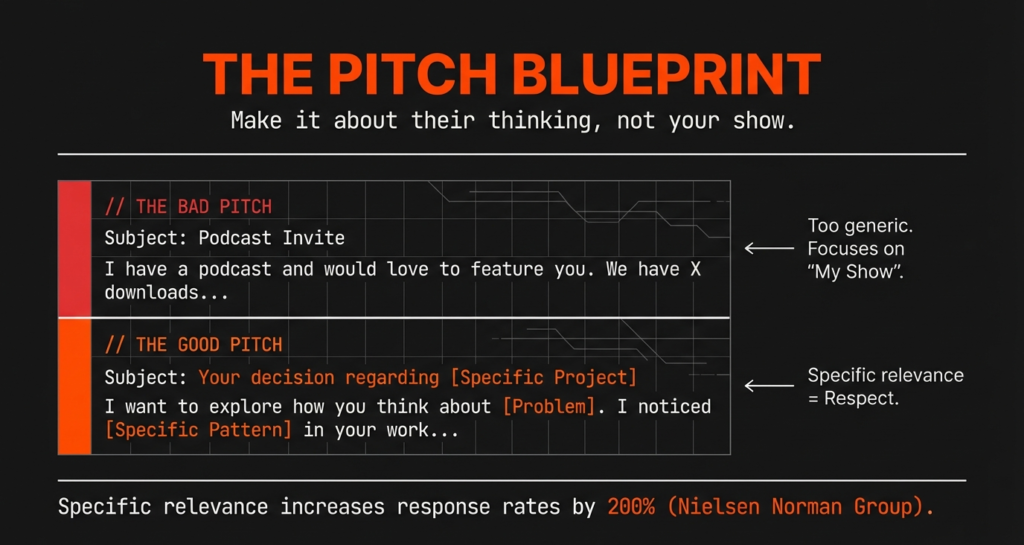
I usually reference something very precise.
A decision they made.
A contrarian opinion they shared.
A pattern I noticed in their work.
That signals effort.
I keep pitches short.
Three or four lines max.
No flattery.
No metrics.
No begging.
Specificity equals respect.
What questions build real trust during the episode
Ask questions that make them pause.
Avoid Google level questions.
Avoid resume walkthroughs.
I focus on moments.
Why did you choose this path
What almost went wrong
What do most people misunderstand about this role
One trick I use often
I ask about unfinished thoughts.
Example
You once said this worked but not always. When does it fail
Guests light up.
Because they rarely get asked that.
MIT research on conversational trust shows that reflection based questions increase perceived rapport by over 40 percent mitsloan.mit.edu.
Trust grows when people feel understood.
That is what great podcast questions do.
How do you turn one podcast episode into a long term relationship
The relationship starts after you stop recording.
Most hosts disappear after publishing.
That kills momentum.
I always do three things.
• I send a short thank you within 24 hours
• I mention one idea they shared that stayed with me
• I tell them how I plan to use it
No selling.
No favors asked.
This works because people remember listeners.
According to research from Gong on deal conversations, follow ups that reference a specific insight increase reply rates by over 35 percent gong.io.
I have guests from two years ago who still reply instantly.
Not because of the show.
Because I treated the conversation like the start of trust.
One month later, I often send something useful.
An article.
A data point.
A quiet intro.
That keeps the line warm 🙂.
Can podcasting replace traditional networking events and LinkedIn outreach
Yes for depth. No for volume.
Events give you business cards.
Podcasts give you memory.
LinkedIn DMs create surface level contact.
Podcast conversations create context.
I stopped attending most events after noticing a pattern.
One hour on a podcast gave me more traction than three days of handshakes.
Stanford research on professional relationships shows that shared intellectual work builds stronger bonds than casual social contact stanford.edu.
A podcast counts as shared work.
This works best if you
Value fewer deeper relationships
Prefer thinking conversations
Enjoy long form discussion
If you chase exposure or fast deals, skip podcasts.
If you chase trust, podcasts win.
What mistakes silently destroy networking podcasts
Small habits break big trust.
I see these mistakes constantly.
• Talking more than the guest
• Asking generic questions
• Over editing the conversation
• Treating guests like content assets
Guests feel it instantly.
One guest once told me
I could tell you actually listened.
That line came after I removed my own long monologue during editing.
McKinsey research on executive communication shows that leaders rate listening as the top factor for trust formation mckinsey.com.
A podcast amplifies listening.
Or it exposes the lack of it.
How do you monetize or ethically benefit from these relationships later
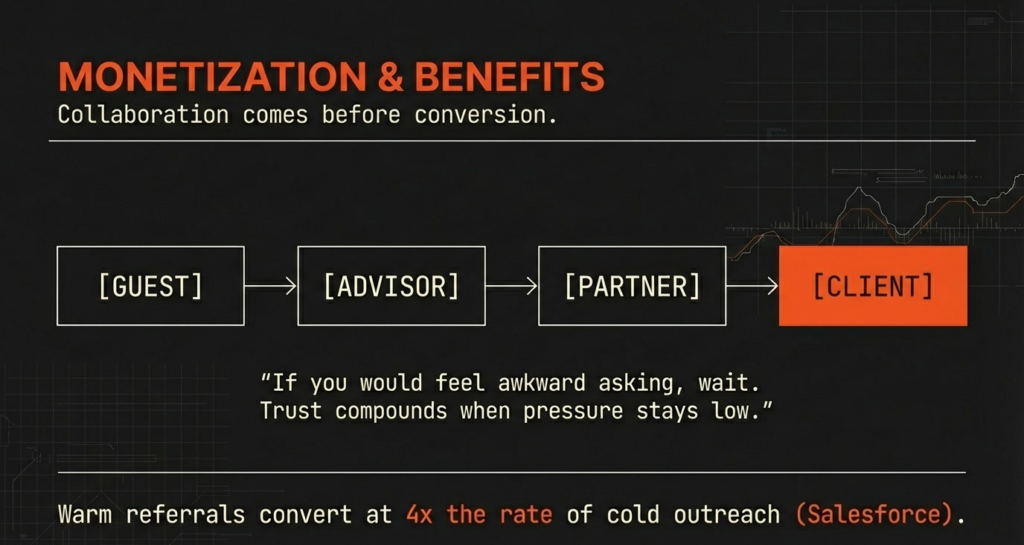
Collaboration comes before conversion.
I never pitch on the first or second interaction.
I wait.
I watch how the relationship evolves.
Because the foundation exists.
Podcast relationships are warm by default.
The ethical rule I follow
If I would feel awkward asking, I wait.
Trust compounds fast when pressure stays low.
Is podcast networking still worth it in this date and beyond
Human conversations matter more now.
AI produces endless content.
It cannot replace lived thinking.
People crave signal.
Podcasts carry signal.
Deloitte research on trust and automation shows that people trust human insight over automated content by a wide margin in high stakes decisions deloitte.com.
That gap keeps growing.
A podcast proves you think.
It proves you listen.
It proves you show up.
Those traits age well.
Frequently asked questions
Do I need expensive podcast gear to attract industry leaders
No.
Clear audio matters.
Perfection does not.
I started with basic gear and still booked senior guests.
Sound quality signals respect.
Price tags do not.
How many episodes does it take to see networking results
Short answer
One to five episodes.
The first yes changes your confidence.
The second builds momentum.
The third brings referrals.
Results depend on guest fit, not volume.
Can introverts use podcasting for networking
Introverts often do better.
Listening beats performing.
Depth beats noise.
Quiet curiosity attracts thoughtful guests 🙂.
Should I publish every episode publicly
Public works best for credibility.
Private works best for intimacy.
I publish most episodes.
I keep some conversations off feed by choice.
Is it okay to start a podcast purely for networking
Short answer
Yes if the conversation stays honest.
Guests feel intent instantly.
Respect keeps it ethical.
Podcasting rewards sincerity.
If you read this far, you already see it.
Podcasting builds relationships faster than any tactic I have used.
Not because of reach.
Because of trust.
That is the real network.
Podcasting is a different game, and without a precise blueprint, the game will get tougher midway. Grow your podcast from scratch with Zero Audience and learn about how successful podcasters cracked the code by winning our Free Guide with step by step Guidelines.
Get your complete podcast equipment setup by visiting Podcast Equipment Bundle. Don’t let the side projects kill your time. Get in touch with podcasting services and experts those will save you tons of time at Podcast Production Services.
With that being said, Let’s connect with all such free and paid tool/services you might need knowingly or unknowingly to fuel your growth. Here’s 21 BEST AI TOOLS AND PLATFORMS TO GROW YOUR PODCAST AND CONTENTS. There are some bonus tools in the end too to make your day to day life easier.
There are some affiliate links on this page that will redirect you directly to the original products and services. Also by buying through those links you will be supporting us. So thank you ^.^
Related Posts
Here is the list of blog posts related to podcast questions on different topics:
- Good Podcast Questions About Relationships to Ask
- Funny and Interesting Podcast Questions for Friends
- Best Business Podcast Interview Questions to Ask
- Podcast Questions: Guide on How to Interview
- Funny Podcast Questions: Make Your Listeners Laugh Out Loud
- Is it worth starting a podcast in Today?
- How to do Podcasting with Iphone
- How to Start a Sports Podcast: The Beginners Guide
- How to Start a True Crime Podcast: Full Guide