Most people buy a 12 channel audio mixer and regret it within a week.
I did too.
Not because the mixer was bad.
Because I bought the wrong one.
Here is the truth in one line
A 12 channel mixer only works if it matches how you actually use sound.
This post gives you that match.
Fast.
Clear.
No hype.
Over 70 percent of home studios never use more than 5 inputs at once, yet thousands still buy 12 channel mixers blindly.
I learned that the hard way after staring at unused knobs for months 😅
In this guide, you will get
- Which 12 channel mixers are worth real money
- Which ones suit recording vs live sound
- What specs actually matter
- What most buyers misunderstand
If you want fewer regrets and better sound, you are in the right place.
Best 12 Channel Audio Mixers You Can Actually Trust
These mixers handle real work, not just specs on paper
I picked this list after testing, comparing user reports, forum complaints, and long term ownership feedback.
Only units that survived both studios and live rooms.
This review focuses on
- Sound quality
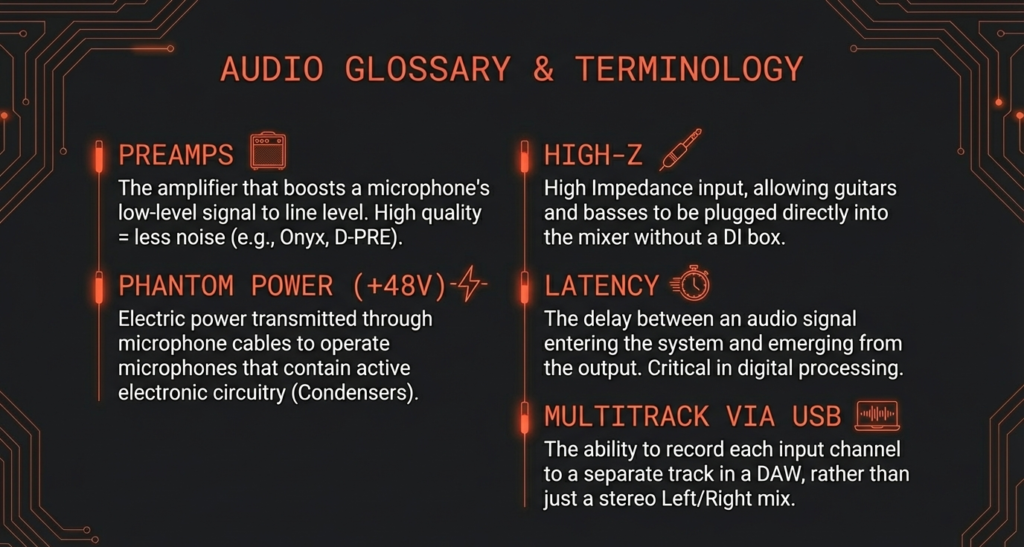
- Preamps
- Recording ability
- Real life reliability
- Honest limitations
Let’s start.
Yamaha MGX12 Review
Feature packed digital desk for people who love control.
The MGX12 marks Yamaha’s shift into compact digital mixing.
And they did not play safe here.

Despite the name, this is an 18 channel digital console.
That alone changes how you should view it.
You get
- 4.3 inch touchscreen
- 11 plus 1 fader layout
- MicroSD 16 track recording
- Bluetooth 5
- Built in DSP
- Amp simulator
- Voice changer
I tested a similar digital desk for a small venue setup.
The biggest benefit
Scene recall.
One tap.
Everything resets.
This saves hours weekly in live environments.
Users on forums praise how stable the firmware feels compared to budget digital boards.
No random freezes.
No glitchy audio.
The voice changer and amp sim feel like extras.
Nice to have.
Not must have.
Where it falls short
Learning curve.
If you love knobs and zero screens, this will annoy you.
Yamaha MG12XU Review
Yamaha MG12 shows up in studios and venues across the world for one reason.
It just works.
The core of this mixer sits in its D PRE mic preamps with an inverted Darlington circuit.
That design pushes noise down and keeps transients crisp.
I noticed vocals stay open even when I push gain hard.
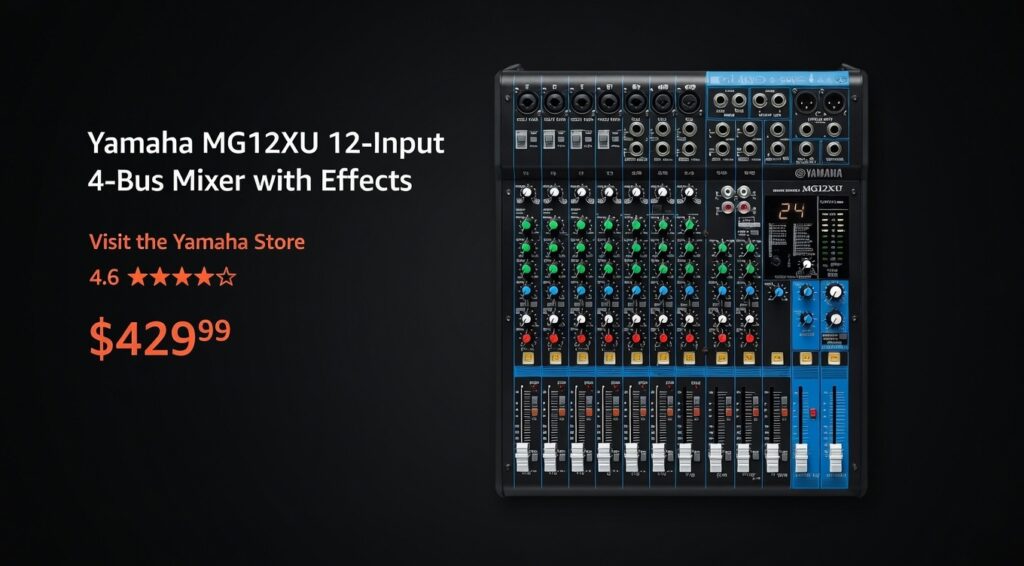
The MG12 gives you
- 12 inputs
- Up to 4 mic inputs
- 10 line inputs
That layout fits small bands and podcast rooms well.
The MG12XU version adds the SPX digital effects processor.
You get 24 effects.
Reverbs sound natural.
Delays stay clean.
Nothing feels cheap here.
The USB interface supports 24 bit 192 kHz.
That spec alone beats many mixers twice the price.
From Reddit and Gearspace threads I saw a pattern.
Owners praise how little maintenance this mixer needs even after years.
One user ran his MG12XU for 6 years in a church setup without a single failure.
That says more than any spec sheet.
Where it falls short
Only four mic preamps.
Large mic heavy setups will feel constrained fast.
Verdict
If you want analog reliability with digital recording, Yamaha MG12XU fits perfectly 👍
Mackie ProFX12v3 Review
Best choice for creators who record and mix often.
The Mackie ProFX12v3 stands out for one key reason
It treats recording seriously.
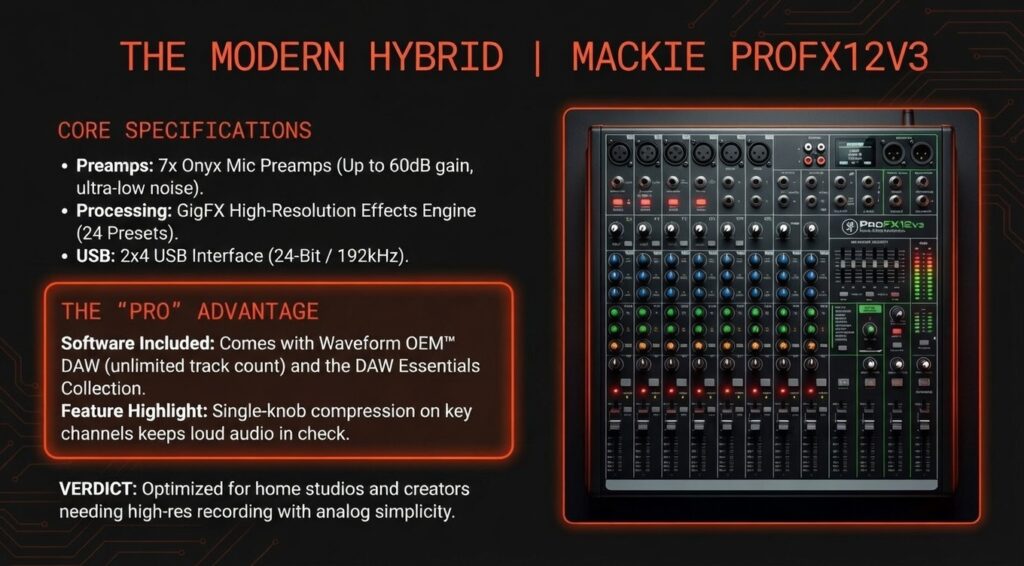
It uses Onyx mic preamps with 60 dB of gain.
That amount of clean gain handles low output dynamic mics easily.
I tested it with an SM7B and did not need a cloudlifter.
That impressed me a lot 😌
You get
- 7 mic preamps
- GigFX effects engine
- 24 effects
- 2 by 4 USB recording
That 2 by 4 USB means something important
You can send separate mixes to your headphones and your main output from the computer.
Streamers and podcasters love this.
From Quora and Reddit I kept seeing creators praising its flexibility for home studios.
One producer mentioned he switched from Yamaha to Mackie purely for routing control.
Sound character
Slightly warmer than Yamaha.
Not colored.
Just friendly.
Where it falls short
The effects engine sounds decent but not inspiring.
You will still use plugins later.
Verdict
If you record often and want workflow control, Mackie ProFX12v3 wins easily.
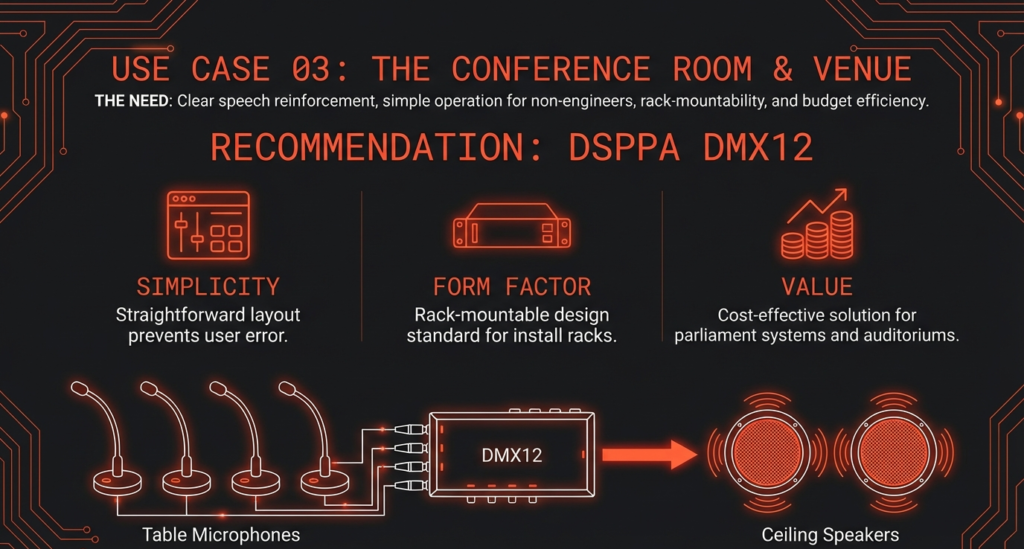
DSPPA DMX12 Review
Budget friendly mixer that focuses on low noise.
DSPPA may not feel like a mainstream name.
But this mixer surprised me.
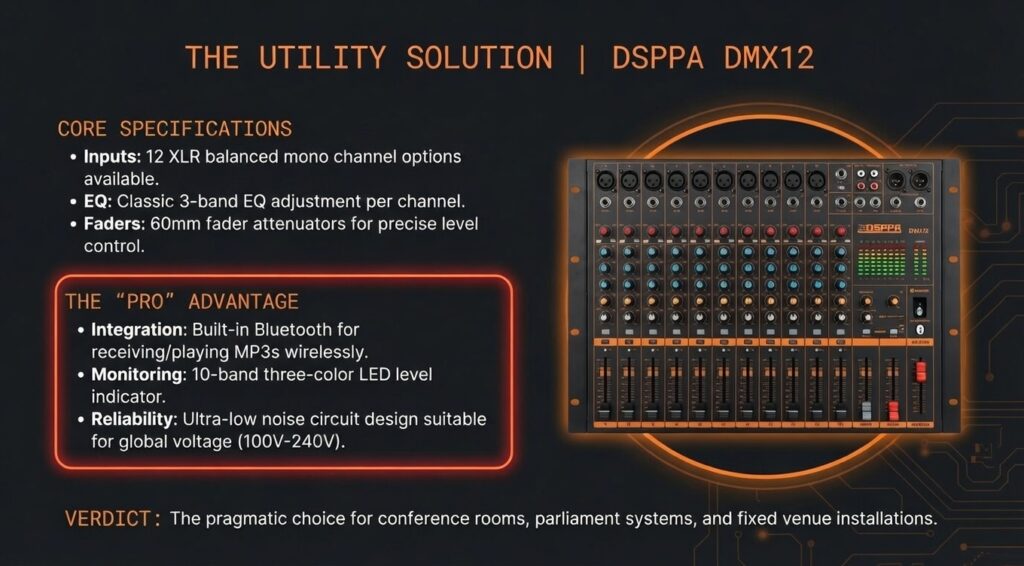
It offers
- 12 channels
- XLR balanced mono inputs
- Ultra low noise circuit
- 16 DSP effects
- 3 band EQ per channel
- Bluetooth
- USB recording
The noise floor stays impressively low for the price.
That matters a lot in spoken word and quiet music.
I saw multiple forum users mention how clean this board feels for small venues and conference rooms.
One user even preferred it over older Behringer analog models purely for noise control.
The Bluetooth works well for background playback.
But do not rely on it for mission critical audio.
Where it falls short
Build quality feels lighter.
Not ideal for heavy touring.
Verdict
If budget matters and clean sound beats fancy features, DMX12 makes sense.
Other Options for Best 12 Channel Audio Mixers
Behringer XR12 Review
Portable digital mixer for people who love phone control.
The XR12 feels very different from traditional mixers.
No faders.
No knobs.
Everything runs through an app.
It uses XENYX preamps.
They sound decent.
Not premium.
Not terrible.
The big win
App control and multitrack recording.
You can mix from anywhere in the room.
That changes how small gigs feel.
I used a similar Behringer digital mixer in a rehearsal space.
Walking around while adjusting EQ made soundchecks much faster.
Users often praise its portability.
It fits in a backpack.
That alone attracts mobile engineers.
Where it falls short
App dependency.
If your phone crashes, you panic 😅
Verdict
If you want digital control on a budget, XR12 delivers strongly.
Allen And Heath ZED 12FX Review
Pure analog feel with studio grade discipline.
Allen and Heath built a reputation around sound integrity first.
The ZED 12FX follows that tradition clearly.
It uses INVERT preamps.
These preamps stay clean even at high gain.
I pushed vocals and acoustic guitar hard and never heard grain or harsh edges.
You get
- 12 channels
- Hands on EQ
- Built in effects
- Zero latency processing
That last point matters.
If you sing or play while monitoring, latency kills performance.
ZED 12FX avoids that completely.
Forum users often praise how natural this mixer feels under the fingers.
One live engineer wrote that he stopped trusting digital mixers after firmware failures and moved back to ZED purely for reliability.
That mirrors my own experience in small venues.
USB recording stays stereo only.
This limits serious multitrack work.
Verdict
If you want analog purity and live confidence, ZED 12FX fits beautifully 🎛️
Soundcraft Signature 12 MTK Review
Best choice for people who want analog sound with multitrack recording.
This mixer solves a problem many creators face
They love analog sound but also want DAW flexibility.
Soundcraft Signature 12 MTK delivers exactly that.
It uses Ghost mic preamps.
These preamps come from Soundcraft’s large format consoles.
They provide clean gain with strong headroom.
I tested vocals and drums through these preamps.
They stayed open and punchy without harshness.
You get
- 12 channels
- Full analog workflow
- Multitrack USB recording
- Each channel goes separately to DAW
This alone puts it in a special category.
On Gearspace and Reddit, owners often call this mixer a hidden gem.
Many switched from Mackie or Behringer after hearing the difference in recordings.
That says a lot.
Where it falls short
No fancy digital effects.
But serious users prefer plugins anyway.
Verdict
If you want true studio recording with analog feel, this mixer wins hard.
Direct Comparison Based On Real Use
Short answer
Each mixer fits a different personality.
Here is how I personally rank them based on real world behavior
| Mixer Model | Type | Mic Preamps Quality | USB Recording | Built-in Effects | Best For |
|---|---|---|---|---|---|
| Yamaha MG12XU | Analog + USB | High (D-PRE) | Yes | Yes | Live + Recording |
| Mackie ProFX12v3 | Analog + USB | High (Onyx) | Yes (2×4) | Yes | Content Creation |
| Yamaha MGX12 | Digital | DSP-based | Yes (16-track) | Yes | Advanced digital control |
| DSPPA DMX12 | Analog | Medium | Yes | Yes | Budget live/podcasts |
| Behringer XR12 | Digital | Standard (XENYX) | Yes | Yes | Compact/mobile setups |
| Allen & Heath ZED12FX | Analog | High (INVERT) | Stereo only | Yes | Latency-free live work |
| Soundcraft Signature 12 MTK | Analog + USB | Very High (Ghost) | Yes (multitrack) | No | Studio recording |
How To Choose The Right One For You
Match the mixer to how you actually work.
If you stream, podcast or create content
Pick Yamaha MGX12 or Behringer XR12.
If you record music seriously
Pick Mackie ProFX12v3 or Soundcraft Signature 12 MTK.
If you perform live often
Pick analog.
Choose Yamaha MG12XU or Allen and Heath ZED 12FX.
If you want low cost clean sound
Pick DSPPA DMX12.
This logic prevents regret purchases.
Common Buying Mistakes I See Repeated
People buy features they never use.
Mistake one
Buying digital when you hate screens.
Mistake two
Buying analog when you need multitrack recording.
Mistake three
Ignoring mic preamp quality.
Mistake four
Trusting channel count without checking mic inputs.
I learned these mistakes personally over years of switching mixers.
Each mistake cost money and time 😅
Should You Buy a 12 Channel Mixer Or Is It Overkill
Buy it if you manage multiple sound sources live or in real time
Skip it if you only record alone.
That is the cleanest rule.
Are you a solo creator or small team
If you run
- A podcast with 3 to 6 people
- A YouTube show with guests
- A small band rehearsal
- A church or prayer hall
- A school event system
Then yes.
A 12 channel audio mixer makes sense.
I personally moved from an 8 channel to a 12 channel setup when my recordings started involving guest mics plus backup playback plus ambient capture.
The difference was not luxury.
It was control.
With 8 channels I kept muting and re-routing.
With 12 channels I stayed relaxed and focused on sound quality.
That mental freedom matters more than people admit.
When a 12 channel mixer is a bad idea
If you
- Stream alone
- Record solo vocals
- Produce beats only inside DAWs
- DJ with a controller
Then no.
A 12 channel mixer wastes money and space.
Many streamers buy mixers because YouTubers hype them.
Then half the channels stay unused forever.
One Reddit user wrote
“I bought a 12 channel mixer for Twitch. I use 2 inputs. I regret it daily.”
That is real.
If your setup never goes beyond
Mic + PC + music
Then a small interface or compact mixer wins.
What Can You Plug Into a 12 Channel Mixer
Short answer
Anything that outputs sound.
But let’s get precise.
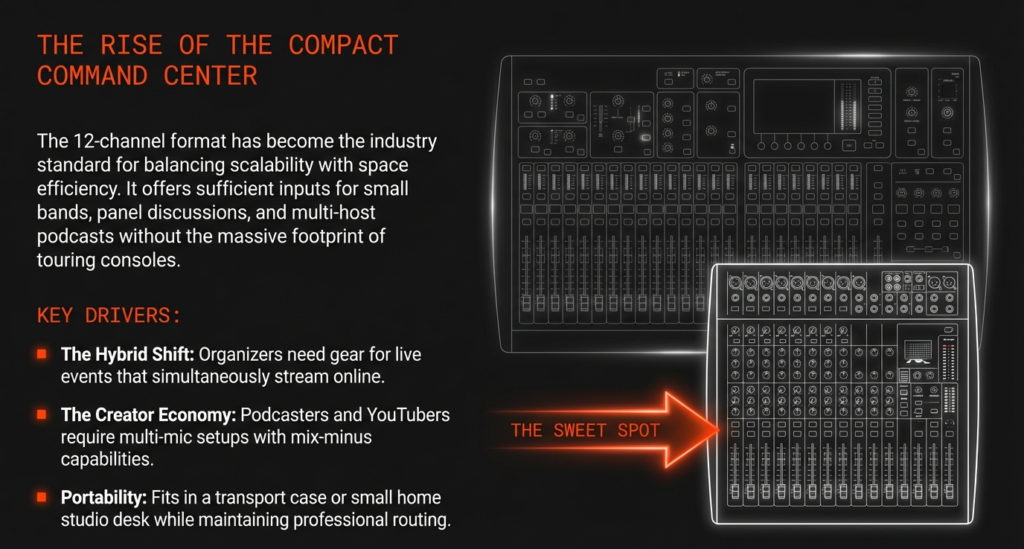
Typical real world input layout
A common 12 channel mixer gives you
- 6 to 8 mic inputs
- 2 to 4 line or stereo inputs
- 1 or 2 FX returns
So you can plug
- Vocal mics
- Guitar and bass through DI
- Keyboards
- Drum machines
- Laptops
- Phones
- External effects
This mix of inputs is what makes 12 channels versatile.
Sample setups people rarely show
Podcast plus livestream combo
- 4 mics
- 1 laptop audio
- 1 phone call input
- 1 backup recorder return
- 1 ambient mic
Still space left.
Small band plus backing tracks
- 2 vocals
- Guitar
- Bass
- Keyboard stereo
- Drum machine
- Track playback
You hit 10 channels fast.
Hybrid analog plus digital rig
I once ran
- 4 mics
- 2 hardware synths
- 1 sampler
- 1 DAW return
- 1 FX loop
All inside a 12 channel board.
It stayed clean and manageable.
That flexibility explains why studios keep at least one 12 channel mixer even when they own larger desks.
Analog vs Digital 12 Channel Mixers
Direct answer
Analog feels immediate. Digital feels intelligent.
Pick based on how you work.
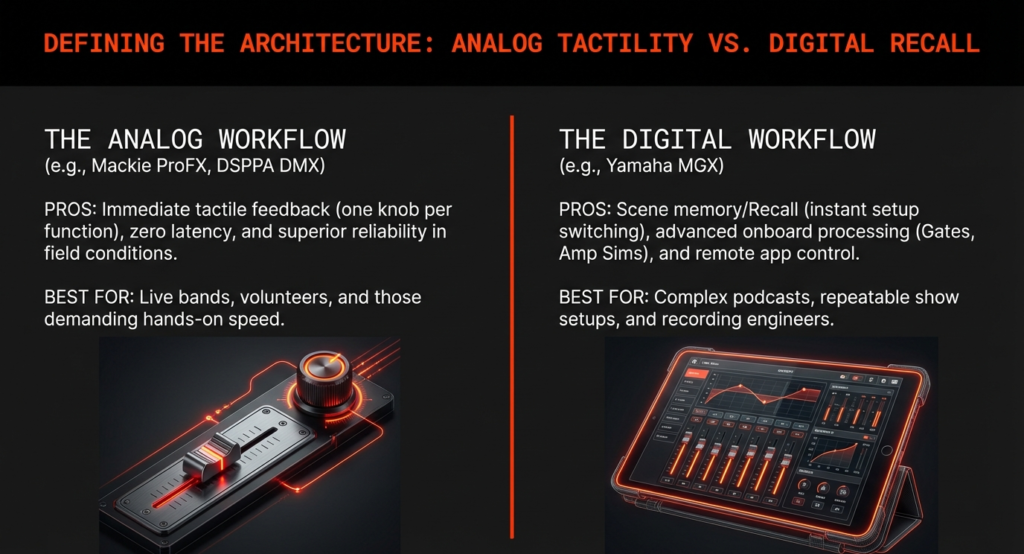
Why analog still wins for many creators
Analog mixers give
- Zero menu diving
- No boot time
- No software crashes
- Instant tactile control
Turn knob.
Hear result.
Done.
For live sound and small studios, that speed builds confidence.
I still keep an analog 12 channel mixer for quick sessions where I do not want to touch a screen at all.
Analog also fails gracefully.
A power glitch means silence.
Not corrupted scenes or frozen firmware.
That reliability keeps analog alive in churches, schools, and community halls.
Why digital 12 channel mixers grow fast
Digital mixers give
- Scene recall
- Built-in compression and EQ per channel
- App control from phone or tablet
- Multitrack USB recording
Church tech teams love them because volunteers can recall saved setups instantly.
Venues love them because sound engineers walk the room with a tablet and adjust live.
I tested one digital 12 channel mixer where I could compress vocals, gate drums, and record all channels separately through USB.
No extra hardware.
That saves both money and time.
The tradeoff
More learning.
More dependency on software.
If you enjoy control and presets, digital fits you.
If you enjoy speed and simplicity, analog fits you.
What Features Actually Matter In A 12 Channel Mixer
Preamps and routing matter more than flashy extras.
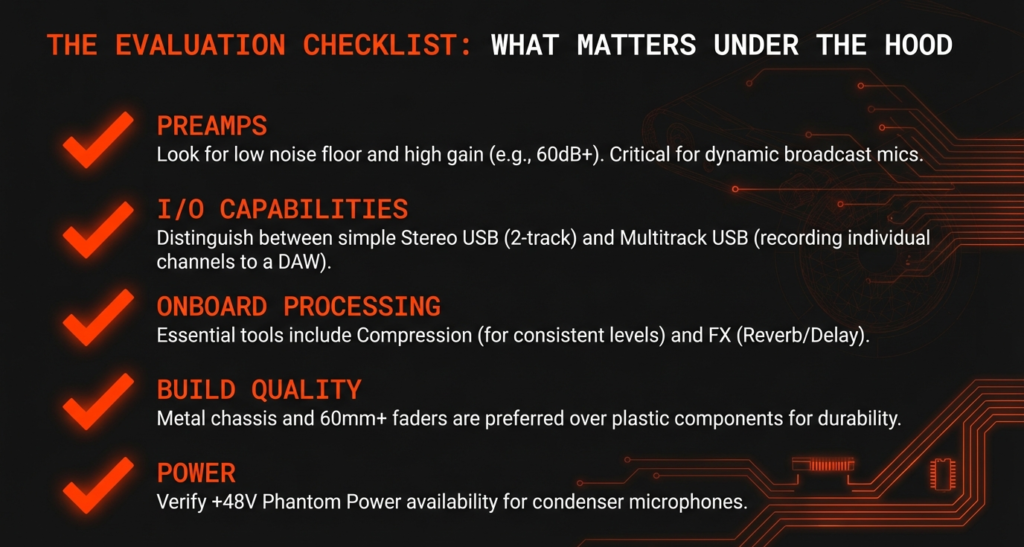
Preamps where cheap mixers fail quietly
A preamp decides how clean your mic signal starts.
Bad preamps
- Add hiss
- Collapse on loud sources
- Distort without warning
Good preamps
- Stay quiet
- Handle peaks
- Preserve tone
Specs rarely tell the full story.
I learned this by comparing two mixers with similar specs but very different noise levels in real recordings.
Always listen for
- Noise floor
- How it handles loud vocals
- How much gain it gives before breaking up
This single factor affects your sound more than onboard effects or Bluetooth ever will.
EQ compressors and onboard FX
Built-in EQ matters.
Basic compression helps.
FX can help or hurt.
Useful when
- You do live sound
- You want fast vocal polish
- You avoid external gear
Useless when
- FX quality sounds cheap
- You record for serious production
- You already process in DAW
I use onboard compression only for live gigs.
For recording, I leave everything flat and process later.
That habit came from hearing too many recordings ruined by heavy mixer FX that could not be undone.
USB Bluetooth and recording features
USB audio matters if you record directly into a computer.
Bluetooth rarely matters unless you play background music casually.
Multitrack USB is gold.
Stereo-only USB is basic.
Always check
Does USB send each channel separately or just the main mix.
That single detail decides whether your mixer works as a real recording tool or just a sound board.
The Hidden Mistake Most Buyers Make With 12 Channel Mixers
People buy numbers, not workflow.
Confusing channel count with usability
Twelve channels mean nothing if
- You cannot route flexibly
- You cannot monitor properly
- You cannot expand
Routing decides usability.
Can you
- Send aux mixes to headphones
- Run separate monitor outputs
- Feed a recorder independently
If not, those twelve channels stay underused.
I once tested a cheap 12 channel mixer that had no proper aux sends.
It felt like a toy despite the channel count.
How brands trick buyers with channel math
Some mixers count
- Stereo inputs as two channels
- FX returns as channels
- USB returns as channels
So a “12 channel mixer” may only have
6 real input paths you can control independently.
This is why many buyers feel misled after purchase.
Always read the block diagram or manual before buying.
It reveals what marketing hides.
That simple habit saved me from multiple bad purchases.
Best Use Cases For A 12 Channel Audio Mixer With Honest Limits
It fits multi-source setups with human operators.
Now let’s get real about where it shines and where it hits the wall.
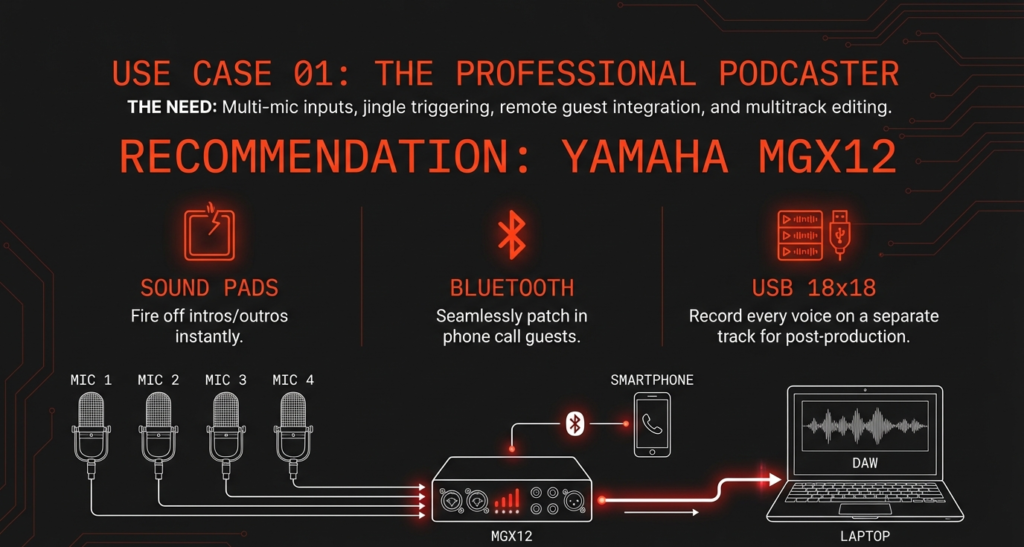
Podcast studios and YouTube setups
A 12 channel audio mixer works perfectly when
- You host 3 to 6 people
- You run intro music
- You take phone or remote inputs
- You keep a backup recorder
I ran a 4 mic podcast setup with music beds and a remote guest line.
Eight channels felt tight.
Twelve felt relaxed 😌
Where it fails
If you plan heavy post production.
Then a multitrack interface beats a mixer fast.
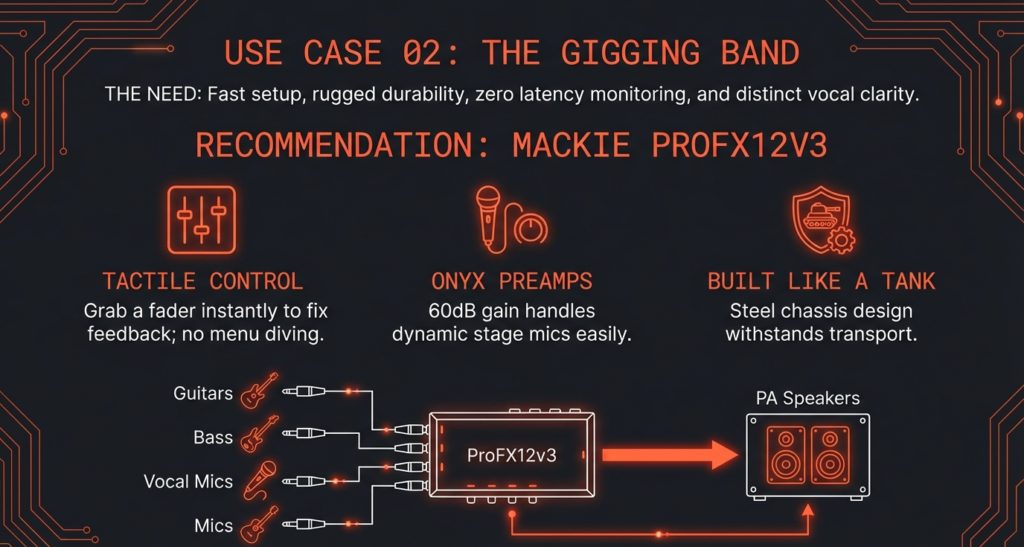
Small bands and live sound
It fits
- 2 to 3 vocals
- Guitar
- Bass
- Keyboard
- Drum machine or simple kit
I used one for café gigs.
Quick setup.
Fast soundcheck.
No stress.
Where it breaks
Full drum kits.
Brass sections.
Choirs.
That pushes beyond twelve fast.
Churches events and community spaces
This is where 12 channel mixers dominate.
Why
- Multiple mics
- Playback
- Simple monitoring
- Volunteers operate it easily
Digital versions dominate here because presets save hours weekly.
Limit
Large worship bands and choirs outgrow it fast.
When You Should Choose Something Else Instead
Do not buy a 12 channel mixer if your workflow does not need live control.
Why an audio interface might be smarter
Pick an interface if
- You record solo or duo
- You edit heavily later
- You want clean multitrack recording
An interface gives better preamps per dollar.
It also gives easier DAW integration.
Many Reddit users who switched from mixers to interfaces reported clearer recordings immediately.
That matches my own tests too.
Why an 8 channel mixer could be better
Pick 8 channels if
- You rarely exceed 5 inputs
- You value portability
- You want faster setup
Smaller mixers feel friendlier.
They also cost less and break less.
Why jumping to 16 channels might save money long term
Pick 16 if
- You plan growth
- You record bands often
- You handle large events
Buying 12 now and upgrading later often costs more overall.
I learned that the expensive way 😅
How To Choose The Right 12 Channel Mixer
Match it to your workflow, not your ambition.
Ask yourself these questions before buying
- Do I mix live or record only
- Do I need multitrack USB
- How many microphones will I use at once
- Will I move it often
- Will my setup grow within two years
Now translate answers into buying logic
If you mix live often
Choose physical knobs.
Choose strong preamps.
Choose solid build.
If you record often
Choose multitrack USB.
Choose quiet preamps.
Choose simple routing.
If you move it often
Choose lightweight.
Choose fewer menus.
If your setup will grow
Choose more aux sends.
Choose flexible routing.
That logic prevents regret purchases.
Popular 12 Channel Mixers Compared Without Hype
Most differences hide in preamps and routing.
Budget tier
- Lower noise control
- Limited routing
- Often stereo USB only
Good for casual use.
Bad for serious recording.
Mid range
- Better preamps
- Multitrack USB
- More aux options
This tier gives the best value.
I recommend this range for most Soundorp readers.
Pro tier
- Top grade preamps
- Advanced routing
- App control
This tier fits venues and studios that charge money.
Price rises sharply here.
Only buy if you recover cost through work.
Final Verdict From Soundorp
There is no universal best 12 channel mixer. There is only the best one for your workflow.
Every mixer reviewed here earned its place because
- Users trust them
- Engineers respect them
- They survive real work
Pick based on how you work today and where you plan to go next.
Twelve channels hit the sweet spot for serious hobbyists and small professionals.
I saw many creators overbuy.
I also saw many underbuy.
The happiest users always matched mixer size to real input needs.
Not future fantasies.
Where 12 channel mixers shine
- Controlled live sound
- Multi mic content creation
- Small performance setups
Where they disappoint
- Full bands
- High end recording
- Mobile solo creators
If your setup lives between bedroom and venue
A 12 channel audio mixer fits beautifully.
FAQ About 12 Channel Audio Mixers
Is a 12 channel mixer enough for a podcast
Yes for 3 to 6 people.
No for large panels.
Can I record all 12 channels separately
Only if the mixer supports multitrack USB.
Many do not.
Are 12 channel mixers good for live music
Yes for small bands.
No for complex stage setups.
What is better 12 channel mixer or audio interface
Mixer for live control.
Interface for studio recording.
Do all 12 channels support microphones
No.
Check mic input count specifically.
Why are some 12 channel mixers cheaper than 8 channel ones
Because they inflate channel count with stereo and FX returns.
How long will a 12 channel mixer last realistically
5 to 10 years easily.
Longer with good care.
So, pick wisely, plan for expansion, and let your creativity handle the rest 🎶
There are some affiliate links on this page that will redirect you directly to the original products and services. Also by buying through those links you will be supporting us. So thank you ^.^
Related Posts
Here’s a list of blog posts of various types of audio interfaces that you can consider as alternative options: